
Introduction
Before any advanced technology touches an aircraft—before the phased array ultrasonic probes, the eddy current scanners, or the digital X-ray tubes—there is one tool that catches more defects than all others combined: the human eye.
Visual Inspection is the absolute foundation of airworthiness. Despite the rapid advancement of sensor technology and automated drones, industry statistics consistently show that over 80% of all aircraft defects are detected through simple, rigorous, and systematic visual checks. Whether it is a leaky hydraulic line hidden in a wheel well, a missing rivet on a wing panel, or early-stage corrosion near a lavatory, the eyes of a skilled technician are the first line of defense against catastrophic failure.
In the high-stakes world of aviation MRO (Maintenance, Repair, and Operations), the ability to “see” is not passive; it is an active, learned skill. It requires an understanding of materials, stress loads, and environmental factors.
In this comprehensive maintenance guide, we explore the critical difference between General Visual Inspection (GVI) and Detailed Visual Inspection (DVI), the “Big Three” defects that every inspector must know, and why mastering the art of “looking” remains the most valuable skill in aviation.
The Hierarchy of Inspection: GVI vs. DVI
Not all looks are created equal. When you open an Aircraft Maintenance Manual (AMM) or a Service Bulletin (SB), you will encounter specific terms that dictate exactly how you should look at a component. Understanding the legal and technical definitions of these inspections is crucial for compliance.
General Visual Inspection (GVI)
A General Visual Inspection (GVI) is a broad, surveillance-style examination of an interior or exterior area, installation, or assembly to detect obvious damage, failure, or irregularity.
- The Scope: GVI is designed to provide an overview. It is the wide-angle lens approach. You are looking for things that are clearly “wrong” without needing to disassemble the entire aircraft.
- Distance: usually performed within touching distance (arm’s length), but can be slightly further depending on the zone (e.g., looking up at a vertical stabilizer from a stand).
- Lighting: Standard hangar lighting or a general handheld flashlight is typically sufficient, provided the area is illuminated enough to distinguish features.
- Goal: To spot “big picture” issues. This includes evident leaks, missing parts, impact damage from ground handling, or large deformations in the fuselage.
- Real-World Example: The daily “Walkaround” is the classic GVI. When a pilot or mechanic walks around the aircraft to check for tire wear, bird strikes, or fuselage dents, they are performing a GVI.
Detailed Visual Inspection (DVI)
A Detailed Visual Inspection (DVI) is a completely different beast. It is an intensive examination of a specific item, installation, or assembly to detect damage, failure, or irregularity that might be missed during a general sweep.
- The Scope: DVI focuses on specific load paths, fastener rows, or high-stress components. It is the macro-lens approach.
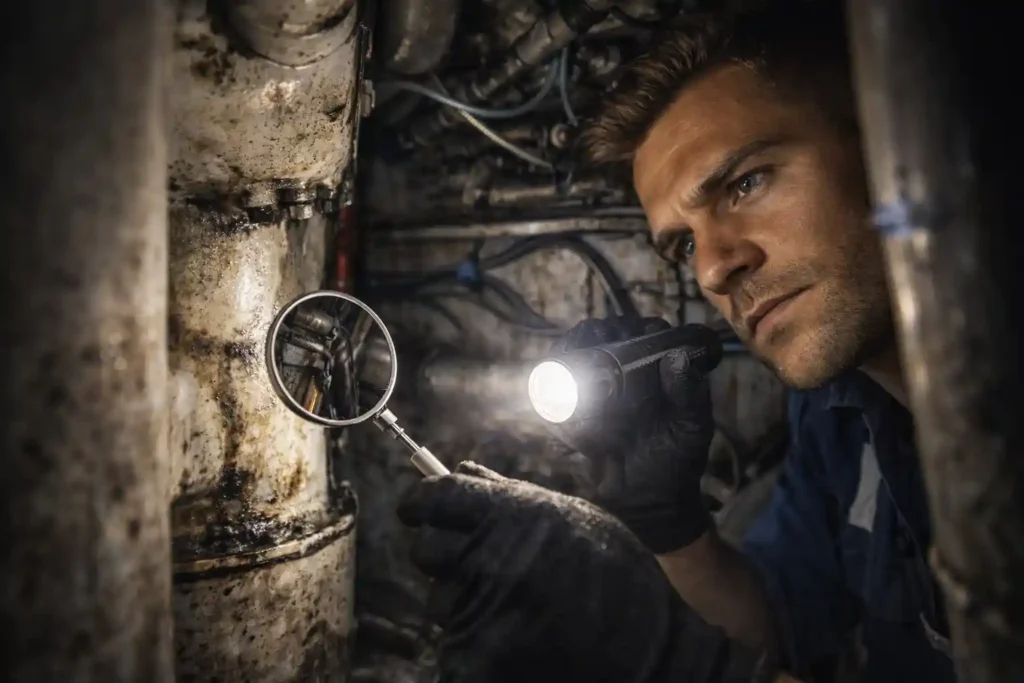
- Distance: This requires very close range, often defined by standards as within 24 inches (60 cm) or less. You are often nose-to-metal.
- Lighting: Requires intense, directed lighting. A high Color Rendering Index (CRI) light is essential here to distinguish between dirt and corrosion.
- Aids: You cannot perform a proper DVI with naked eyes alone. It often requires specific NDT Tools such as telescoping mirrors, magnifying glasses (typically 5x to 10x), or borescopes for internal engine inspections.
- Surface Prep: This is a key differentiator. For a DVI, the area typically needs to be cleaned thoroughly before inspection. You cannot detail inspect a dirty landing gear strut.
Special Detailed Inspection (SDI)
While GVI and DVI are the most common, advanced maintenance sometimes calls for an SDI. This typically involves NDT methods (like Ultrasound or Eddy Current) to see what the eye cannot, but it begins with the visual identification of the inspection zone.
The “Big Three” Visual Defects
What are we actually looking for? While an aircraft has thousands of potential failure modes, visual inspection mostly targets three primary enemies of airworthiness. Mastering the identification of these three will make you an elite inspector.
1. Corrosion (The Silent Killer)
Corrosion is cancer for metal. It is an electrochemical process that returns refined metal to its natural, stable state (usually an oxide).
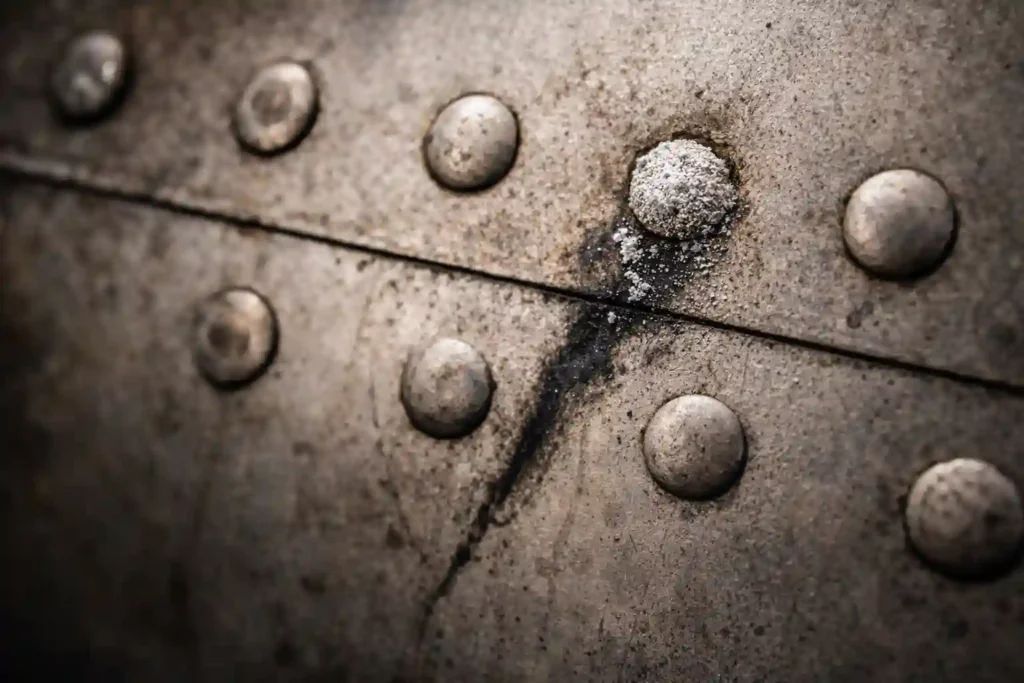
- Aluminum Alloys: On aluminum skins and stringers, corrosion appears as a white or grey powder. It often creates “pillowing” or bulging around rivets (exfoliation corrosion) as the oxide layer expands and pushes the metal apart.
- Steel Components: On landing gear or engine mounts, it presents as the familiar reddish-brown rust.
- Magnesium: Often found in gearbox housings, magnesium corrosion looks like snowy white crystals and can advance very rapidly.
- Where to look: Moisture is the catalyst. Always check bilges (lowest points), lavatory and galley areas (due to fluid spills), and battery compartments. Early detection during a routine GVI prevents expensive structural repairs later.
2. Cracks (Fatigue Damage)
Aircraft breathe. Every time a plane takes off and lands, the pressurization cycles expand and contract the fuselage like a balloon. This cyclic loading leads to metal fatigue.
- The “Working Rivet”: Often, a fatigue crack is invisible to the naked eye in its early stages. However, the eye can spot the secondary signs. The most common is the “working rivet” or “smoking rivet.” This appears as a black or grey smoke trail streaming behind a fastener head.
- What it means: This trail is actually fine aluminum dust created by the rivet fretting against the skin because the hole has elongated. This suggests the fastener is loose and the metal is moving.
- Confirmation: If you suspect a crack visually, you cannot just guess its depth. You will often call for advanced methods like Ultrasonic Testing to confirm the crack’s existence and measure its propagation into the subsurface material.
3. Chafing (Rubbing)
An aircraft is a high-vibration environment. If wires, tubes, or cables are not secured properly, vibration causes parts to rub against each other, wearing away protective coatings.
- The Risk: Hydraulic lines rubbing against electrical harnesses is a nightmare scenario that can lead to arc tracking, fires, or loss of flight controls (as seen in historical accidents like Swissair 111).
- The Golden Rule: “Clamping and clearance.” A good visual inspector always checks that pipes and wires are securely clamped and have adequate space (stand-off) between them. If you see a clamp that is twisted or missing its rubber cushion, you have found a potential future failure.
The Critical Role of Lighting and Cleanliness
You simply cannot inspect a dirty airplane. It is a physical impossibility.
Clean First, Look Second
Grease, dirt, hydraulic fluid, and runway grime are excellent at masking defects. A hairline crack filled with grease looks exactly like… nothing. Standard practice requires cleaning the inspection zone with approved solvents (like MEK or Naphtha, following safety protocols) before starting a DVI.
The Angle of Light (Shadowing)
Lighting is an active technique. Pointing a light directly at a surface can wash out details. Experienced inspectors use the “Shadowing” technique.
- How it works: Move your flashlight beam across a surface at a low angle (15 to 30 degrees).
- The Result: This low-angle light creates long shadows from very small surface irregularities. A slight dent, a raised rivet head, or the lip of a crack will cast a shadow that makes the defect pop out visually.
Human Factors in Visual Inspection
The biggest limitation of visual inspection is not the eye, but the brain. The FAA and other regulatory bodies emphasize the “Dirty Dozen” of human factors. Three of them are particularly dangerous for visual inspectors:
1. Expectation Bias
If you inspect the same wing panel 500 times and it has never had a crack, your brain begins to expect it to be clean. You stop looking for the defect and start looking to confirm the part is good. This is dangerous. You must treat every inspection as if it is the one that will fail.
2. Fatigue (Physical and Mental)
Inspecting hundreds of rivets in a row is hypnotic. After 20 minutes of staring at fastener rows, your focus degrades. This is known as the “vigilance decrement.” Technicians must take breaks to reset their focus.
3. Complacency
“I’ve seen this a thousand times.” This dangerous mindset leads to “pencil whipping” inspections—signing off the paperwork without giving the aircraft the attention it requires.
For more on the psychological aspects of inspection, resources like the Federal Aviation Administration (FAA) Human Factors guide provide essential reading for career technicians.
The Future of Visual Inspection (2026 and Beyond)
As we move through 2026, Visual Inspection is evolving. We are seeing the rise of “Enhanced Visual Inspection.”
- Drone Inspections: Automated drones fly around the fuselage performing GVI for lightning strikes or paint damage, using high-resolution cameras to capture images that a human reviews later.
- Augmented Reality (AR): Technicians wearing AR glasses can now see the DVI instructions overlaid directly onto the aircraft part they are looking at, highlighting exactly where to look for known fatigue issues.
However, these tools are aids, not replacements. The decision to ground an aircraft or release it for flight still rests on the judgment of the certified technician.
Conclusion
Technology will continue to advance. We now have drone inspections, automated scanners, and AI-driven defect recognition. However, the intuition, experience, and sharp eyes of a licensed Aircraft Maintenance Engineer (AME) remain irreplaceable.
Mastering visual inspection is not just about having 20/20 vision; it is about knowing where to look, what to look for, and having the discipline to never blink when safety is on the line. It is the first, and often the most important, line of defense in aviation safety.