

Introduction: The Trillion-Dollar Backbone
Behind every safe takeoff and landing lies a massive, intricate industrial complex known as aircraft MRO. The acronym stands for Maintenance, Repair, and Overhaul. It refers to the overarching industry dedicated to keeping aircraft in an airworthy condition according to strict regulatory standards set by the FAA and EASA.
While passengers typically focus on the airline brand, the reality is that the safety of their flight depends heavily on the aircraft MRO provider. This sector includes everything from the technicians on the tarmac to the logistics managers sourcing rare titanium bolts from across the globe. As fleets modernize and flight hours increase, the global aircraft MRO market has grown into a multi-billion dollar juggernaut, projected to expand significantly by 2025 and beyond.
This guide delves into the operational sectors of aircraft MRO, the difference between airline-owned and independent facilities, and the technological revolution transforming how planes are fixed.
The Four Sectors of the MRO Market
To understand the scope of aircraft MRO, it is essential to break the industry down into its four primary market segments. Each requires distinct certifications, tooling, and labor skills.
Airframe Maintenance
This is the most visible sector. It encompasses the physical structure of the plane—the fuselage, wings, tail, and landing gear. Airframe aircraft MRO ranges from minor line maintenance checks at the gate to heavy structural modifications. During heavy checks, MRO teams may strip the aircraft interior, replace corroded skin panels, and repaint the exterior. This sector is highly labor-intensive and requires massive hangar space. For a deeper dive into the specific check intervals involved here, refer to our comprehensive Aircraft Maintenance Guide.
Engine Maintenance
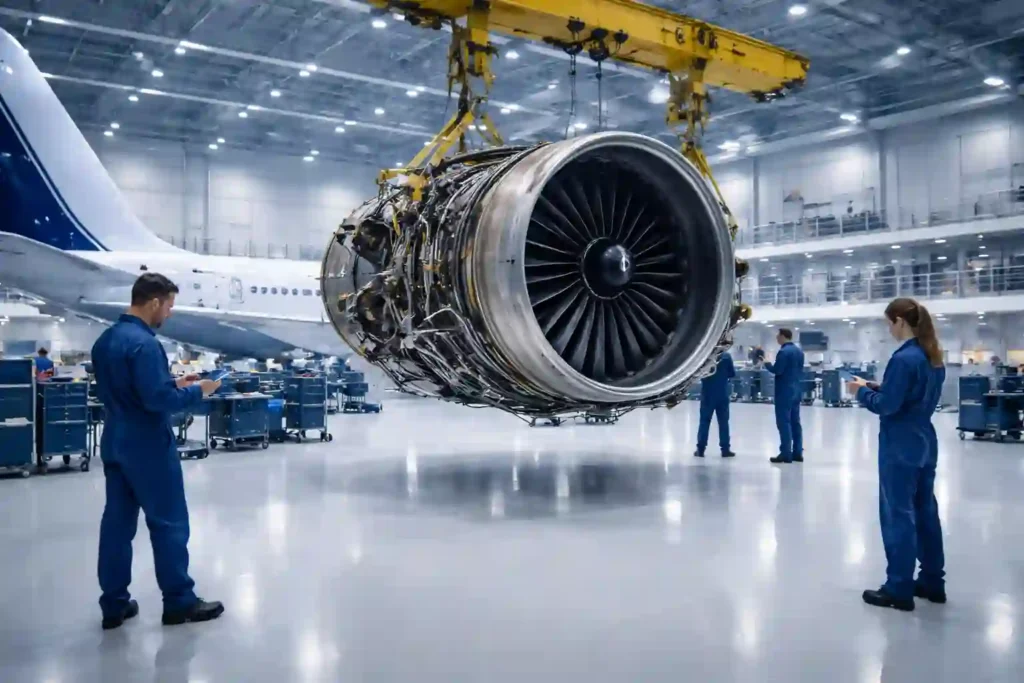
Engine MRO is the most expensive and technically demanding segment. Modern turbofan engines are marvels of engineering, operating at temperatures that would melt standard metals. Consequently, engine aircraft MRO commands the largest share of the market’s revenue. Work here involves dismantling engines into modules, inspecting turbine blades for microscopic creep or fatigue, and rebuilding them to zero-hour specifications. This process often relies on advanced diagnostics, as detailed in our Borescope Inspection Guide.
Component Maintenance
An aircraft is a collection of thousands of individual parts, from hydraulic pumps and avionics computers to coffee makers and toilet assemblies. Component aircraft MRO focuses on repairing these specific units off-wing. When a part fails, it is removed and sent to a specialized shop where it is repaired, tested, and certified for return to service. This sector relies heavily on supply chain logistics to ensure “rotable” parts are always available when an airline needs them.
Line Maintenance
While often categorized separately, Line Maintenance is a critical subset of aircraft MRO. It involves light, daily checks performed on the apron between flights. The goal is to certify the aircraft for immediate release. If a Line Maintenance technician discovers a fault that cannot be fixed within the turnaround time, the aircraft may be grounded and handed over to a Base Maintenance MRO team.

Business Models: Who Fixes the Planes?
The aircraft MRO landscape is divided into different business models, each serving a unique role in the aviation ecosystem.
Airline-Affiliated MRO
Some major airlines, such as Lufthansa (Lufthansa Technik) or Delta (Delta TechOps), own their own massive MRO divisions. Originally created to service their own fleets, these subsidiaries grew so large and capable that they now sell aircraft MRO services to other airlines. This allows the parent airline to offset its own maintenance costs by generating third-party revenue.
Independent MRO
These are companies that are not owned by an airline. They operate purely as service providers. They compete on price, turnaround time, and specialized capability. An independent aircraft MRO might specialize solely in landing gear overhaul or avionics upgrades. They are often agile and can adapt quickly to market trends, serving low-cost carriers (LCCs) that prefer not to invest in their own heavy maintenance infrastructure.
Original Equipment Manufacturers (OEMs)
Companies like Boeing, Airbus, GE, and Rolls-Royce are increasingly entering the aircraft MRO aftermarket. By offering “Power by the Hour” contracts, they guarantee maintenance support for the engines or airframes they build. This creates a closed loop where the manufacturer maintains control over the asset throughout its lifecycle, ensuring genuine parts are used.
The Digital Transformation of MRO
By 2026, the aircraft MRO industry will be fully immersed in a digital transformation. The days of paper logbooks and manual tracking are fading.
Paperless Operations
Regulatory bodies like EASA (European Union Aviation Safety Agency) are increasingly approving electronic technical logs and digital signatures. This reduces the administrative burden on aircraft MRO technicians and eliminates the risk of lost paperwork, which can technically ground an airworthy plane.
Predictive Maintenance
Leveraging the Internet of Things (IoT), modern aircraft MRO is becoming predictive rather than reactive. Sensors on aircraft transmit real-time health data to the MRO center. Algorithms analyze this data to predict component failures days or weeks in advance. This allows the MRO team to procure the necessary parts and schedule the repair during a convenient overnight stop, preventing costly flight cancellations.
Supply Chain Resilience
The global aircraft MRO supply chain is fragile. A shortage of raw materials or a shipping delay can leave an engine sitting in a shop for months. To combat this, MRO providers are investing in AI-driven inventory management systems that forecast demand for consumables (like rivets, sealants, and oil) and rotables (like generators and starters).
Challenges Facing the Industry
Despite the growth, the aircraft MRO sector faces significant hurdles that threaten operational efficiency.
The Mechanic Shortage
There is a global shortage of qualified Aircraft Maintenance Technicians (AMTs). As the older generation retires, there are not enough young technicians entering the field to replace them. This drives up labor costs and extends turnaround times. For those interested in this career path, the current market offers high job security and competitive wages, as detailed in our guide to Aviation Technician Jobs.
Sustainability Pressures
Aviation is under immense pressure to decarbonize, and aircraft MRO is no exception. Facilities are being retrofitted with solar panels, and there is a push to recycle end-of-life aircraft parts rather than scrapping them. MROs are also adopting “eco-wash” techniques for engines and airframes to reduce water consumption and chemical runoff.
Regulatory Complexity
Navigating the web of global regulations is a constant challenge. An aircraft MRO facility in Singapore repairing a plane for a US airline must comply with FAA regulations, while simultaneously adhering to local CAAS rules. Keeping certifications current across multiple jurisdictions requires a dedicated Quality Assurance department.
Conclusion
The aircraft MRO industry is the silent engine that keeps the global economy moving. It is a sector defined by precision, regulation, and an unyielding commitment to safety. As we look to the future, the successful MRO providers will be those who can blend the traditional craftsmanship of wrench-turning with the digital efficiencies of AI and predictive data.
For airlines, selecting the right aircraft MRO partner is a strategic decision that impacts their bottom line and their brand reputation. For the traveling public, the robust nature of this industry offers the ultimate peace of mind: knowing that the aircraft they board has been cared for by the most rigorous maintenance system in the world.
Frequently Asked Questions (FAQ)
What does MRO stand for in aviation? MRO stands for Maintenance, Repair, and Overhaul. It refers to the spectrum of services required to keep an aircraft in airworthy condition, from simple repairs to complete structural rebuilds.
How big is the aircraft MRO market? According to data from IATA (International Air Transport Association), the commercial aircraft MRO market is valued at over $80 billion annually and is expected to grow as the global fleet expands.
What is the difference between Line and Base MRO? Line MRO is performed on the tarmac during short stops and focuses on quick fixes and checks. Base MRO is heavy maintenance performed in a hangar, requiring the aircraft to be taken out of service for longer periods.
Why is aircraft MRO so expensive? The high cost is due to strictly regulated labor requirements, expensive specialized tooling, and the high price of certified aircraft parts, which must be traceable back to the manufacturer.
Do airlines do their own MRO? Some large airlines have their own in-house aircraft MRO departments. However, many airlines, especially low-cost carriers, outsource this work to independent third-party providers to save on infrastructure costs.