
If you ask a veteran A&P mechanic what scares them more than engine failure, the answer is often one word: Aircraft Corrosion.
Unlike a mechanical failure that happens instantly, aircraft corrosion is a slow, silent cancer. It eats away at the structural integrity of an airframe from the inside out, often hiding behind stringers, under lavatories, or inside wing spars where the sun never shines. For the aviation maintenance technician, understanding aircraft corrosion is not just about keeping an airplane pretty; it is a legal requirement for airworthiness and a critical safety responsibility.
In this comprehensive guide, we will break down the electrochemical science behind the rust, identify the most dangerous aircraft corrosion types, and outline the FAA-approved methods for detection, treatment, and prevention.
The Science: Why Metal Wants to Return to Earth
To fight aircraft corrosion, you must first understand it. In simple terms, this is the natural process of refined metal trying to return to its stable state (ore).
Aluminum requires massive amounts of energy to refine. Nature wants to release that energy and turn that aluminum back into aluminum oxide (a white powder). For this to happen, four elements must be present simultaneously. We call this the Aircraft Corrosion Cell:
- Anode: The metal that gets eaten away (has a lower potential).
- Cathode: The metal that causes the corrosion (has a higher potential).
- Electrolyte: A conductive liquid connecting the two (water, humidity, condensation).
- Electrical Contact: The physical connection between the anode and cathode (rivets, bolts, touching surfaces).
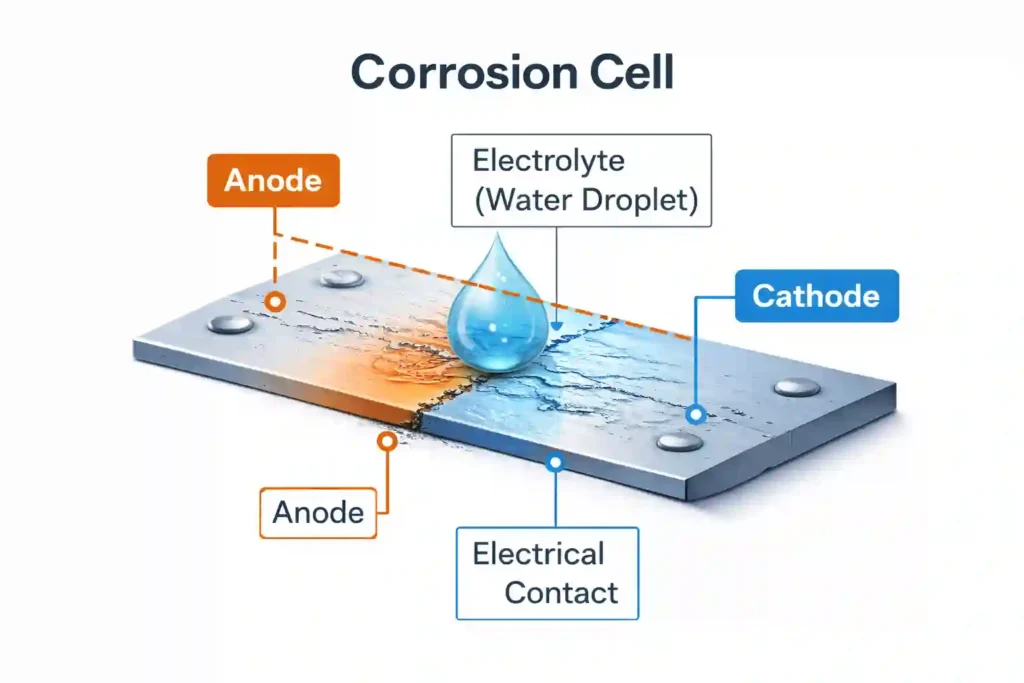
The Mechanic’s Rule: If you remove any one of these four elements, corrosion stops. Our entire job—painting, greasing, washing—is simply an attempt to break this chain.
The 7 Most Common Types of Aircraft Corrosion
The FAA Advisory Circular FAA AC 43-4A lists several types, but these are the ones you will encounter in the hangar daily.
1. Uniform Etch Corrosion
This is the most common and easiest to spot. It attacks the surface evenly.
- Appearance: On polished aluminum, the surface looks dull or “frosted.” On painted surfaces, you might see general discoloration.
- The Fix: Usually removed with an abrasive pad (Scotch-Brite) and chemical neutralization.
2. Pitting Corrosion (The “Iceberg”)
Pitting is extremely dangerous because the surface damage is tiny, but the internal damage is deep.
- Appearance: It looks like white or gray powder clumping on the surface. When you clean it away, you find tiny pinholes.
- The Danger: These pits act as “stress risers.” Imagine a microscopic notch in a metal sheet. Under vibration, that pit becomes a crack.
3. Galvanic Corrosion (Dissimilar Metals)
This happens when two different metals touch in the presence of moisture.
- The Scenario: A mechanic installs a Stainless Steel screw into an Aluminum wing panel without using a washer.
- The Result: The aluminum sacrifices itself and corrodes rapidly around the screw head.
4. Intergranular Corrosion (The Hidden Killer)
This is the most terrifying form of corrosion for an inspector because it happens inside the metal grain boundaries.
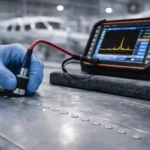
- Detection: Visual inspection often fails here. This is where advanced Non-Destructive Testing (NDT) is vital. Eddy Current and Ultrasonic testing are often the only ways to find it before the part fails.
5. Filiform Corrosion
This looks like biological worms burrowing under your paint.
- Cause: Painting over a surface that wasn’t properly cleaned or fully dry.
- The Fix: You must strip the paint completely, treat the metal, and repaint.
6. Fretting Corrosion (Smoking Rivets)
This is actually a form of mechanical wear combined with corrosion.
- Appearance: You will see a black or grey trail of “smoke” streaming back from a rivet head. This is actually fine metal dust that has oxidized.
Detection: How to Find What Cannot Be Seen
Finding corrosion requires a mix of sharp eyes and advanced technology.
Visual Inspection
The Mark 1 Eyeball is still your best tool. Use a bright inspection light at a low angle (skimming the surface) to reveal bubbling paint or exfoliation.
The Role of Borescopes
We cannot disassemble the entire airplane for every inspection. This is where your Borescope earns its keep.
- Internal Access: Use your borescope to inspect inside wing spars, behind firewalls, and inside cylinders.
- What to look for: Inside an engine cylinder, rust on the cylinder walls indicates the engine hasn’t been run often enough.
Aircraft Corrosion Prevention: The “An Ounce of Prevention” Strategy
As an aircraft owner or mechanic, your goal is to stop aircraft corrosion before it starts by keeping the “Electrolyte” (Water) away from the metal.
1. Frequent Washing It sounds simple, but it is the most effective tactic. If you fly near the coast, salt spray is the primary driver of aircraft corrosion. Salt is a hygroscopic electrolyte—it pulls moisture from the air and accelerates the decay process 10x.
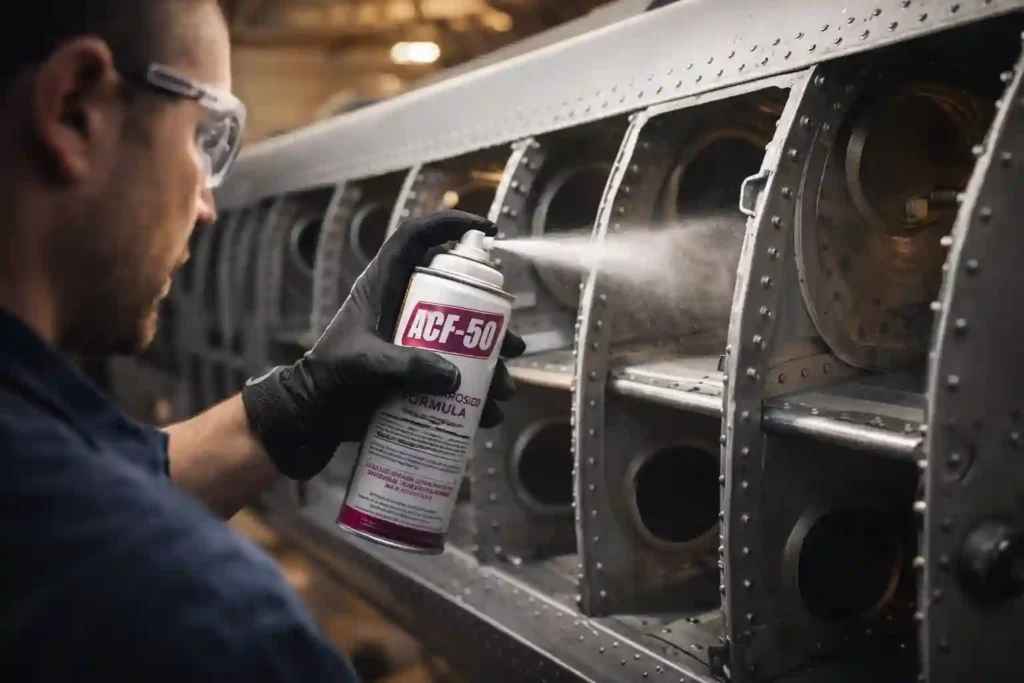
2. Aircraft Corrosion Preventative Compounds (CPCs) These are sticky, oily substances sprayed into the internal structures of the airframe (like ACF-50 or CorrosionX). These aircraft corrosion inhibitors penetrate the metal joints and displace water effectively.
3. Keep Drain Holes Clear Every airplane has small holes on the underside of the fuselage and wings. Use a small pick from your Basic Tools Set to verify every drain hole is open during your pre-flight. This prevents water accumulation, a leading cause of internal aircraft corrosion.
Aircraft Corrosion Treatment: Fixing the Damage
If you find aircraft corrosion during an inspection, can you fix it? It depends on the severity. FAA AC 43.13-1B provides the standard practices for assessing and repairing the damage.
Step 1: Mechanical Removal You must remove all active traces of aircraft corrosion.
- Tools: Aluminum wool (never steel wool!), Scotch-Brite pads, or glass bead blasting.
- Warning: Do not use a steel wire brush on aluminum! You will embed steel particles into the aluminum, causing immediate galvanic aircraft corrosion.
Step 2: Chemical Neutralization After sanding, the metal is raw and vulnerable. You must chemically stop the aircraft corrosion reaction from restarting.
- Etching: Use an acid etch (like Alumiprep) to deep clean the pores.
- Conversion Coating: Apply Alodine (Chromic Acid). This turns the aluminum a golden-yellow color and creates a chemical skin that protects the metal from further aircraft corrosion.
Step 3: Paint and Seal Never leave Alodined metal exposed for long. Apply a high-quality Epoxy Primer followed by a Polyurethane Topcoat. This paint layer acts as the final shield against environmental elements that cause aircraft corrosion.
Conclusion: The Battle Never Ends
Corrosion control is not a one-time task; it is a lifestyle for the aircraft. Whether you are a student mechanic learning to spot “smoking rivets” or an owner debating whether to pay for an ACF-50 treatment, remember this: Rust never sleeps.
A clean, dry, and lubricated airplane is a safe airplane. By understanding the types of corrosion and catching them early with the right tools and inspections, you preserve not just the asset’s value, but the safety of everyone on board.
Frequently Asked Questions (FAQ) about Aircraft Corrosion
Q: How often should I apply corrosion inhibitors like ACF-50 or CorrosionX? A: It depends heavily on your basing location. For aircraft based near the coast (high salinity), a full “fogging” treatment is recommended every 12 months, ideally during the Annual Inspection. For aircraft in dry, inland climates (like Arizona), every 24 months is usually sufficient.
Q: Can a pilot-owner remove corrosion legally? A: Yes, but with limits. Under FAR Part 43 Appendix A (Preventive Maintenance), a pilot owner is allowed to remove small amounts of surface corrosion and apply protective coatings to fairings, cowlings, and non-structural landing gear parts. However, if the corrosion involves a wing spar or primary structure, an A&P mechanic must evaluate it. You will need basic cleaning gear like those listed in our Essential A&P Tools List.
Q: How can I tell if my engine has internal corrosion without taking it apart? A: The only way to see inside a cylinder without removing it is by using a Borescope Inspection Camera. If you see orange/red pitting on the cylinder walls, the engine has likely been sitting inactive for too long.
Q: What is the difference between “Alodine” and “Anodizing”? A: Anodizing is an electrolytic process done in a factory when the part is made; it creates a very hard ceramic-like coating. Alodine (Chromate Conversion) is a chemical liquid that mechanics apply in the field (using a brush or sponge) to repair the protection layer after sanding away corrosion.
Q: Does painting over corrosion stop it? A: Absolutely not. Painting over corrosion is arguably worse than leaving it exposed because the paint traps moisture against the metal, accelerating the “Corrosion Cell.” This leads to Filiform Corrosion, which looks like worms tunneling under the paint. You must mechanically remove the rust and treat the metal before painting.

Senior NDT Controller with over 20 years of experience in aviation (FAA, EASA, and NRCAN certified). Expert in aircraft maintenance, non-destructive testing (NDT), and pilot training. I share practical, up-to-date 2026 guides for pilots and aviation maintenance technicians.