Introduction: The Indispensable Workhorse of Aerospace NDT
It is widely considered the oldest method in Non-Destructive Testing, a technology with roots tracing back to the early 20th century and the railroads. Yet in 2026, amid a landscape of automated ultrasonics and digital radiography, Liquid Penetrant Testing (PT)—often called Liquid Penetrant Inspection (LPI) or Dye Penetrant—remains absolutely irreplaceable. It is the fundamental workhorse of aviation manufacturing, maintenance, repair, and overhaul (MRO) operations worldwide.
Whether inspecting a massive forged titanium turbine disk for a jet engine or a small, intricate magnesium casting in a flight control system, Liquid Penetrant Testing is the universal first-choice method for locating surface-breaking defects in non-porous materials. Its genius lies in its simplicity and universality. Unlike Eddy Current Testing, which is confined to conductive metals, or Magnetic Particle Inspection, which requires ferromagnetic materials, Liquid Penetrant Testing can be applied to virtually any solid, non-absorbent material—aluminum, titanium, stainless steel, nickel-based superalloys, engineered ceramics, and certain high-density composites.
In this comprehensive guide, we move far beyond the simplistic “spray and pray” mentality sometimes associated with field kits. We will explore the precise physics of capillary action, demystify the critical importance of sensitivity levels (Level 1 to 4), break down the six non-negotiable process steps, and explain why the seemingly simple “wash” or “removal” step is where most inspection failures—and potential escapes—occur. For aviation professionals, mastering Liquid Penetrant Testing is not just about following a procedure; it’s about understanding the interplay of chemistry, physics, and meticulous technique that guards against catastrophic failure.
Primary Keywords: Liquid Penetrant Testing, LPI Aviation, Dye Penetrant Inspection, PT NDT, Surface Crack Detection, Fluorescent Penetrant, Aerospace NDT, Capillary Action.
1: The Physics of Detection: Capillary Action Demystified
At its core, the remarkable effectiveness of Liquid Penetrant Testing relies on a fundamental and elegant physical principle: Capillary Action (or capillarity). This is the ability of a liquid to flow into narrow spaces—against gravity if necessary—due to the interplay of cohesive forces within the liquid and adhesive forces between the liquid and the solid surface.
The Molecular Battle: Cohesion vs. Adhesion
- Cohesion: The attractive force between molecules of the same substance (e.g., water molecules sticking to other water molecules). This creates surface tension.
- Adhesion: The attractive force between molecules of different substances (e.g., water molecules sticking to the molecules of a crack wall).
A penetrant is specifically engineered to have low surface tension (low cohesion) and high wettability (high adhesion to metal surfaces). When applied to a part, this combination causes the liquid to spontaneously be drawn into any open discontinuity that touches the surface.
The Crack as a Micro-Scale Tube
Imagine a fatigue crack as an incredibly narrow, irregular capillary tube. The penetrant, drawn by adhesive forces to the crack walls, “wicks” its way deep into the flaw. The narrower the crack, the stronger the capillary pull, often allowing the penetrant to penetrate tighter flaws more effectively than wider ones.
The Reverse Process: Developer Action
After excess surface penetrant is removed, the applied developer (a fine, dry powder or a suspension) acts via reverse capillary action. It draws the trapped penetrant back out of the flaw and onto the surface. Crucially, it also spreads the indication, creating a visible mark that is often 10 to 100 times wider than the actual defect opening. This magnification effect is what transforms an invisible micron-scale crack into a visible, evaluable indication under proper lighting.
2: The Six Critical Steps of Aviation LPI: A Standards-Driven Process
https://www.nas410.com/In aviation, safety is protocol. We do not “do penetrant”; we perform an LPI process in strict adherence to standards like ASTM E1417 (Standard Practice for Liquid Penetrant Testing) and NAS 410 (NASA/Aerospace NDT Certification). The process consists of six sequential, critical steps. Omitting or short-cutting any step invalidates the entire inspection.
Step 1: Pre-Cleaning – The Foundation of Success
The Absolute Rule: You cannot inspect a dirty part. Contaminants are the arch-nemesis of Liquid Penetrant Testing.
- Blockage: Oil, grease, paint, plating, smeared metal, or even water can block the entrance to a discontinuity, forming a capillary block that prevents penetrant entry.
- False Indications: Contaminants can trap penetrant on the surface, creating irrelevant, non-relevant, or false indications that waste time and obscure real defects.
- Approved Methods: For aviation, chemical cleaning is king. This includes solvent wiping, vapor degreasing, alkaline cleaning, and ultrasonic baths. Mechanical cleaning (grinding, wire brushing, abrasive blasting) is generally forbidden after the part enters the NDT process flow, as it can peen over or smear shut the very cracks you are trying to find.
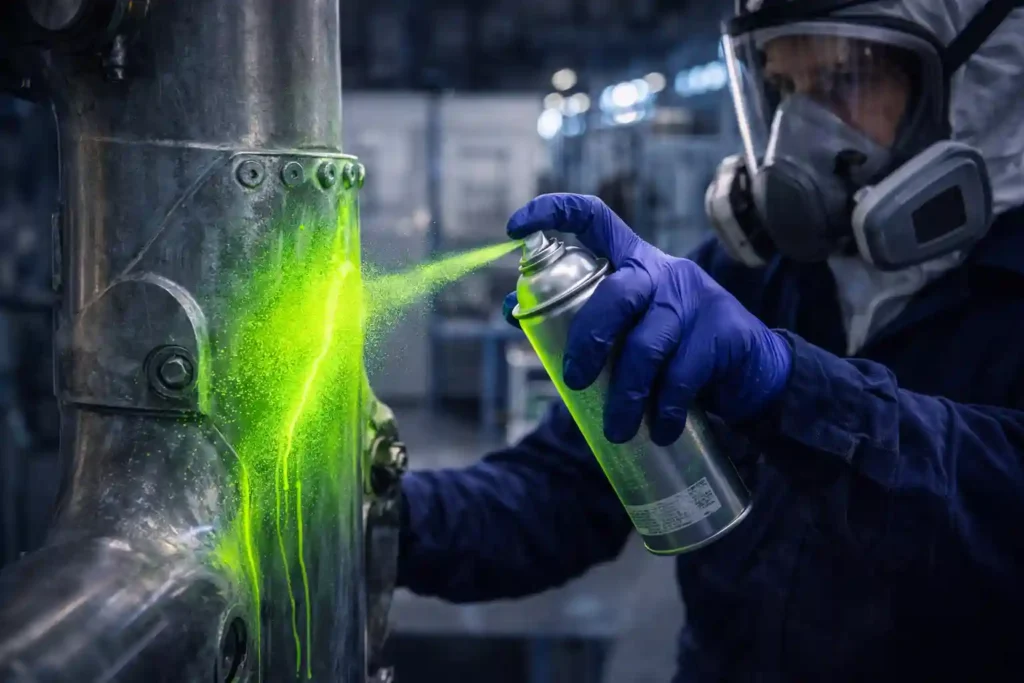
Step 2: Penetrant Application
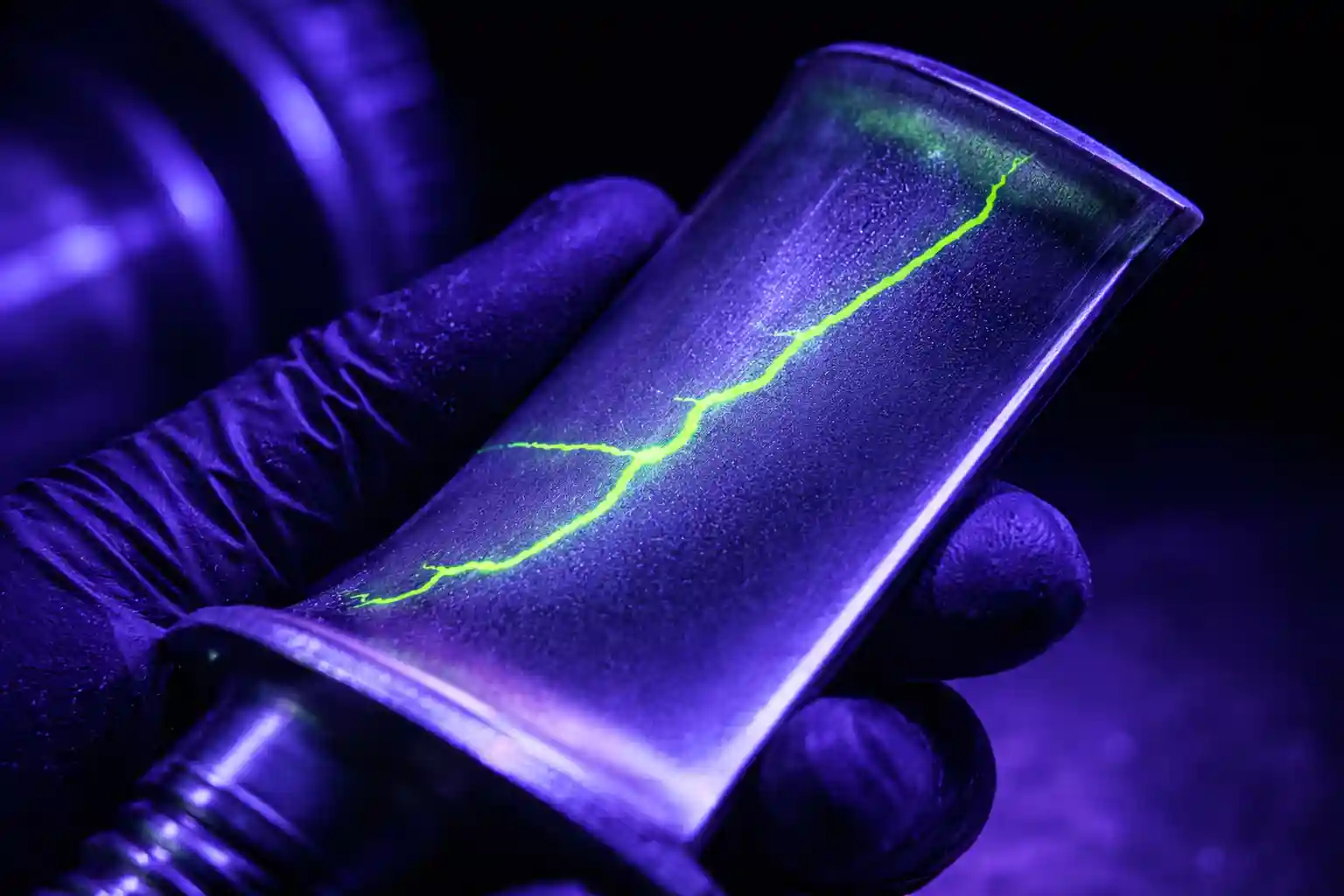
The cleaned, dry part is coated with penetrant via spraying, brushing, dipping, or flowing. In aerospace, Type I (Fluorescent) penetrants are used almost exclusively. They offer far greater sensitivity than Type II (Visible Red) dyes because the human eye is exceptionally sensitive to the bright green-yellow glow under UV light. The part must be completely covered to ensure defect saturation.
Step 3: Dwell Time – The Patient Wait
This is the time allowed for capillary action to occur. The penetrant must be given sufficient time to seep into flaws.
- Factors: Dwell time depends on penetrant sensitivity, material type, defect type (tight fatigue cracks require longer dwells than wide porosity), and temperature. Typical times range from 10 to 45 minutes at 10-50°C (50-125°F).
- Critical Error: Cutting dwell time short is a guaranteed path to missing tight, critical cracks. The clock starts when the part is fully coated.
Step 4: Excess Penetrant Removal – The “Make or Break” Step
This is the most skill-intensive and critical step. The goal is to remove all penetrant from the part’s surface without removing it from within the defects. This step is typically performed under UV-A (365 nm) black light illumination for precise control.
- Over-washing/Over-removal: Uses too much water, solvent, or emulsifier time. It strips penetrant out of the cracks, leading to false negatives and catastrophic inspection escapes. This is the most dangerous error.
- Under-washing/Under-removal: Leaves excessive background fluorescence, creating “noise” that can mask or hide smaller, fainter defect indications.
Step 5: Developer Application
The developer is applied to the dry, cleaned surface. It forms a thin, uniform, contrasting layer (white for fluorescent PT) that acts as a “blotter.”
- Function: It draws the trapped penetrant out via reverse capillarity and spreads it, creating a visible indication.
- Forms: Dry powder (Form a), water-soluble (Form b), water-suspendible (Form c), and non-aqueous solvent-based (Form d). Non-aqueous wet developers (NAWD – Form d) are common in aviation for their high sensitivity and good definition.
- Developer Dwell: Time is allowed (typically 10-30 minutes) for the bleed-out to occur and stabilize.
Step 6: Inspection & Post-Cleaning
- Inspection: Conducted in a dark or dimly lit booth using high-intensity UV-A black lights (minimum 1000 µW/cm² at 15 inches). A certified Level 2 or Level 3 technician evaluates the size, shape, brightness, and location of indications against accept/reject criteria per the relevant standard (e.g., ASTM E433, customer engineering specs).
- Linear Indications: Sharp, continuous lines suggest cracks, lack of fusion, or forging laps.
- Rounded Indications: Dots or circular bleed-outs typically indicate porosity, pitting, or shrinkage.
- Post-Cleaning: After inspection and documentation, the part must be thoroughly cleaned to remove all developer and residual penetrant chemicals, which could cause corrosion or interfere with subsequent processes.
3: Penetrant Systems & Sensitivity Levels: Choosing the Right Tool
Not all penetrant systems are equal. Selection is governed by the required sensitivity, part geometry, and production environment.
The Four Methods (Defined by Removal Process)
- Method A: Water-Washable (Self-Emulsifying)
The penetrant contains an built-in emulsifier. Removal is done with a direct water spray. It’s fast and economical but offers the least control, making over-washing a high risk. Common for less critical components or large volumes. - Method B: Lipophilic Post-Emulsifiable
A two-step process. First, pure penetrant is applied and dwells. Then, a separate lipophilic (oil-based) emulsifier is applied, which diffuses into the surface penetrant, making it water-washable. It provides excellent sensitivity and control for fine cracks. Common in European aerospace. - Method C: Solvent Removable
The familiar portable kit. Excess penetrant is removed by wiping with solvent-dampened cloths. It’s ideal for localized spot checks, field inspections, or very large parts that cannot be processed in a tank line. Its sensitivity is highly dependent on technician skill. - Method D: Hydrophilic Post-Emulsifiable
The aerospace gold standard for critical parts (especially jet engines). After penetrant dwell, a separate hydrophilic (water-based) emulsifier or “remover” is applied, which acts as a detergent to lift off surface penetrant. It offers the highest sensitivity and control, minimizing over-washing risk. This is the method specified for most rotating engine components.
Sensitivity Levels: The Hierarchy of Detection
Within Type I (Fluorescent) penetrants, sensitivity is classified. Using the wrong level is a major quality non-conformance.
- Level ½ (Ultra Low Sensitivity): For very rough surfaces where high background is problematic.
- Level 1 (Low Sensitivity): General purpose for large, obvious defects.
- Level 2 (Medium Sensitivity): The workhorse for most airframe components, castings, and welds.
- Level 3 (High Sensitivity): The industry standard for critical, machined, or smooth-surface components (landing gear, actuators, machined fittings).
- Level 4 (Ultra-High Sensitivity): Reserved for life-limited rotating parts in turbine engines (disks, blades, spacers). Capable of detecting fatigue cracks mere microns in width. The background fluorescence must be near-zero.
4: Advantages, Limitations & Comparison to Other Methods
Why Liquid Penetrant Testing Endures
- Unmatched Geometry Flexibility: Can inspect parts of astonishing complexity—cooling holes in turbine blades, internal threads, gear teeth, and welded fabrications—with relative ease.
- High Theoretical Sensitivity: A properly processed Level 4 system can detect flaws with openings as small as 1 micron (0.001 mm).
- Universal Material Application: The only major NDT method equally effective on all non-porous metals, ceramics, and some plastics.
- Portability & Relative Low Cost: Solvent-removable kits enable inspections anywhere, from the flight line to a remote hangar. Initial capital investment is lower than for most automated NDT systems.
- Direct Visual Result: The indication is a direct, intuitive representation of the defect on the part surface.
Inherent Limitations & Challenges
- Surface-Breaking Defects Only: PT is blind to subsurface flaws (inclusions, voids, internal cracks). It requires an open path to the surface.
- Surface Condition Critical: Rough, scaled, or porous surfaces produce uncontrollable background, rendering inspection impossible. Parts must be smooth and non-absorbent.
- Chemical & Environmental Handling: Involves chemicals that require proper ventilation, PPE, and hazardous waste disposal. Darkened inspection booths are necessary.
- Process Sensitivity: Highly dependent on meticulous technique, especially during cleaning and removal. Small deviations can cause major errors.
- No Depth Information: Liquid Penetrant Testing reveals a flaw’s length and location but provides no data on its depth, which is critical for fracture mechanics analysis.
Comparison to Other Surface Methods:
| Method | Best For | Material Limitation | Primary Advantage |
|---|---|---|---|
| Liquid Penetrant (PT) | Any solid, non-porous material | Surface-breaking only | Universal material use, complex geometry |
| Magnetic Particle (MT) | Ferromagnetic metals (steel, iron) | Surface & slightly subsurface | Directly gives defect length & orientation |
| Eddy Current (ET) | Conductive metals (Al, Ti, Cu) | Surface & near-surface | No contact, fast, can measure conductivity |
5: The Human Factor: Certification, Interpretation, and the Future
The Role of the Certified Technician
PT is not an automated process. The Level 2 Technician is the process owner: they perform and supervise the inspection, calibrate equipment (UV light meters, penetrometer checks), and most importantly, interpret the indications. A Level 2 must distinguish between false, non-relevant (tool marks, scratches), and relevant defect indications—a skill honed through experience and rigorous training per NAS 410/EN 4179.
The Future of PT in a Digital Age
While the core physics remain unchanged, technology is enhancing PT:
- Automated & Robotic Processing: For high-volume parts (blades, disks), robotic arms ensure consistent application, dwell, and removal, removing human variability.
- Digital Imaging & Archiving: High-resolution UV-sensitive cameras capture indications, allowing for digital measurement, archiving for trend analysis, and remote expert review.
- Advanced Fluorescent Chemistry: New penetrant formulations offer brighter fluorescence, better environmental profiles, and improved removability.
Conclusion: The Unshakable Gatekeeper of Surface Quality
In an era of advanced phased array ultrasounds and computed tomography, the humble liquid penetrant test retains its throne as the most reliable, versatile, and sensitive method for detecting surface-breaking discontinuities in aerospace materials. It is the gatekeeper at every stage: from the raw forging and casting vendor, through the manufacturing lines of Boeing, Airbus, and GE Aviation, to the MRO facility extending an aircraft’s service life.
For the aviation NDT professional, mastering Liquid Penetrant Testing is a rite of passage. It teaches an unwavering respect for process, a keen eye for detail under the black light, and a deep understanding that the difference between a reliable component and a potential in-flight failure can hinge on the patience of a dwell time or the deftness of a wash. It is a foundational skill that, even in 2026, continues to underpin the structural integrity and safety of every aircraft in the sky.

Senior NDT Controller with over 20 years of experience in aviation (FAA, EASA, and NRCAN certified). Expert in aircraft maintenance, non-destructive testing (NDT), and pilot training. I share practical, up-to-date 2026 guides for pilots and aviation maintenance technicians.