
In aviation maintenance, the most dangerous failures don’t start with smoke, noise, or a caution light. They start quietly—inside metal you’ve looked at a hundred times.
A crack doesn’t need a dramatic overload event to form. It only needs time, repetition, and the right stress concentration. One gust cycle. One pressurization cycle. One hard landing. One more. And eventually, the structure reaches a point where the next cycle isn’t “just another flight”—it’s the one that crosses the line.
That’s what makes aircraft structural fatigue different from most maintenance problems. You can’t troubleshoot it like an electrical fault, and you can’t “feel it out” like a vibration. For long stretches of its life, fatigue damage is invisible, even to a skilled mechanic with a flashlight and mirror. The airplane can look clean, fly normally, and still be carrying the early stages of failure—often buried under paint, sealant, or inside a joint where no one’s eyes can reach.
And here’s the uncomfortable truth: in high-cycle aircraft—especially older trainers, commuter fleets, and aircraft operated in corrosive coastal environments—fatigue isn’t a “maybe.” It’s a maintenance certainty. The only question is whether the program catches it early, while a repair is possible, or late, when it becomes unrecoverable.
This guide is built to do three things:
- explain how fatigue really forms and grows (without vague textbook language),
- show why “visual-only” inspections can miss critical cracks, and
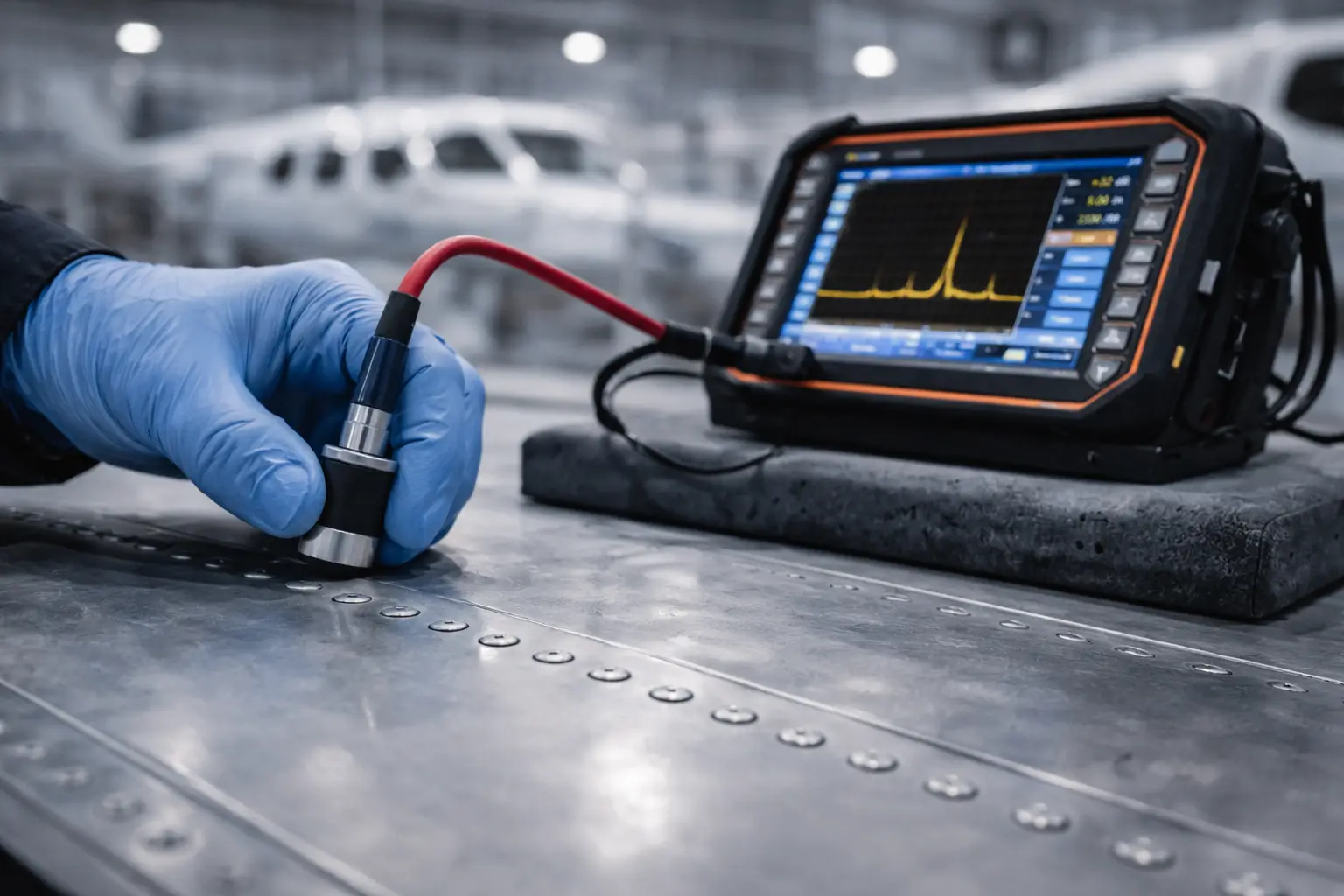
- give you a practical map of the NDT methods—eddy current, penetrant, ultrasonic, and magnetic particle—that allow maintenance teams to “see the unseen” before a small crack becomes a major structural event.
How Aircraft Structural Fatigue Starts: The Microscopic Reality.
Structural fatigue is progressive, localized damage that occurs when a material is subjected to cyclic loading—repeated stress that may be far below the material’s ultimate strength.
In plain terms: every time a wing flexes in turbulence, every landing loads the gear, and every pressurization cycle stretches the fuselage skin, the structure accumulates “invisible history.” Over time, that history becomes damage.
The physics: micro-movement and stress concentration
At the microscopic level, metals deform through the movement of defects in their crystal structure (often described as dislocations). Under repeated stress, these movements concentrate at stress risers—features that amplify local stress, such as:
- Fastener holes (rivet/bolt holes)
- Scratches, tool marks, corrosion pits
- Sharp corners, poorly blended repairs
- Fretting interfaces (micro-rubbing contact surfaces)
Those locations don’t just “wear.” They act like magnifiers for fatigue damage, which is why so many critical inspections focus on attachments, holes, joints, lap seams, and fittings.
The fatigue crack lifecycle (why timing matters)
Fatigue failures typically follow a predictable progression:
- Crack Initiation
A crack begins at a microscopic level—too small for visual detection. At this stage, even a meticulous visual inspection can honestly find nothing. - Crack Propagation
The crack grows with each cycle. It may still be invisible under paint, sealant, within joints, or in hidden geometry. This is the phase where targeted NDT can catch it. - Final Fracture
Once the remaining intact cross-section can’t carry operational loads, failure accelerates rapidly. This is where “it looked fine last time” becomes a tragedy.
That’s the real danger: the window between “detectable” and “catastrophic” can be shorter than people assume, especially in high-cycle aircraft or corrosion-assisted environments.

Why Aircraft Structural Fatigue NDT is Better Than Visual Inspection.
Visual inspection (VT) is essential—but it’s not a complete fatigue strategy.
The “tight crack” problem
Many fatigue cracks remain tight/closed when the part is at rest. In a hangar, under zero load, a crack can be compressed and effectively “hide.” Under flight load, it opens—sometimes just enough to propagate faster, not enough to be seen.
The critical-length gap
By the time a crack is obvious visually, it may already be approaching a critical size—especially in primary structure. In other words: visible doesn’t mean “early.”
Paint, sealant, grime, and geometry hide evidence
Fatigue doesn’t always present like a clean movie crack. In real aircraft, evidence can be masked by:
- Thick paint systems and primer
- Sealant squeeze-out around joints
- Grease and contaminant films
- Shadowing and poor access
- Layered assemblies (skin/stringer/frame interfaces)
Human factors: expectation bias
If you expect to find nothing, your brain tries to make every suspicious mark into something harmless: a scratch, a stain, a scuff. This is a real, documented maintenance risk—and one reason serious programs push inspectors toward objective NDT methods where possible.
If you want an internal “bridge” article to support this section, your Visual Inspection guide is the perfect supporting link.
The NDT Toolkit: How Pros “See” Fatigue Before It Wins
If visual inspection is the watchman, NDT is the radar. Fatigue management becomes reliable when you combine VT with targeted methods that detect cracks while they’re still repairable.
A) Eddy Current Testing (ET): The king of near-surface fatigue
Eddy Current is one of the best tools for detecting surface and near-surface cracks in conductive materials, especially aluminum skins and fastener regions.
Why it dominates fatigue inspections:
- Extremely effective around fasteners and bolt holes
- Often works through paint/primer (depending on setup)
- Highly sensitive to early-stage cracking
- Fast—ideal for recurring inspection programs
Where ET shines:
- Rivet lines, lap joints
- Fastener rows in high-stress zones
- Bolt-hole cracking (with probes designed for holes)
- Wheel inspections and other program-dependent areas
This is why you’ll see ET written into many critical inspection requirements: it’s the practical method for catching fatigue before it becomes visible.
B) Fluorescent Penetrant (FPI / PT): The crack “revealer” for non-porous surfaces
Fluorescent penetrant is simple in concept but brutally effective when done correctly:
- Clean the surface properly
- Apply penetrant and allow dwell time
- Remove excess penetrant correctly
- Apply developer
- Inspect under UV-A with controlled lighting
Why it matters for fatigue:
- It reveals surface-breaking cracks that may be invisible in white light
- Under UV, indications can pop with high contrast
- Great for many non-ferrous components and machined parts
But PT is also where shortcuts create false confidence. Poor cleaning, wrong dwell, over-washing, contaminated developer, or bad UV control can turn a real crack into a missed finding—or create false calls.
C) Ultrasonic Testing (UT): Internal flaws and thickness loss (where fatigue can start)
UT uses high-frequency sound waves to detect internal discontinuities, thickness changes, and certain crack conditions depending on part geometry and technique.
Where UT earns its keep:
- Thick sections (spars, fittings, trunnions—program dependent)
- Corrosion mapping and thickness trending
- Certain bonded/composite inspections (different failure modes, but same “invisible threat” problem)
UT isn’t “just scanning.” Good UT is calibration discipline, coupling control, scan plan consistency, and documentation that can survive audit review.
D) Don’t forget MT (for steel/ferromagnetic structures)
If the fatigue concern is in ferromagnetic material (landing gear components, steel fittings), Magnetic Particle Testing (MT) is often the go-to. Directionality, field strength verification, demag discipline, and surface condition control are everything.
Case Study: The High-Cycle Trainer (Where Fatigue Grows Fast)
Flight school aircraft (Cessna 150/172, Piper Cherokee family, etc.) are often “low glamour, high reality.”
Even if total hours aren’t extreme, these aircraft can accumulate huge cycle counts:
- Takeoffs and landings every day
- Repeated training maneuvers
- Occasional hard landings
- High frequency of pressurization changes (if applicable) and repetitive loads
Why coastal environments are worse
In coastal regions, corrosion pits become perfect stress risers. Corrosion doesn’t just weaken metal—it prepares the crack initiation site. Corrosion-assisted fatigue is why “looks clean” can be dangerously misleading.
The practical takeaway
High-cycle + corrosive environment + visual-only = you’re depending on luck.
A smarter approach is building proactive, targeted NDT intervals on known high-stress areas and attachment points—especially where failure becomes unrecoverable.
Damage Tolerance vs Safe Life (Why Some Parts Have Hard Limits)
Two design philosophies show up constantly in fatigue conversations:
Safe Life
A component has a calculated life limit and must be removed at a defined hour/cycle threshold, regardless of appearance. The assumption is you prevent failure by retiring the part before fatigue becomes statistically likely.
Damage Tolerance
The structure is designed assuming cracks will occur, but the aircraft can safely carry load with a crack present—as long as it’s detected before reaching critical length. This puts heavy responsibility on inspection quality and inspection intervals.
The practical message for maintainers: inspection quality becomes part of the design safety margin.
Fighting the “Tombstone Imperative” (Staying Ahead of the Mandate)
In aviation, there’s a harsh reality: sometimes major inspection mandates become widespread only after a failure teaches the industry a lesson the hard way.
You don’t want to be the case study.
How to stay ahead
- Read Service Bulletins (SBs) like they matter (because they often do)
- Track recurring inspection items and known fleet hotspots
- Identify single points of failure (attachments and primary load paths)
- Use voluntary NDT strategically during annuals/major checks
- Make your documentation audit-proof: settings, calibration references, photos (where allowed), traceability

FAQ: Critical Insights for Structural Guardians
The following questions represent the most common points of friction for technicians and owners navigating structural integrity.
Can a fatigue crack be repaired?
It depends on the “Where” and “How Big.”
- Secondary Structure: Small cracks in non-critical areas (like fairings or cowlings) can often be “stop-drilled” or patched per standard practices (AC 43.13-1B).
- Primary Structure: Cracks in wing spars, carry-through structures, or engine mounts are a different story. These typically require Specific Engineering Approval (DER) or component replacement. A simple patch on a primary load path doesn’t stop the stress; it often just hides the failure until it becomes unrecoverable.
Does “shotgunning” apply to structures?
Yes, and it’s a costly gamble. Structural “shotgunning” is the practice of replacing large sections—like entire skins or rib assemblies—because a symptom (like a fuel leak or “smoking rivets”) is present, but the exact source isn’t confirmed.
- The Risk: Without NDT, you might replace a skin but leave the cracked internal fitting that caused the stress in the first place.
- The Solution: Targeted NDT identifies the “zero point” of the crack, ensuring you fix the root cause, not just the symptom.
How often should I perform NDT if there’s no AD?
Usage dictates the interval, not just the calendar. While Airworthiness Directives (ADs) are the legal minimum, they are often reactive. You should consider proactive baselining if your aircraft falls into these categories:
- High-Cycle Environments: Flight schools or short-haul cargo.
- Corrosive Environments: Coastal regions or high-humidity hangars.
- Known Hotspots: If the manufacturer has issued a Service Bulletin (SB) even without an AD mandate, the risk has already been identified.
Do composites “fatigue” the same way as metal?
No—the physics of failure are entirely different.
- Aluminum: Follows a predictable “initiation and propagation” cycle of cracking.
- Composites: These fail through delamination (layers separating), disbonding (adhesive failure), or matrix cracking.
- Detection: You can’t always “see” a composite failure. While you use Eddy Current for metal, composites require Ultrasonic (UT) techniques, Thermography, or the classic Tap Test to find internal voids that the eye will miss.
External Resources & Technical References
To deepen your understanding of structural guardianship and stay ahead of the “Tombstone Imperative,” consult these industry-standard resources:
AOPA’s Guide to Airworthiness Directives and Service Bulletins A clear breakdown of the legal versus recommended requirements for aircraft maintenance, helping you navigate the “Mandate” landscape effectively.
FAA Advisory Circular AC 43-215: Standardized Procedures for NDT The “gold standard” for understanding how the FAA expects technicians to approach Non-Destructive Testing and structural inspections.
The Aviation Safety Reporting System (ASRS) Database Search “structural failure” or “fatigue” to read anonymous reports from other technicians. Learning from others’ “near misses” is the best way to ensure you don’t become a case study yourself.
Conclusion: The Goal Is Simple—Never Let “Unrecoverable” Happen
Understanding structural fatigue transforms the role of a technician; it turns a mechanic from a simple parts-replacer into a structural guardian. In the high-stakes environment of aviation, the margin for error is non-existent, and the cost of oversight is measured in lives and airframes.
The ultimate goal of a professional safety culture is to ensure that the word “unrecoverable” never enters the flight log. This requires a fundamental shift in the maintainer’s mindset, moving away from subjective observation and toward objective, data-driven verification.
The Professional Shift
| From: Reactive Maintenance | To: Professional-Grade Safety |
| “It looks fine.” | “Can I prove it’s fine?” |
| Relying on visual checks for deep-seated issues. | Utilizing NDT and calibrated tooling for certainty. |
| Waiting for the next mandatory AD or mandate. | Staying ahead of the “Tombstone Imperative” via SBs. |
| Treating documentation as a clerical burden. | Treating documentation as audit-proof evidence. |
The Guardian Mindset
True structural guardianship means recognizing that metal doesn’t heal; it only remembers. By identifying single points of failure and tracking fleet hotspots before they become emergencies, you aren’t just following a checklist—you are interrupting a chain of events that could lead to catastrophe.
Ultimately, the difference between average maintenance and a professional-grade safety culture is the refusal to accept “good enough.” It is the commitment to being the case study for excellence, rather than the case study for failure.


