

In the modern world, information is no longer a scarce resource; it is an overwhelming flood. Most professionals—from aviation NDT inspectors and A&P mechanics to software engineers and CEOs—do not struggle because they lack data. They struggle because they are drowning in a sea of competing explanations, “just-so” stories, and over-engineered theories.
When complexity becomes a cage, we need a tool to restore clarity. That tool is Ockham’s Razor.
Why Ockham’s Razor Matters Today
Often misunderstood as a rule that “the simplest answer is always right,” Ockham’s Razor is actually a principle of parsimony. It suggests that when presented with competing hypotheses that make the same predictions, one should select the solution with the fewest assumptions.
In technical fields, this is the difference between finding the root cause of a structural crack and “shotgunning” parts based on a complex web of guesses. By applying Ockham’s Razor, you prioritize the most likely, direct explanations first, ensuring your resources are spent on reality rather than speculation.
Cutting Through the “Noise”
In data-heavy environments, we often fall into the trap of “overfitting”—creating theories so complex they explain every tiny fluctuation in the data but fail to predict the future. Ockham’s Razor acts as a filter, helping us distinguish the “signal” of truth from the “noise” of random coincidence.
Whether you are auditing a maintenance log or debugging a lines of code, the “Razor” reminds you: don’t multiply entities beyond necessity.
1. What is Ockham’s Razor? The Principle of Parsimony
Ockham’s Razor is a thinking tool used to “shave away” unnecessary baggage from a theory or explanation. In technical terms, it is known as the principle of parsimony.
Defining the Principle
- The core rule: When two explanations account for the same facts equally well, the one that makes the fewest assumptions is generally the one to prefer.
- Merriam-Webster definition: A rule in philosophy and science that states that entities should not be multiplied unnecessarily.
- The “Entities” concept: In this context, an “entity” is any new force, cause, or variable you must assume to be true for your theory to work.
- Simplicity vs. Economy: The razor doesn’t necessarily favor “simple” (easy to understand) ideas; it favors “economical” ideas that explain the most data with the least amount of “guesswork”.
[Backlink: What are Mental Models?]
2. The Historical Origins: Who was William of Ockham?
The principle is named after William of Ockham, a 14th-century English Franciscan friar, philosopher, and theologian.
The 14th-Century Context
- Scholasticism: During Ockham’s time, philosophy was dominated by complex debates that often “multiplied entities” to explain theological concepts.
- Ockham’s contribution: He argued that “plurality should not be posited without necessity,” essentially challenging the bloated logic of his era.
- The “Razor” metaphor: While Ockham practiced the principle, the “razor” terminology was popularized centuries later to describe how the principle “shaves off” the excess.
- The Slogan Mystery: The famous Latin phrase “Entia non sunt multiplicanda praeter necessitatem” (entities must not be multiplied beyond necessity) is the slogan most associated with him, yet many scholars note this exact wording is not found in his surviving texts.
3. The Hidden Logic: Why Fewer Assumptions Lead to Truth
Why is a simpler explanation statistically more likely to be correct? The logic is rooted in the “Assumption Load”.
The Liability of Assumptions
Every time you add an assumption to a theory, you create a new failure point. If Explanation A relies on 2 assumptions and Explanation B relies on 10, Explanation B has 8 more chances to be proven wrong by reality.
The Probability of Success
Consider a simple probability model:
- Assume each assumption has an 80% chance of being true.
- An explanation with 1 assumption has an 80% total probability of being correct.
- An explanation with 5 assumptions ($0.8^5$) has only a 32% probability of being correct.
By minimizing assumptions, you are mathematically maximizing the likelihood that your model of reality is accurate.
4. Ockham’s Razor in Science and Data
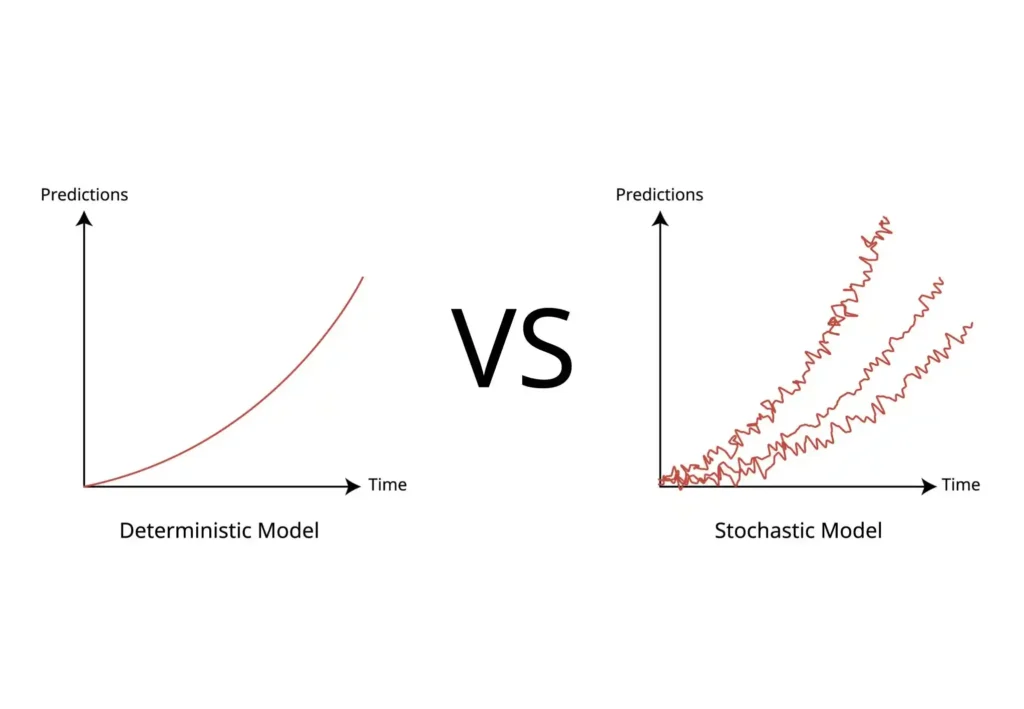
Scientists and statisticians use the razor as a guide for model-building, helping them avoid the trap of overfitting. By applying Bayesian Inference and Probability, researchers can mathematically weight the likelihood of a simpler model being the more accurate representation of reality.
Fights Overfitting
- Definition: Overfitting occurs when a statistical model is so complex that it describes random “noise” instead of the underlying “signal.”
- Generalization: Parsimonious models (those that are slightly simpler) typically generalize better to new, unseen data. A model that perfectly fits past data but fails to predict the future is functionally useless.
- Scientific Preference: Scientists often prefer theories that explain data without introducing unnecessary mechanisms or entities.
The Role of Evidence
Heuristic vs. Law: The razor is a heuristic (a practical guide) rather than a law of nature like gravity; it is a way to prioritize research and identify which hypothesis to test first, not a final judge of objective truth.
The “Other Things Being Equal” Clause: The razor only applies when competing theories have equal explanatory power.
Complexity as a Necessity: If a more complex model explains the facts significantly better than a simple one, the simple one is discarded. Science does not sacrifice accuracy for the sake of simplicity.
5. Practical Application: A Step-by-Step Guide
In the high-stakes world of Aviation NDT or corporate decision-making, you can apply Ockham’s Razor using this 5-step framework.
Step 1: Enumerate the Explanations
- Do not leave theories in your head; write them down clearly.
- Identify the core claim of each theory.
Step 2: Level the Playing Field
- Ask: Do these theories explain all the currently known facts?.
- If one theory ignores half the evidence, it isn’t “simple”—it’s just wrong.
Step 3: Count the Assumptions
- Look for “unsupported claims” or “leaps of faith”.
- An assumption is something you have to accept as true without direct evidence for the theory to work.
Step 4: Prioritize the “Lightest” Theory
- Select the explanation with the fewest unsupported assumptions as your primary hypothesis.
- Investigate this theory first.
Step 5: Remain Open to Upgrades
- If new data proves the simple theory insufficient, you must add complexity.
- Complexity should only be added when the evidence demands it.
6. Real-World Examples for the Professional
Example A: Troubleshooting Equipment (The A&P Mechanic)
- Scenario: An ultrasonic testing (UT) machine is giving erratic readings during an inspection.
- Complex Theory: A rare cosmic ray interference is affecting the software, combined with a microscopic crack in the transducer housing.
- Simple Theory: The cable is loose or the battery is dying.
- The Razor’s Choice: Check the cable and battery first. It requires fewer new entities to explain the failure.
Example B: Interpersonal Communication
- Scenario: A client has not replied to your project proposal for three days.
- Complex Theory: They found a competitor, they are secretly angry about a typo on page 4, and their email server is undergoing a targeted hack.
- Simple Theory: They are busy or haven’t seen it yet.
- The Razor’s Choice: Assume they are busy. It prevents unnecessary stress and preserves the professional relationship.
7. When Ockham’s Razor Fails: Common Misunderstandings
Ockham’s Razor—the principle that $entities \ should \ not \ be \ multiplied \ beyond \ necessity$—is one of the most frequently cited tools in logic, yet it is often misused to justify laziness or to ignore genuine complexity. To use it effectively, one must recognize where the “blade” dulls and when to pivot to Hickam’s Dictum: The Anti-Razor, which reminds us that multiple complex causes can exist simultaneously.
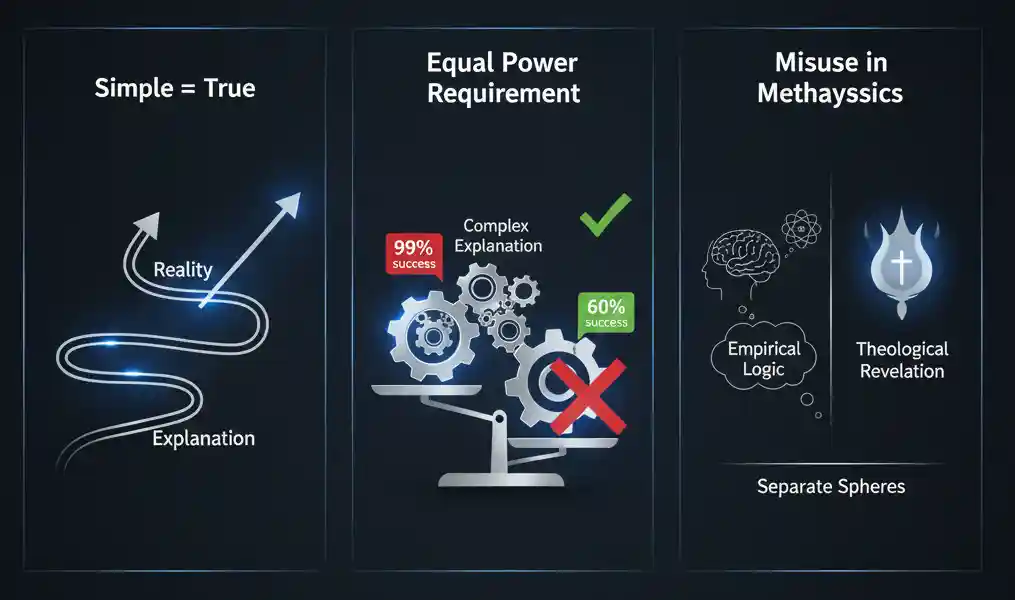
1. Simple $\neq$ True
The razor does not claim that the universe is inherently simple; it claims that our explanations of the universe should be as simple as possible. Reality is often chaotic, multifaceted, and deeply counterintuitive. The razor suggests we shouldn’t add “extra” layers of mystery if the existing facts already provide a sufficient path.
2. The “Equal Power” Requirement
A critical mistake is applying the razor to two theories that don’t have equal explanatory weight.
- If a complex explanation predicts a 99% success rate.
- And a simple explanation predicts only a 60% success rate.
- The complex one wins. The razor is a “tie-breaker,” not a “power-player.” It only applies when two theories explain the same set of data with equal accuracy.
3. Misuse in Metaphysics
People often wield the razor to “prove” or “disprove” the existence of God or other metaphysical concepts. However, the razor is a tool for empirical inquiry and explanatory economy, not a metaphysical judge. Interestingly, William of Ockham himself was a friar who carefully separated theological revelation from empirical logic, arguing that faith and reason operate in different spheres.
8. The Anti-Razor: Hickam’s Dictum
In medicine and aviation, there is a counter-principle known as Hickam’s Dictum: “A patient can have as many diseases as they damn well please.”
This reminds us that in complex systems—like the human body or a jet engine—multiple failures can happen at once. Ockham’s Razor tells us to look for a single cause first, but Hickam’s Dictum reminds us that reality is under no obligation to be simple.
Conclusion: Integrating the Razor into Your Blueprint
Ockham’s Razor is the “backbone” of clear thinking. For the aviation professional or the business leader, it acts as a filter that separates actionable insights from distracting noise. By mastering this principle, you ensure that your “Roadmap” is not cluttered with unnecessary obstacles, allowing you to focus on the precision and liability that keeps the industry safe.
The Ockham Checklist for Your Next Meeting:
- What are the undisputed facts?
- What is the simplest explanation that covers all of them?
- What assumptions am I making that have no evidence?
- What test can I run to prove or disprove the simplest theory first?
Would you like me to create a downloadable PDF “Cheat Sheet” of this checklist that you can use for your NDT team or business brainstorming sessions?
FAQ: Mastering the Razor in Life and Industry
1. Is the simplest explanation always the correct one?
No. Ockham’s Razor is a heuristic (a rule of thumb), not an absolute law of nature. It suggests that the simplest explanation is the most likely to be correct because it has the fewest failure points (assumptions). However, if a more complex explanation is backed by superior evidence, the simpler one must be discarded.
2. What is the difference between “simple” and “parsimonious”?
In casual conversation, “simple” can mean “easy to understand” or “basic.” In professional logic, parsimony refers specifically to the economy of assumptions.
- Simple: “The engine stopped because it ran out of fuel.”
- Parsimonious: “The engine stopped due to a single mechanical failure in the fuel pump,” (rather than assuming five different sensors failed simultaneously).
3. How does Ockham’s Razor help in Aviation NDT?
In Non-Destructive Testing, the Razor is the foundation of effective Root Cause Analysis (RCA). When an inspector sees an indication:
- Without the Razor: You might assume a unique combination of material fatigue, chemical corrosion, and manufacturing defects all occurred in the same spot.
- With the Razor: You first investigate the most likely single cause (e.g., a known stress point for that specific airframe). It saves time, reduces “rabbit hole” investigations, and focuses resources on the most probable risk.
4. Can Ockham’s Razor be used to “over-simplify” problems?
Yes, this is a common trap. The Razor only applies when two explanations explain the same set of facts equally well. If you ignore 20% of the data just to make your theory “simpler,” you aren’t using Ockham’s Razor—you are committing confirmation bias.
5. What is the mathematical basis for preferring fewer assumptions?
It is rooted in the Multiplication Rule of Probability. If you have multiple independent assumptions ($A$, $B$, $C$), the probability of the total explanation being true is:
$$P(Total) = P(A) \times P(B) \times P(C)$$
As you add more assumptions (entities), the total probability of the explanation being true decreases exponentially, even if each individual assumption is relatively likely.
6. How does Ockham’s Razor relate to Hickam’s Dictum?
These two principles represent a classic “tug-of-war” in diagnostic fields:
| Principle | Core Philosophy | Best Used For… |
| Ockham’s Razor | Look for a single cause that explains all symptoms. | Initial troubleshooting and high-probability scenarios. |
| Hickam’s Dictum | A system can have multiple, unrelated problems at once. | Complex, aging systems (MRO) or “mystery” failures that don’t respond to standard fixes. |

Senior NDT Controller with over 20 years of experience in aviation (FAA, EASA, and NRCAN certified). Expert in aircraft maintenance, non-destructive testing (NDT), and pilot training. I share practical, up-to-date 2026 guides for pilots and aviation maintenance technicians.