
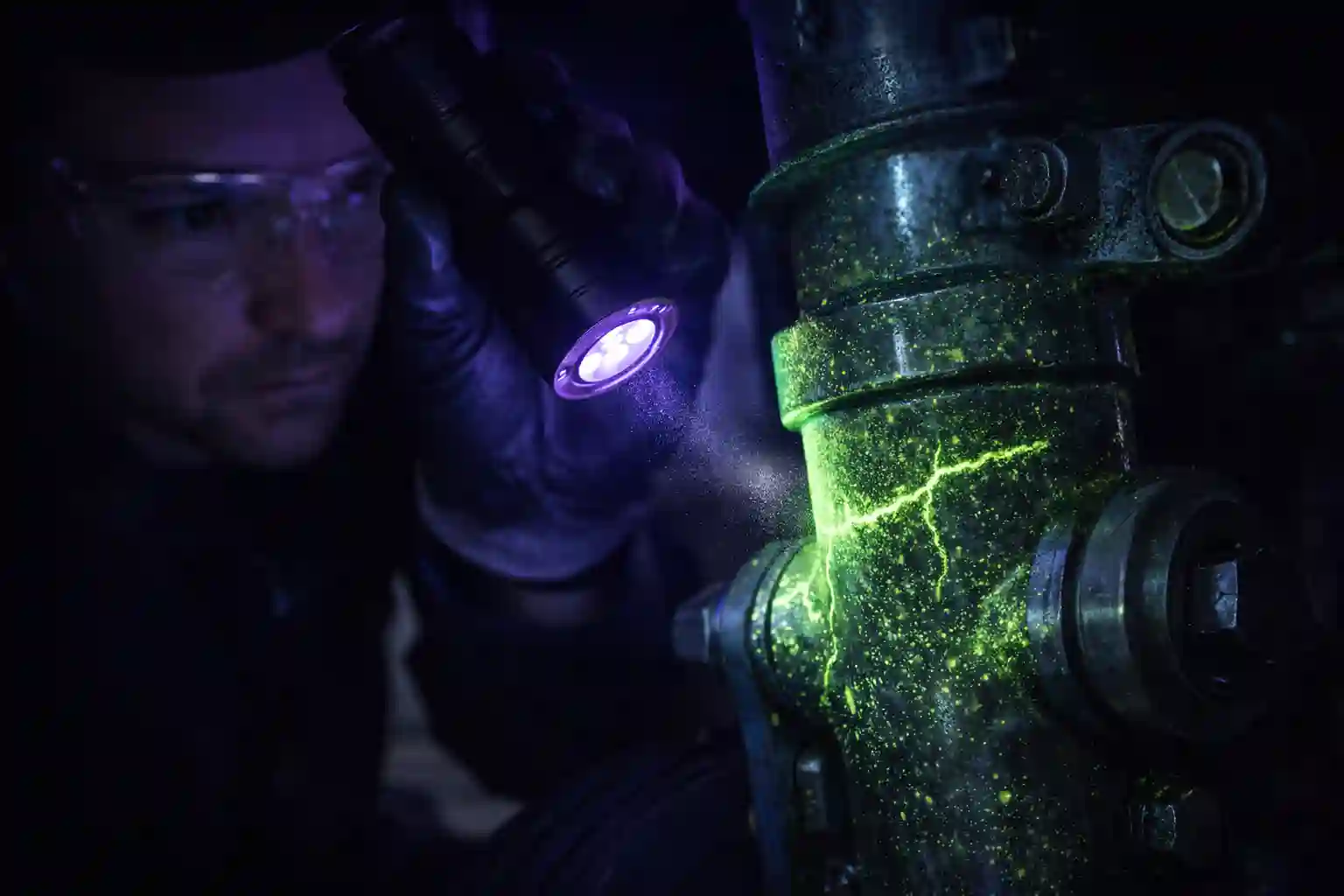
In the world of aviation maintenance, some threats are invisible. A microscopic crack inside a turbine blade or a fatigue fracture hiding behind a rivet head can bring down an airliner just as surely as an empty fuel tank. This is where the NDT Inspector enters the picture.
If the A&P Mechanic is the “doctor” of the airplane, the NDT Inspector is the “radiologist.” Using advanced technology—from high-frequency sound waves to electromagnetic fields—these specialists look inside the metal itself to find defects before they become disasters.
Pursuing NDT inspector training is one of the smartest career moves a technician can make. It offers higher pay, less physical grunt work, and the prestige of being a specialized safety expert. In this guide, we will break down the science, the certification levels (NAS 410 vs. ASNT), and the exact roadmap to launching a lucrative career in Non-Destructive Testing.
Part 1: What is Non-Destructive Testing (NDT)?
Non-Destructive Testing (NDT) is exactly what it sounds like: testing a material/component for structural integrity without damaging it.
In traditional destructive testing (like a crash test or a tensile pull), the part is destroyed to prove it works. You obviously cannot do that to a flying aircraft. This is why NDT inspector training emphasizes the ability to inspect the “bones” of the aircraft—the spars, ribs, and landing gear—while the plane sits on the ramp. Students undergoing NDT inspector training learn to detect these microscopic faults without altering the physical state of the material.
Why is NDT Inspector Training in Demand?
As aircraft fleets age, metal fatigue becomes the #1 enemy. The FAA mandates strict inspection cycles for older jets. Consequently, the demand for certified inspectors who can sign off on these legal requirements is skyrocketing. According to the American Society for Nondestructive Testing (ASNT), the NDT market is projected to reach $12.6 billion by 2026.
Part 2: The “Big Five” Methods of NDT
Before you sign up for NDT inspector training, you must understand the different disciplines. Most inspectors specialize in one or two methods initially.
1. Liquid Penetrant Testing (PT)
- The Concept: A low-viscosity fluorescent dye is applied to a clean surface. It seeps into tiny cracks via capillary action. After cleaning the excess and applying a developer, the dye bleeds back out, revealing the crack under UV light.
- Best For: Surface cracks on non-porous materials (aluminum, steel, titanium).
- Training Difficulty: Low. This is often the first certification inspectors get.
2. Magnetic Particle Testing (MT)
- The Concept: A magnetic field is induced into a steel part using a “yoke” or coil. Iron particles (dry or wet) are dusted onto the part. If there is a crack, the magnetic field leaks out and traps the iron particles, forming a visible line.
- Best For: Ferrous metals (steel landing gear, engine bolts).
- Limitation: Does not work on aluminum (which is non-magnetic).
3. Eddy Current Testing (ET)
The Concept: This is the “bread and butter” of aviation NDT and a major focus of any advanced NDT inspector training curriculum. An electrical coil induces a circular current (Eddy Current) into the conductive metal. If the current hits a crack or corrosion, the flow is disturbed, and the impedance changes on the inspector’s screen.
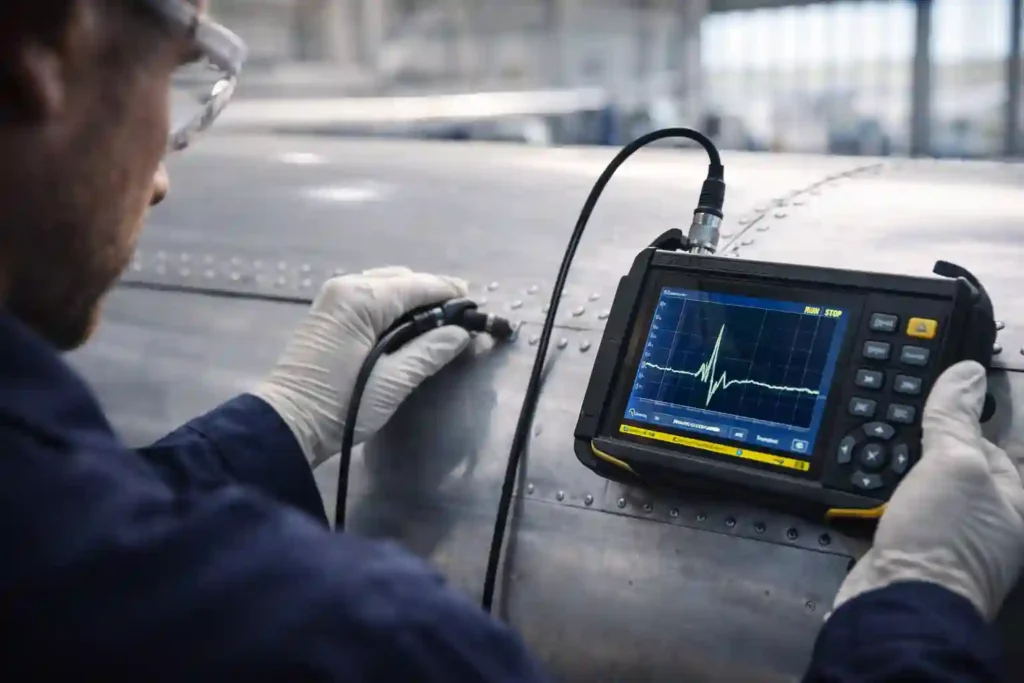
4. Ultrasonic Testing (UT)
- The Concept: High-frequency sound waves are beamed into the material. The sound bounces off the back wall of the part. If there is a hidden crack or delamination inside, the sound bounces back early.
- Best For: Internal defects, thickness measurements, and composite inspection.
5. Radiographic Testing (RT)
- The Concept: Using X-rays or Gamma rays to create a shadow image of the part’s interior on film or a digital detector.
- Best For: Seeing deep inside complex structures (like welded joints or engine castings).
- Risk: Requires strict radiation safety training.
Part 3: Understanding the Certification Levels (Level I, II, III)
Unlike a college degree, NDT inspector training is tiered. You don’t just “become” an inspector; you climb a ladder defined by the NAS 410 standard (the aviation industry standard) or SNT-TC-1A (general industry).
Level I: The Apprentice
- Role: You are a trainee. This is the entry point where your formal NDT inspector training begins in the real world. You can calibrate the equipment and perform specific tests under supervision.
- Authority: You cannot interpret results or sign off on a tag. You are essentially gathering data for the Level II.
- Salary: $20 – $28/hour.
Level II: The Professional (The Goal)
- Role: This is the “working” certification. A Level II inspector can set up equipment, perform the test, interpret the results (Pass/Fail), and sign the maintenance release.
- Authority: Most job postings ask for “NAS 410 Level II in UT/ET.”
- Salary: $35 – $60/hour (depending on method and industry).
Level III: The Master
- Role: The expert who writes the procedures, trains Level I and II personnel, and resolves disputes.
- Authority: Requires years of experience and passing rigorous ASNT exams.
- Salary: $100,000 – $160,000+ annually.
Part 4: How to Get NDT Inspector Training
You generally have two pathways to get those coveted certifications.
Pathway A: Formal NDT Schools
Specialized vocational schools offer intensive NDT inspector training programs.
- Duration: 9 to 18 months.
- Curriculum: You will cover the theory (physics, math) and get hands-on lab time for all 5 methods.
- Pros: You graduate with the “Classroom Hours” required for certification already done.
- Where to look: Spartan College, Ocean Corp, or the American Institute of Nondestructive Testing.
Pathway B: On-the-Job Training (OJT)
Many technicians start their journey as a general mechanic. Read our guide on how to start an A&P mechanic career to see where the foundation begins.
- The Process: You work alongside a Level II or III inspector. You log your hours in a specific method (e.g., 400 hours for PT).
- Pros: You earn while you learn.
- Cons: It can take years to accumulate the specific hours needed if your shop doesn’t do NDT often.
Crucial Note on Certification: In aviation, you are usually certified by your employer. Even if you go to school, your company (Delta, Boeing, SpaceX) must certify you in accordance with their Written Practice (based on NAS 410). The school gives you the knowledge; the employer gives you the license.
Part 5: Tools of the Trade
NDT requires specialized, often expensive gear. While the company provides the $50,000 X-ray tube, the individual inspector often carries their own personal inspection kit.
- Inspection Mirrors & Flashlights: You can’t test what you can’t reach. High-lumen LED flashlights are essential.
- Visual Aids: 10x Magnifiers and comparators.
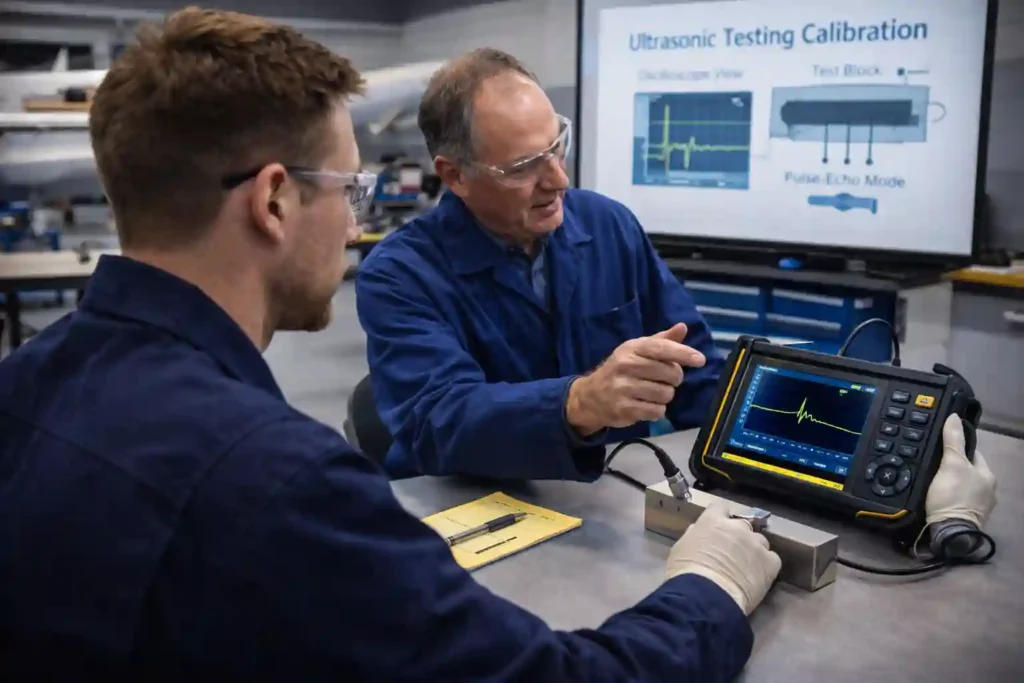
- Reference Blocks: Metal blocks with known defects used to calibrate machines.
- UV Lights: For Penetrant and Magnetic particle inspections.
Looking to build your kit? Check out our [Affiliate Link: Recommended NDT Starter Tools] for high-quality magnifiers and lights.
Part 6: Salary and Career Outlook
Is the specialized NDT inspector training worth the cost? Financially, yes.
Because NDT inspectors are harder to replace than general mechanics, they command a premium.
- Aerospace NDT: $35/hr to $65/hr.
- Contracting (Road Warriors): If you are willing to travel to shutdowns (power plants, pipelines, or hangars), you can earn $3,000 – $5,000 per week including per diem.
Furthermore, NDT is physically less demanding than general wrenching. You aren’t lifting heavy tires or wrestling with hydraulic actuators. You are moving a probe or looking at a screen. This makes it an excellent “retirement plan” for older mechanics who want to save their backs but stay in the industry.
Summary: Is NDT Right For You?
If you enjoy science, have a keen eye for detail, and prefer “investigation” over “replacement,” NDT is a fantastic career path.
Your Next Steps:
- Pick a Method: Start with Liquid Penetrant (PT) or Magnetic Particle (MT) as they are the easiest to learn.
- Get the Hours: Ask your lead mechanic if you can assist with NDT tasks to start logging OJT.
- Study the Physics: NDT is math-heavy. Brush up on your trigonometry and physics.
- Get Certified: Work toward your Level II status to unlock the real earning potential.
The safety of the skies depends on the things we cannot see. As an NDT inspector, you are the one who makes them visible.
Frequently Asked Questions (FAQ) regarding NDT
Is NDT training difficult? NDT training is academically more challenging than general mechanical training. It requires a strong grasp of physics and mathematics (specifically trigonometry). You must understand wave propagation, magnetic fields, and electrical impedance. If you enjoy science and logic puzzles, you will likely do well; if you struggle with math, you may find methods like Ultrasonic and Eddy Current challenging.
Do I need a college degree to become an NDT inspector? No. While a degree in “Non-Destructive Testing Technology” helps fast-track your career, it is not a strict legal requirement. Most aviation NDT inspectors start with a high school diploma, attend a vocational certificate program, and gain their certification through on-the-job training (OJT) hours and employer-mandated exams.
Is NDT dangerous? It depends on the method.
- Safe: Visual, Eddy Current, and Ultrasonic testing are harmless.
- Requires PPE: Liquid Penetrant and Magnetic Particle use chemicals that can be skin irritants, so gloves and respirators are necessary.
- Strict Safety: Radiographic Testing (X-Ray/Gamma) involves ionizing radiation. It requires strict adherence to safety protocols, dosimeters, and specialized training to ensure zero health risks.
What is the difference between ASNT and NAS 410? This is the most important distinction in aviation.
- SNT-TC-1A (ASNT): This is a guideline used for general industry (pipelines, bridges, construction).
- NAS 410: This is the standard required for the Aerospace/Aviation industry. It has stricter requirements for training hours and vision exams. If you want to work on airplanes, ensure your training aligns with NAS 410.
How many hours do I need for Level II certification? It varies by method under NAS 410 standards. For example:
- Liquid Penetrant (PT): Typically requires ~32 classroom hours + 400 OJT hours.
- Ultrasonic (UT): Typically requires ~80 classroom hours + 1,600 OJT hours.
- Note: These requirements change based on your prior education level.


