Introduction
Having the right NDT tools is just as important as having the right certification. In the high-stakes world of aviation maintenance, you are rarely working in a perfectly lit, climate-controlled laboratory. Instead, you are often contorted inside fuel tanks, balancing on wing structures, or squeezing into engine nacelles. In these challenging environments, your toolkit is your lifeline.
Many newcomers to the industry assume that NDT (Non-Destructive Testing) is entirely about expensive flaw detectors, advanced Phased Array ultrasonic sets, or robotic scanners. While that technology is vital, 80% of an inspector’s daily life relies on basic, reliable hand tools. The reality is simple: if your flashlight dies, your mirror fogs up, or your caliper batteries fail, the inspection stops. And when the inspection stops, the aircraft stays on the ground (AOG).
In this guide, we break down the essential NDT tools every aviation technician needs in their bag. From high-CRI lighting to precision measurement instruments, this is the gear that separates the amateurs from the pros. Whether you are a fresh Level 1 or a seasoned Level 3, optimizing your loadout is key to efficiency and safety.
Why Your Toolkit Matters (The Psychology of Inspection)
In aviation, “Tool Control” is treated like a religion. Every tool must be accounted for at the start and end of a shift to prevent Foreign Object Debris (FOD), which could catastrophically damage an engine or flight control system. But beyond mere compliance, the quality of your personal tools directly impacts your Probability of Detection (POD).
Think of your tools as an extension of your senses. A cheap flashlight might wash out the subtle contrast of a fatigue crack. A poor-quality mirror might distort the image of a corrosion pit, making it look acceptable when it is actually out of limits.
Building a reliable collection of NDT tools takes time, but it protects your reputation. Investing in professional-grade that you don’t miss the critical defects that jeopardize airworthiness. As you progress through your career—moving up the ranks as detailed in our NDT Levels Guide—your toolkit will evolve, but the need for reliability remains constant.
1. The Inspector’s Eyes: Advanced Lighting & Mirrors
Visual Inspection (VT) is the foundation of all other NDT methods. Even if you are preparing to perform Eddy Current or Ultrasonic testing, you must visually assess the surface condition first. If you can’t see it, you can’t inspect it.
High-Performance Flashlights
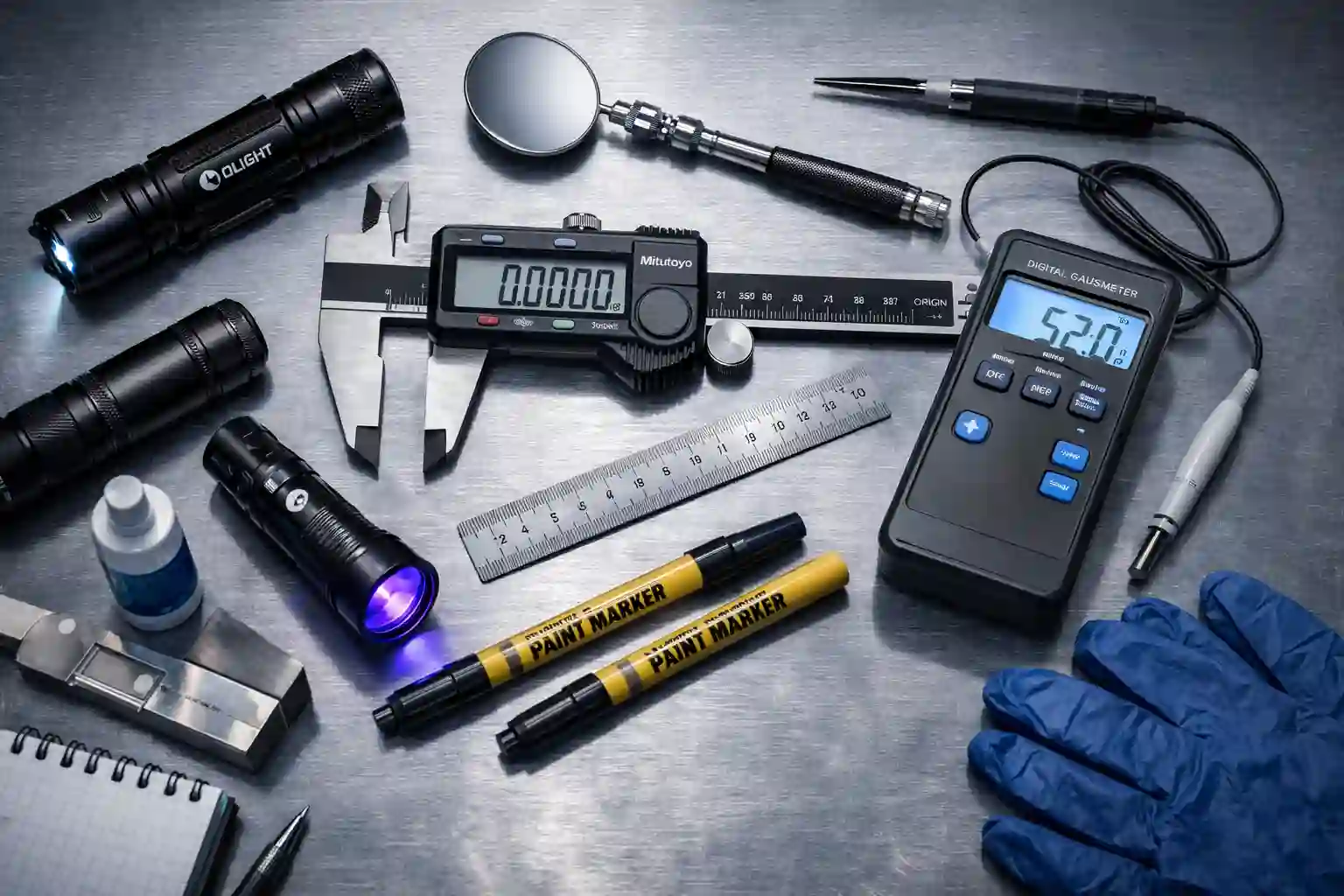
Forget the cheap plastic torch you keep in your kitchen drawer. Among all your visual NDT tools, lighting is critical. An aviation NDT inspector needs a light that mimics daylight. and can survive a drop from a wing.
- Lumens vs. CRI (The Critical Difference): Do not be fooled by high lumen counts. A 1000-lumen light that is blindingly bright is useless if the color temperature is wrong. You need to look for a high Color Rendering Index (CRI).
- Why CRI Matters: A high CRI (90+) reveals the true color of the object. Corrosion on aluminum alloys often appears as a reddish-brown or powdery white substance. Under a cheap, low-CRI “cool white” LED (blue tint), corrosion can blend in and look grey. High CRI lighting separates the defect from the background.
- Beam Focus: You need a light with an adjustable focus. A wide flood beam is necessary for general area orientation, while a tight spot beam is critical for inspecting the bottom of a fastener hole or inside a bore.
- Form Factor: A complete setup usually includes a penlight (for quick looks), a handheld tactical light (primary inspection), and a high-quality headlamp (for hands-free work inside fuselage panels).
Inspection Mirrors
Mirrors are some of the most simple yet effective NDT tools in your arsenal. You can’t inspect what you can’t see directly. In the complex geometry of an airframe, defects often hide behind stringers, frames, and brackets.
- Glass vs. Metal:
- Glass Mirrors: Offer the best optical clarity and scratch resistance. However, they pose a FOD risk if they shatter.
- Polished Stainless Steel: These are safer for “FOD-critical” areas like inside jet engines or gearboxes. If they drop, they dent rather than shatter.
- Telescoping vs. Articulated: Telescoping mirrors allow you to reach deep into structural voids. Ensure the hinge (articulation point) is stiff; nothing is more frustrating than a “floppy” mirror head that won’t hold its angle.
- Pro Tip: In cold hangars, mirrors fog up instantly when you breathe near them. Keep a small bottle of anti-fog solution in your kit, or gently warm the mirror in your pocket before use.
2. Precision Measurement Tools (The Evidence)
When you find a defect, your job shifts from “detection” to “evaluation.” Writing “it looks big” on a report is not acceptable. You need exact numbers to compare against the Structural Repair Manual (SRM) limits.
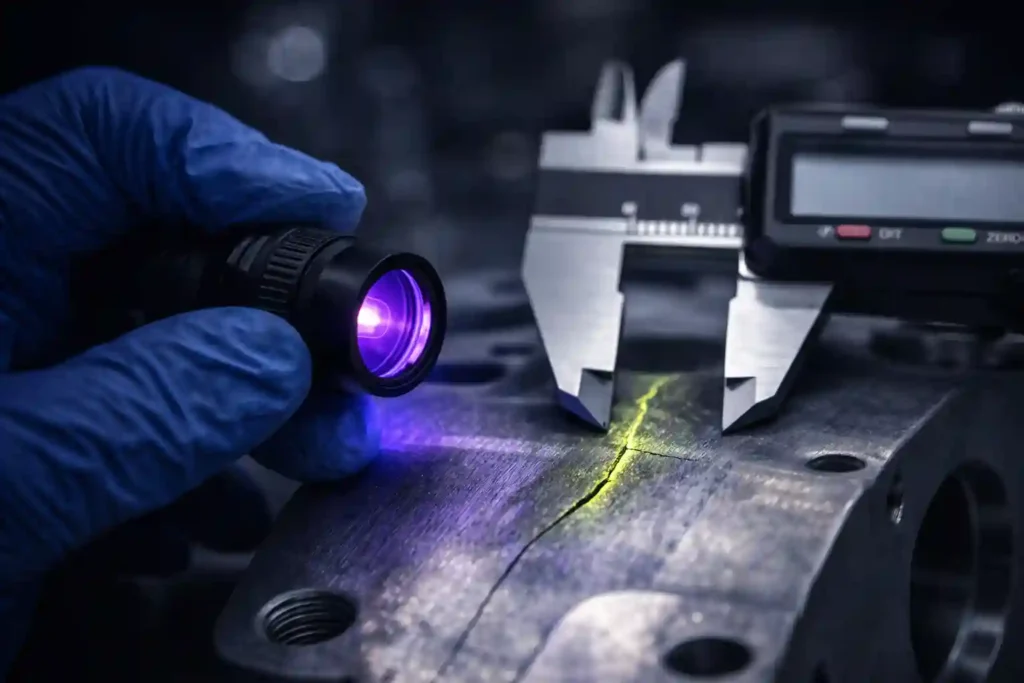
Digital Calipers
The caliper is often considered one of the most important NDT tools in your bag.. You will use it to measure scratch depth (using the depth rod), corrosion blending limits, and remaining part thickness.
- IP Rating: Aviation maintenance involves Skydrol (hydraulic fluid), oil, and solvents. Look for calipers with an IP67 rating, which means they are dust-tight and resistant to liquid immersion.
- Zeroing: Always zero your calipers before every use.
- Calibration: Remember, if you use your personal caliper to accept or reject an aircraft part, that tool typically needs to be in your company’s calibration system with a valid sticker.
6-Inch Steel Rule (The Scale)
A simple, high-quality steel rule is indispensable. It is used for measuring indication lengths, such as a crack indication found during Magnetic Particle testing or the distance of a defect from a fastener row.
- Graduations: Look for a rule with 1/64 inch or 0.5mm graduations for fine work.
- Finish: Avoid shiny chrome rules. They reflect your flashlight glare, making them hard to read. Choose a “Satin Chrome” or matte finish.
- Compliance: Ensure your rule is etched, not printed. Printed markings will fade after a week of exposure to MEK or acetone cleaning solvents.
Magnifiers (Optical Aids)
According to most international standards, such as those maintained by ASTM International, specific magnification levels are required for verification.
- 5x Magnifier: The standard for general verification.
- 10x Loupe: Used for detailed characterization. Is that a crack or just a deep scratch? A 10x look usually gives the answer.
- Lighted Magnifiers: These are excellent for creating contrast on surface defects without needing to juggle a separate flashlight.
3. Method-Specific Accessories
Depending on your specialty, your specific NDT tools will vary. A generalist keeps a bit of everything, but specialists need dedicated NDT tools.
For Penetrant (PT) & Magnetic Particle (MT)
- UV-A Lights (Black Lights): For fluorescent inspections, you need a compliant UV source. Modern LED UV lights are lighter and battery-operated, replacing the heavy, hot mercury-vapor lamps of the past. Ensure your light meets ASTM E3022 standards for intensity and wavelength (365nm).
- Lint-Free Cloths: Essential for cleaning parts prior to inspection. Using a standard rag can leave fibers behind that fluoresce under UV light, creating false indications.
- Timers: Penetrant dwell times are strict (e.g., minimum 10 minutes). A reliable digital timer—or a watch with a timer function—is mandatory to ensure process control.
For Ultrasonic Testing (UT)
Ultrasonic testing requires a unique set of accessories to ensure sound transmission.
- Couplant Bottles: A small, leak-proof dispenser bottle for your coupling gel is a lifesaver. There is nothing worse than trying to manipulate a large industrial tub of gel while balanced on a ladder.
- Reference Blocks: While the lab has the master blocks, you should carry a basic step-wedge or a miniature calibration block in your bag. This allows you to quickly verify your settings if your readings start to look strange during a job.
- Learn more about the equipment needed for this method in our complete Ultrasonic Testing Guide.
For Eddy Current (ET)
- Probe Tape: Teflon tape is often applied to the tips of contact probes to prevent wearing them down against the aircraft skin.
- Non-Metallic Tools: When working with Eddy Current, you want to avoid bringing magnetic tools near the probe during balancing. Plastic or ceramic tweezers can be very useful here.
4. The “Everyday Carry” (EDC) for Hangars
Beyond the specific NDT tools listed above, these miscellaneous items make life easier and prevent wasted trips back to the tool crib.
- Paint Markers: You need to mark defect locations on the aircraft skin for repair. However, you cannot use just any marker. Standard permanent markers can contain halogens or sulfur that corrode titanium and stainless steel at high temperatures. Always use “Low Chloride” or aviation-approved markers (brands like Dykem or Sharpie T.E.C.).
- Notebook & Pen: Digital tablets are common for manuals, but a physical notepad never runs out of battery. Use it to write down part numbers, serial numbers, and locations immediately. “I’ll remember it later” is the biggest lie in aviation.
- Multi-tool: Great for opening access panels or tightening loose screws on your own equipment. Warning: Never use personal multi-tools on aircraft components unless authorized by company policy.
- Dental Picks: A set of plastic or soft metal picks is incredibly useful for removing old sealant or digging debris out of fastener heads before inspection.
5. Tool Control & FOD Prevention Strategies
Owning great NDT tools brings responsibility. The most expensive tool in the world is the one you leave inside a jet engine.
Shadow Boxing (Kaizen Foam)
The professional standard for toolboxes is “Shadow Boxing.” This involves cutting foam inserts for your toolbox so every tool has a specific, cut-out place.
- Visual Check: If a slot is empty (a “black hole” in the foam), you immediately know something is missing before you close the box. This simple visual check saves hours of searching.
Tethering
When working at heights—such as on a tail dock, vertical stabilizer, or wing—gravity is your enemy.
- Lanyards: Tether your tools to your wrist or belt. Dropping a steel caliper from 20 feet onto a composite carbon-fiber wing results in very expensive damage. Dropping it onto a person below is a safety incident. Modern tool tethers are retractable and unobtrusive.
Conclusion
Your toolkit is an extension of your professionalism. While the company provides the expensive calibrated test sets, your personal NDT tools—your light, your mirror, your rule—define your daily efficiency and accuracy.
By investing in quality gear, maintaining strict tool control, and understanding the specific requirements of your methods, you ensure that you are always ready to make the right call. Remember: in aviation, finding the invisible is what prevents the catastrophic, and you can’t find what you can’t see or measure.

Senior NDT Controller with over 20 years of experience in aviation (FAA, EASA, and NRCAN certified). Expert in aircraft maintenance, non-destructive testing (NDT), and pilot training. I share practical, up-to-date 2026 guides for pilots and aviation maintenance technicians.