The aviation industry is the backbone of modern global transport, but it doesn’t move without the skilled hands that keep it airworthy. If you are looking for a profession that combines high-tech problem solving, hands-on mechanical work, and strict safety standards, an A&P mechanic career might be your perfect runway.
Unlike many industries that face threats from automation, aviation maintenance requires human intuition, dexterity, and critical thinking. The demand for qualified technicians is at an all-time high. According to the Boeing Pilot and Technician Outlook, the industry forecasts a need for over 600,000 new technicians over the next 20 years.
In this extensive guide, we will map out the entire trajectory of an A&P mechanic career, from the very first day of aviation maintenance training to landing a job with a major airline.
Part 1: What Exactly is an A&P Mechanic?
Before diving into the aviation maintenance training required, we must define the role. “A&P” stands for Airframe and Powerplant. This is the gold-standard certification issued by the Federal Aviation Administration (FAA) in the United States.
- Airframe: Covers the body of the aircraft, wings, skin, landing gear, hydraulic systems, and flight control surfaces. It deals with the structure and the systems that make the plane fly.
- Powerplant: Covers the engine (turbine or piston) and the propeller. It deals with the propulsion systems that move the plane forward.
While you can hold just one rating, a successful A&P mechanic career almost always requires both. Having both ratings makes you more employable and allows you to sign off on a wider variety of maintenance tasks. Without this certification, you cannot legally approve an aircraft for return to service—a responsibility that defines the gravity of this profession.
Part 2: The Two Pathways to Aviation Maintenance Training
There is no single road to the hangar floor. The FAA allows for three primary methods to gain the experience needed to test for your license. Choosing the right path is the first strategic decision of your A&P mechanic career.
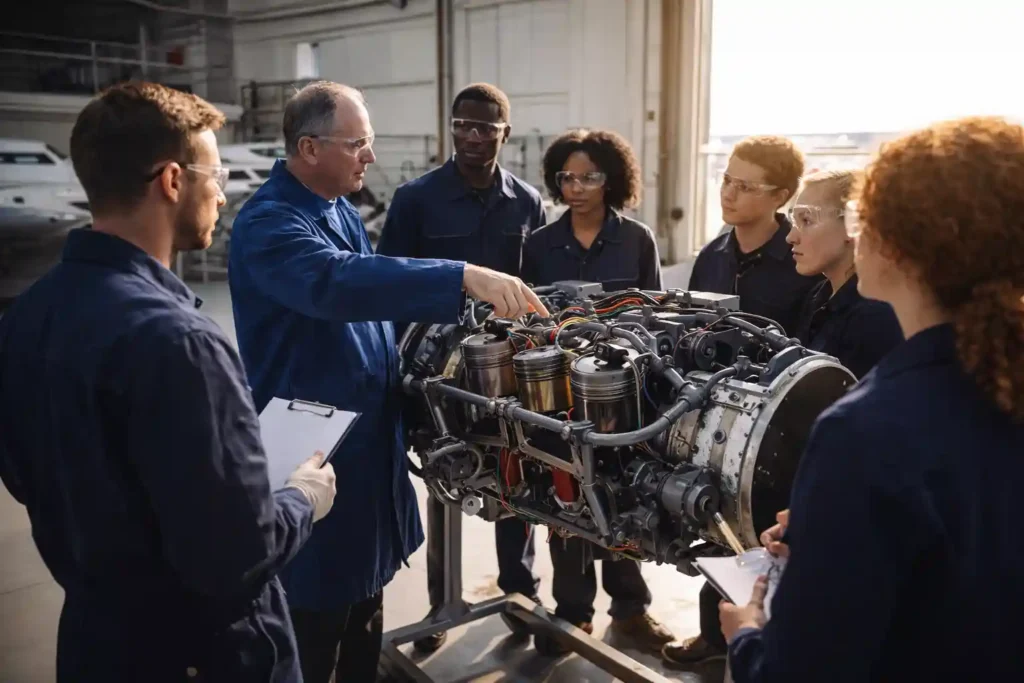
Method 1: FAA-Approved Part 147 Schools (The Academic Route)
This is the most popular route for civilians. You can find accredited programs using the FAA Part 147 School Locator. These are technical colleges or aviation institutes specifically certified to teach aviation maintenance training.
- Duration: Typically 18 to 24 months.
- Curriculum: You will split your time between classroom theory (aerodynamics, physics, regulations) and hangar labs (riveting, engine tear-downs, electrical troubleshooting).
- The Benefit: The school tracks your hours. Once you graduate, you are automatically qualified to take the FAA exams. You also gain structured learning, which helps significantly with the written tests.
- The Cost: This is the most expensive entry point into an A&P mechanic career, with tuition ranging from $15,000 to $50,000 depending on the institution.
Method 2: On-the-Job Training (The Apprenticeship Route)
If you prefer to earn while you learn, you can build your A&P mechanic career through practical experience. The FAA requires documented experience working under the supervision of a licensed mechanic.
- Requirements:
- 18 months of experience for either Airframe or Powerplant.
- 30 months of concurrent experience for both Airframe and Powerplant.
- The Benefit: No tuition debt. You are getting paid to learn the trade.
- The Drawback: It is harder to find a shop willing to train an apprentice from scratch. Furthermore, without the structured classroom environment of formal aviation maintenance training, passing the written exams (which cover intense physics and electrical theory) can be much more difficult. We recommend using [Affiliate Link: King Schools Online Ground School] to bridge this knowledge gap.
Method 3: Military Service (The Tactical Route)
Many veterans transition into a civilian A&P mechanic career after serving as maintainers in the Air Force, Navy, Army, or Marines.
- The Process: Military experience is highly valued, but it does not automatically grant you an A&P license. You must present your Joint Service Transcript (JST) and training records to an FAA Flight Standards District Office (FSDO).
- The Interview: An FAA inspector will interview you to ensure your military specialty aligns with civil aviation requirements. If approved, they will sign FAA Form 8610-2, granting you permission to take the testing phase of your aviation maintenance training.
Part 3: The Gauntlet – Passing the FAA Exams
Regardless of how you trained, every A&P mechanic career faces the same hurdle: the testing phase. You cannot touch an airplane as a licensed tech until you pass these three distinct stages.
1. The Written Exams
You must pass three multiple-choice computer exams. A passing score is 70%, but striving for a higher score creates a buffer of knowledge for your oral exams.
- General Exam: Covers basic electricity, weight and balance, regulations, and ground operations.
- Airframe Exam: Covers structures, sheet metal, hydraulics, and avionics.
- Powerplant Exam: Covers reciprocating engines, turbine engines, and fuel metering.
2. The Oral Evaluation
This is often the most nerve-wracking part of aviation maintenance training. You will sit one-on-one with a Designated Mechanic Examiner (DME). They will ask you random questions based on the FAA practical test standards. If you hesitate or look unsure, they will dig deeper. Confidence here is key.
3. The Practical Test
Immediately following the oral exam, the DME will assign you real-world tasks.
- Example: “Install a magneto,” “safety wire this turnbuckle,” or “identifying aircraft corrosion types on this spar.”
- Failure to follow the manual or a safety violation causes an immediate failure.
Passing these exams marks the official start of your A&P mechanic career. You will receive your temporary airman certificate on the spot.
Part 4: Career Trajectories and Salary Expectations
Once licensed, where do you go? The aviation industry is vast, and an A&P mechanic career can take many forms.
General Aviation (GA)
This involves working on small piston aircraft (Cessnas, Pipers) at local airports.
- Pros: You become a “Jack of all trades.” You will do everything from sheet metal patches to engine overhauls. It is the best way to master the fundamentals.
- Cons: Generally lower pay and fewer benefits compared to airlines.
- Salary: $20 – $30 per hour (entry-level).
Commercial Airlines (Part 121)
Working for major carriers like Delta, United, or FedEx is the goal for many.
- Pros: Highest earning potential, flight benefits, and union protection.
- Cons: You may be pigeonholed into specific tasks (e.g., only doing tires or only doing interiors) and will likely work overnight shifts for years.
- Salary: Starting at $30-$40/hr, with top-outs exceeding $60/hr (over $120k annually).
Corporate Aviation (Business Jets)
Maintaining Gulfstreams and Bombardiers for private companies or charter fleets.
- Pros: Clean environments, high-end equipment, and sometimes the opportunity to fly with the aircraft as a flight mechanic.
- Cons: Demanding schedules; owners expect the jet to be ready 24/7.
- Salary: Highly variable, but experienced corporate techs can earn six figures easily.
Contract Maintenance (MROs)
Maintenance, Repair, and Overhaul (MRO) stations perform heavy maintenance checks.
- Pros: Great for gaining experience quickly on heavy jets. High overtime potential.
- Cons: Often contract-based (no job security), lots of travel, and physically demanding work.
Part 5: Essential Tools and Soft Skills
An A&P mechanic career is not just about turning wrenches; it is about integrity.
The Toolkit
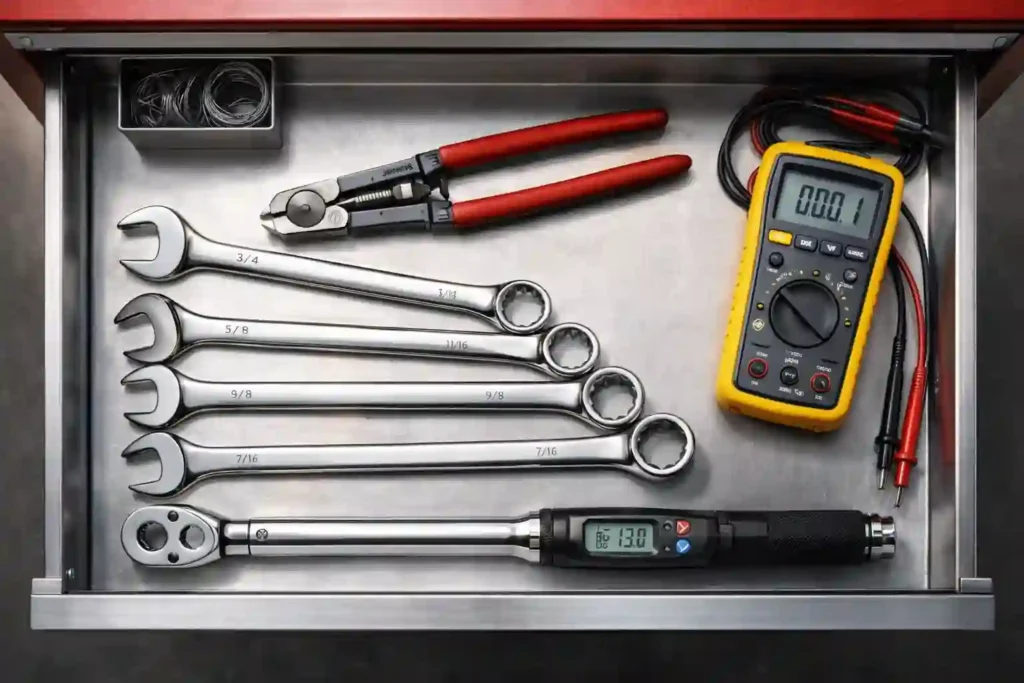
Unlike office jobs where the company provides the computer, mechanics generally provide their own tools. As detailed in our Ultimate Aircraft Mechanic Tool List, a basic setup includes ratchets, wrenches, and safety wire pliers., and a multimeter. As you advance in your A&P mechanic career, your tool collection will grow to include sheet metal shears, rivet guns, and specialized avionics tools. Expect to invest $2,000 to $5,000 in tools during your first few years.
The “Human Factor”
The most dangerous thing in aviation is complacency. This is why “Human Factors” training is now a mandatory part of aviation maintenance training. You must master the “Dirty Dozen”—the twelve common precursors to human error, including:
- Complacency: Thinking “I’ve done this a thousand times.”
- Lack of Communication: Assuming the next shift knows you left a bolt loose.
- Distraction: Checking your phone while torquing a cylinder head.
- Pressure: Rushing to get the plane out on time.
You can download the full list from the FAA Safety Team (FAAST) to keep in your toolbox. In an A&P mechanic career, your signature in the logbook is your bond. If you sign it, you are legally stating the aircraft is safe to carry passengers.
Part 6: Continuing Education and Specialization
Obtaining your license is just the beginning. The technology in aviation evolves rapidly, and a stagnant A&P mechanic career is a dying one.
To stay competitive, you should consider specialized aviation maintenance training post-certification:
- Avionics Certificates: As planes become more computerized, knowing how to troubleshoot digital systems is invaluable. The NCATT Aircraft Electronics Technician (AET) is the industry standard.
- Composite Repair: Modern aircraft like the Boeing 787 and Airbus A350 are made largely of carbon fiber. Learning composite repair makes you a specialist.
- Inspection Authorization (IA): After holding your A&P for three years, you can test for your IA. This allows you to perform Annual Inspections and sign off on major repairs and alterations. An IA significantly boosts your earning power and authority.
Part 7: The Future of the Industry
Is now the right time to start an A&P mechanic career? The data suggests a resounding “yes.”
An aging workforce is retiring, creating a massive vacuum of talent. Airlines are currently offering signing bonuses, tuition reimbursement for aviation maintenance training, and expedited career paths that did not exist a decade ago. Furthermore, the rise of eVTOL (electric Vertical Take-Off and Landing) aircraft and drone delivery systems will require a new breed of mechanic who understands high-voltage systems and electric propulsion.
However, the industry is cyclical. Fuel prices, pandemics, and geopolitical events can impact hiring. But historically, cargo and freight (like UPS and FedEx) remain stable even when passenger travel dips. Building a resilient A&P mechanic career means remaining adaptable and constantly learning.
Summary: Your Checklist to Takeoff
If you are ready to commit to this path, here is your step-by-step checklist:
- Choose your training path: Decide between a Part 147 school (college) or an apprenticeship.
- Commit to the study: Treat your aviation maintenance training like a full-time job.
- Pass the exams: Conquer the General, Airframe, and Powerplant written, oral, and practical tests using [Affiliate Link: ASA Test Prep Guides].
- Buy your tools: Assemble a professional-grade kit.
- Get your first job: Don’t be picky. Get your hands on airplanes and start building your logbook experience.
- Keep learning: pursue your IA or avionics certifications to future-proof your A&P mechanic career.
The sky is not the limit; it is just your office.
Frequently Asked Questions (FAQ)
Is A&P school hard? Aviation maintenance training is rigorous but manageable. The difficulty lies in the volume of information you must memorize, from federal regulations to physics equations. However, because the training is hands-on, students who struggle in traditional classrooms often thrive in the hangar environment. If you can stay disciplined with your study habits, you will pass.
How much does an A&P mechanic make starting out? Entry-level A&P mechanics typically earn between $25 and $35 per hour, depending on the location and sector. Regional airlines and General Aviation (GA) shops usually pay less to start, while major cargo carriers and commercial airlines offer higher starting wages. With 5-7 years of experience, many mechanics earn over $50 per hour.
Can I work on airplanes without a license? Yes, but with strict limitations. You can work as a “repairman” or an apprentice under the supervision of a licensed A&P mechanic. However, you cannot sign off on work or approve an aircraft for return to service. To advance your career and earning potential, you must eventually get certified.
How long does it take to get an A&P license? If you attend a full-time FAA Part 147 school, it takes roughly 18 to 24 months. If you choose the apprenticeship route (on-the-job training), the FAA requires 30 months of documented experience working concurrently on airframes and powerplants before you can test.
Do A&P mechanics fly with the plane? Generally, no. Most mechanics work at maintenance bases or line stations. However, some “Flight Mechanics” for corporate jets or cargo airlines do travel with the aircraft to handle maintenance issues at remote airports. This is a highly coveted role that requires significant experience.
Top 3 Reasons People FAIL the A&P O&P Exam
This video is highly relevant because it addresses the “Oral and Practical” exam, which is often the most intimidating part of the certification process described in your article’s “Part 3: The Gauntlet.”

Senior NDT Controller with over 20 years of experience in aviation (FAA, EASA, and NRCAN certified). Expert in aircraft maintenance, non-destructive testing (NDT), and pilot training. I share practical, up-to-date 2026 guides for pilots and aviation maintenance technicians.