

What does it cost to completely disassemble, inspect, and rebuild a commercial airliner? Between $5 million and $10 million for wide-body aircraft like the Boeing 777—and that’s just the maintenance bill. Factor in 55 days of lost revenue at $50,000+ per day, and you’re looking at a $100 million economic impact every time an aircraft undergoes heavy maintenance.
Welcome to the world of Heavy Maintenance Visits (HMV)—also called D-Checks—where America’s aviation maintenance expertise generates over $20 billion annually and keeps the world’s safest transportation system flying. This is the complete insider’s guide to what happens when a $350 million aircraft goes to the hospital.
What Is a Heavy Maintenance Visit? Understanding Aircraft D-Checks
A Heavy Maintenance Visit (HMV) represents the most comprehensive maintenance procedure in commercial aviation. Unlike routine checks that happen every few months, D-Checks occur every 6-10 years and involve near-complete disassembly of the aircraft.
Heavy Maintenance Visit Quick Facts:
- Frequency: Every 6-10 years or 30,000-40,000 flight hours
- Duration: 45-60 days of intensive work
- Cost: $5-10M for wide-body aircraft (Boeing 777, 787, Airbus A350)
- Workforce: 200+ specialized technicians working 24/7 shifts
- Components inspected: Virtually every system, structure, and mechanical assembly
The process unfolds at specialized MRO (Maintenance, Repair, and Overhaul) facilities across the United States, from AAR’s facility in Mobile, Alabama, to Delta TechOps in Atlanta, and American Airlines’ massive operation in Tulsa, Oklahoma.
Aircraft Heavy Maintenance Cost Breakdown: What Airlines Actually Pay
Understanding heavy maintenance costs requires looking beyond the sticker price. Here’s what airlines invest in a typical D-Check:
Direct Maintenance Costs
| Aircraft Type | D-Check Cost Range | Engine Overhaul (if included) | Total Potential Cost |
|---|---|---|---|
| Narrow-body (737, A320) | $2-4 million | $2-3M per engine | $6-10 million |
| Wide-body (777, 787, A350) | $5-10 million | $4-6M per engine | $13-22 million |
| Legacy wide-body (747-400) | $8-12 million | $5-7M per engine (×4) | $28-40 million |
Hidden Costs: Opportunity and Revenue Loss
The direct maintenance bill tells only half the story. Airlines face substantial opportunity costs when aircraft sit in maintenance:
- Revenue Loss: $40,000-60,000 per day in lost ticket sales (55 days = $2.2-3.3M)
- Fleet Rebalancing: Costs to reroute passengers and adjust schedules
- Spare Aircraft Requirements: Capital tied up in backup planes
- Crew Redeployment: Training and scheduling adjustments
According to FAA regulations, these maintenance visits aren’t optional—they’re mandatory for maintaining an aircraft’s Certificate of Airworthiness. Miss a D-Check, and the aircraft is legally grounded.
💡 Learn More: Explore our comprehensive Aircraft Maintenance Hub for insights into routine checks, emergency repairs, and preventive maintenance strategies.
Inside the Process: 55 Days of Intensive Aircraft Surgery
Phase 1: Arrival and De-Configuration (Days 1-7)
When a Boeing 777 arrives at AAR’s 350,000-square-foot hangar in Mobile, it’s flying under its own power for the last time in two months. The aircraft brings with it terabytes of operational data from 36,000+ flight hours—every vibration, temperature fluctuation, and stress pattern recorded since its last heavy maintenance visit.
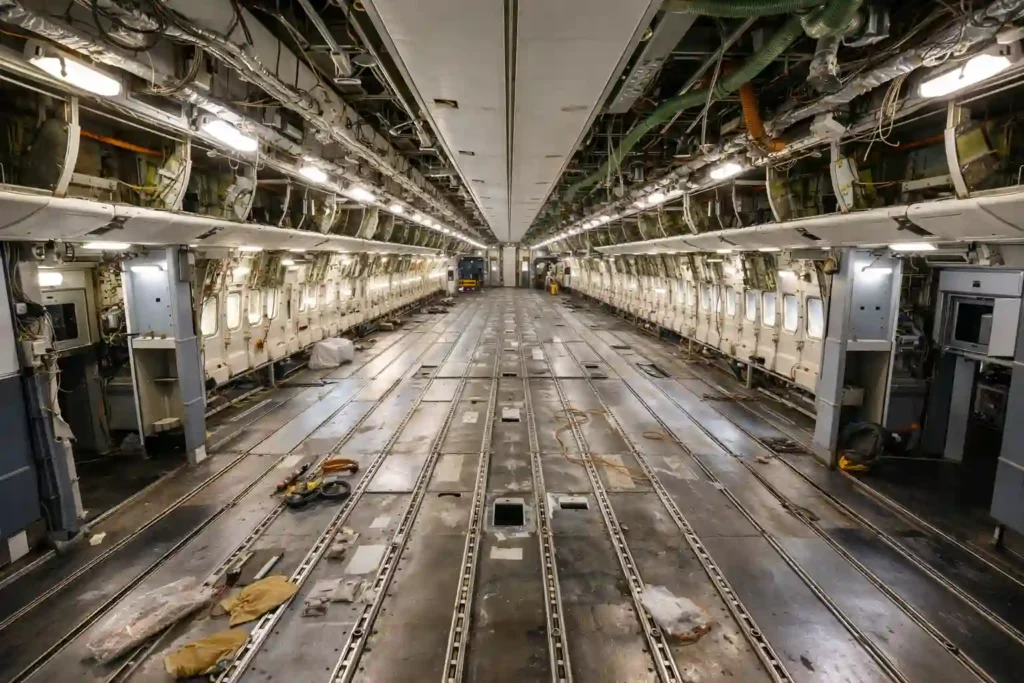
The de-configuration phase strips the aircraft to its skeletal structure:
- 450 passenger seats removed (50-75 lbs each)
- Miles of carpeting rolled up to expose structural floors
- Galleys, lavatories, and overhead bins disconnected and extracted
- Cockpit instrument panels removed to access avionics
- Exterior panels and engine cowlings detached in sequence
Within 72 hours, the $350 million aircraft looks more like an anatomical skeleton than a passenger transport. This is when the real detective work begins.
Phase 2: Deep Inspection with Non-Destructive Testing (Days 8-25)
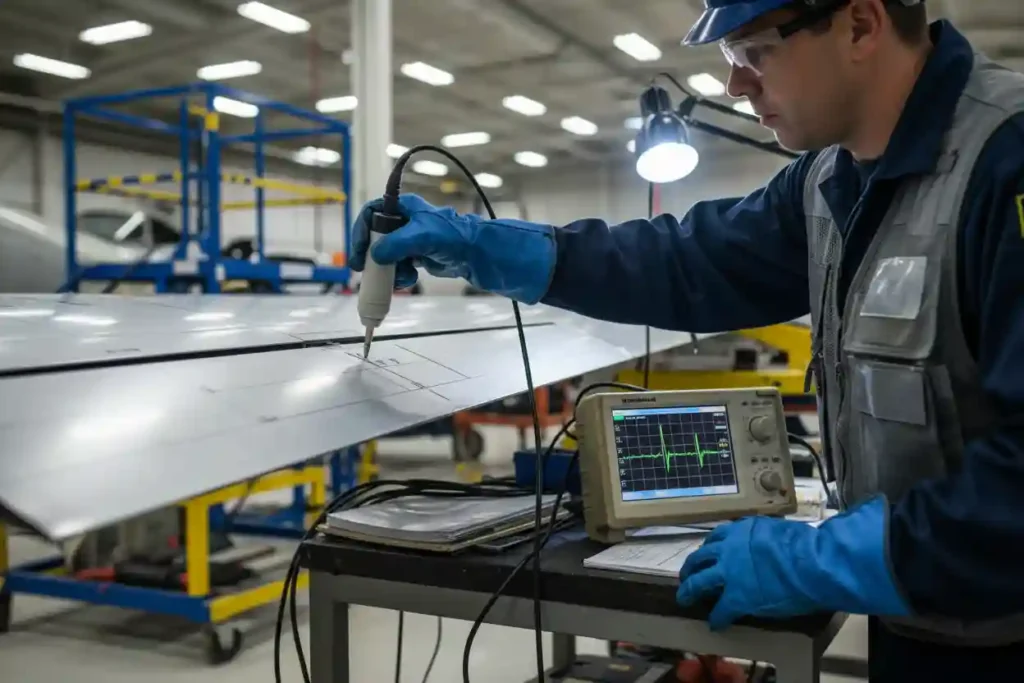
Modern aircraft inspection uses technology that would seem like science fiction to earlier generations of mechanics. Non-Destructive Testing (NDT) teams deploy with sophisticated equipment:
Ultrasonic Testing
High-frequency sound waves penetrate critical structures—wing spars, fuselage frames, bulkheads—detecting internal cracks measured in microns. These microscopic flaws, invisible to the naked eye, are precursors to catastrophic structural failure if left unaddressed.
Eddy Current Inspection
Electromagnetic fields scan aluminum skin around rivet holes and structural joints, identifying subsurface fatigue cracks before they propagate through the material.
Radiographic Imaging
Similar to medical X-rays, radiographic equipment images internal conditions in composite structures and critical load paths that can’t be accessed visually.
Borescope Inspection
Fiber-optic cameras snake through narrow cavities in wing boxes and engine interiors, allowing inspectors to see areas that haven’t been accessed since the aircraft left the factory.
🔧 Expert Insight: Wing Flex and Stress Concentrations
Aircraft wings flex upward several feet during flight, especially during turbulence and high-G maneuvers. This constant flexing creates stress concentrations at attachment points and rivet lines. During D-Checks, every inch of wing box structure undergoes scrutiny—a single crack extending beyond allowable limits triggers extensive structural engineering analysis.
The specialized tools and equipment used in these inspections represent millions of dollars in capital investment—another reason why US MRO facilities command premium pricing.
Phase 3: The Surgery—Repair and Replacement (Days 26-45)
Inspection inevitably reveals issues. Some are routine wear items; others require custom engineering solutions:
Structural Repairs
Cracks in fuselage frames require precision surgery: cutting out damaged sections and installing reinforcing doublers—additional aluminum plates that redistribute structural loads. These repairs follow meticulous engineering drawings approved by both the aircraft manufacturer and FAA.
The process demands old-school craftsmanship: technicians drill out damaged rivets using precision jigs, fabricate custom doublers in on-site sheet metal shops, then install them using solid rivets driven by pneumatic bucking guns. This fastening method hasn’t changed since the 1940s because nothing else matches its reliability.
Corrosion Treatment
Pressurization cycles cause fuselage expansion and contraction every flight, creating stress at door frames, window cutouts, and fuselage joints. Moisture accumulation in bilge areas, around lavatory drains, and near galley water lines creates corrosion that must be removed and treated.
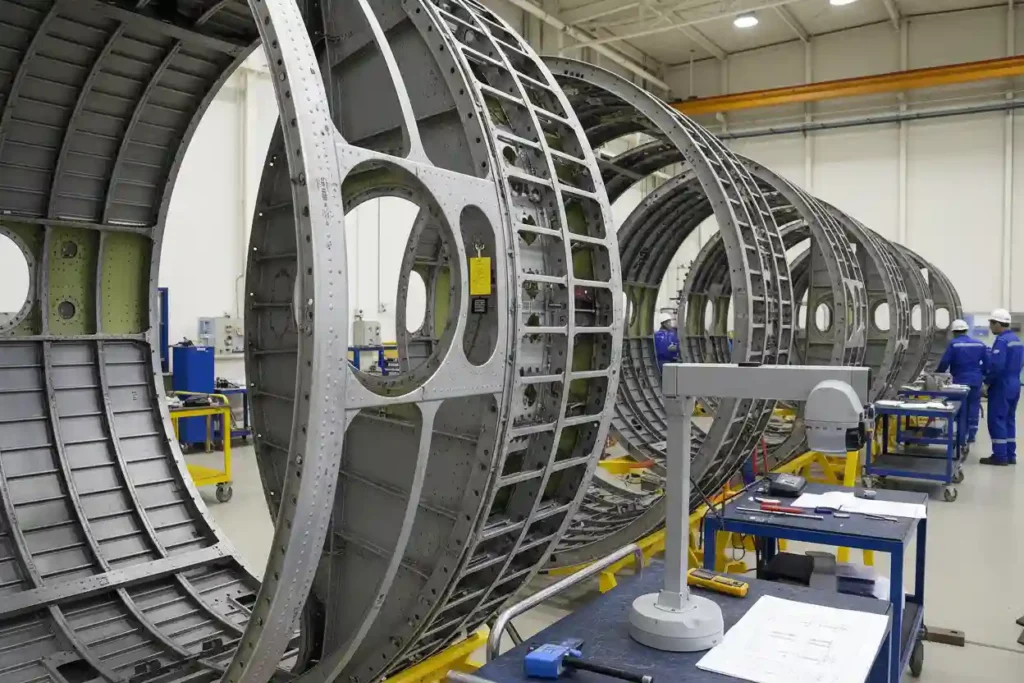
Engineers calculate remaining material thickness after corrosion removal, comparing measurements against minimum allowable specifications. Insufficient margins require custom-designed reinforcements.
Landing Gear Overhaul
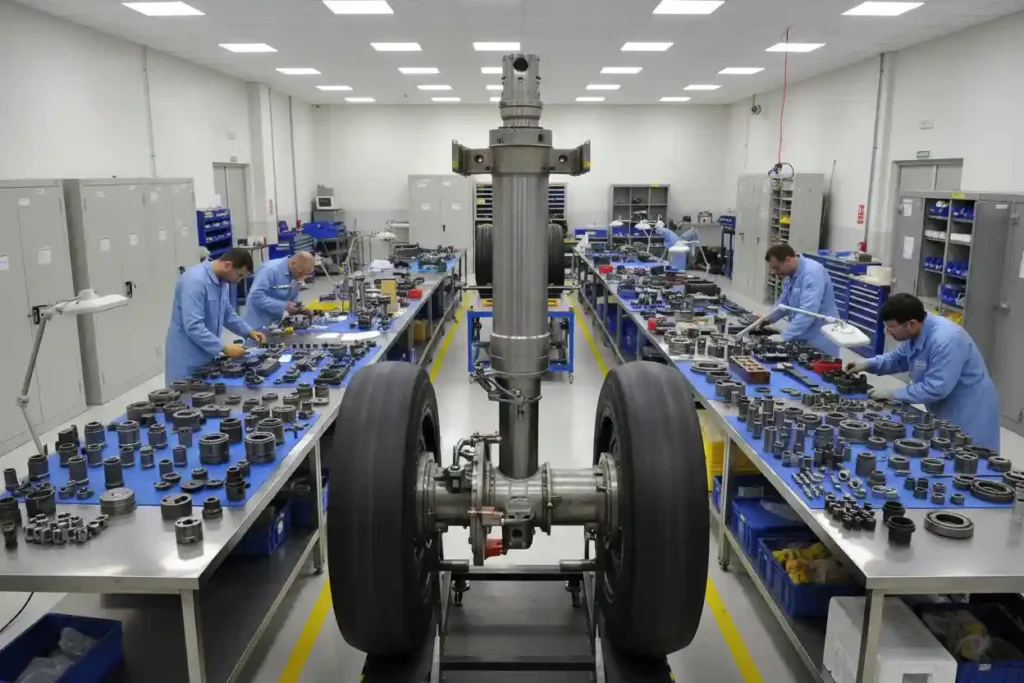
Landing gear assemblies absorb tremendous forces—a 500,000-lb aircraft touching down at 150 knots transfers shock loads that would destroy automotive suspensions instantly. Each strut is extracted and transported to specialized shops where:
- Hydraulic cylinders are completely disassembled
- Seals and precision bushings are measured for wear and replaced
- Brake assemblies come apart with heat-damaged components replaced
- Hydraulic systems are flushed and pressure-tested to aerospace standards
Systems Overhauls
Every major aircraft system undergoes comprehensive maintenance:
- Hydraulic systems: Drained, flushed, pressure-tested; every line inspected for chafing
- Environmental control: Air conditioning packs overhauled, bleed air valves tested
- Electrical systems: Wiring harnesses inspected for insulation brittleness, connectors cleaned
- Avionics: Black boxes undergo functional testing and software updates
Engine Work
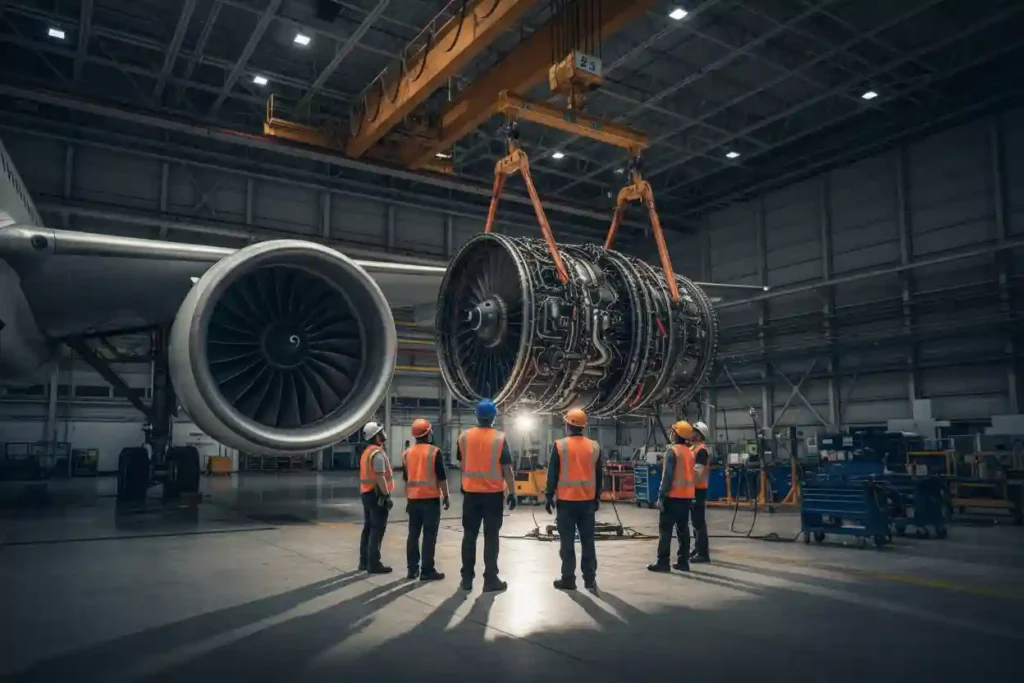
While complete engine overhauls typically occur on separate schedules, D-Checks include significant engine maintenance. Engines are removed using specialized hoists and transported to test cells for:
- Comprehensive performance testing
- Borescope inspections of combustion sections and turbine blades
- Identification of cracks, erosion, or foreign object damage
Major engine issues trigger shipment to dedicated overhaul facilities operated by manufacturers like GE Aviation or independent shops like StandardAero. Heavy engine shop visits for large turbofans easily exceed $5 million per engine.
Phase 4: Reassembly and Rebirth (Days 46-55)
After weeks of surgery, the aircraft is methodically rebuilt. Every component returns to precisely its original configuration—or improved if modifications have been incorporated.
Systems are reconnected incrementally with comprehensive testing at each stage:
- Hydraulic lines installed and pressure-tested for leaks
- Electrical connections made and continuity-verified
- Flight control surfaces reattached and rigged to specifications measured in fractions of degrees
- Engines reinstalled with mounting bolts torqued to exact specifications
- Cabin transformed from industrial workspace back to passenger accommodation
Validation Testing
Comprehensive functional testing verifies every system:
- Landing gear swing tests: Extension and retraction cycles
- Flight control checks: Surface movements commanded and measured
- Environmental system tests: Heating and cooling cycles
- Emergency systems: Oxygen, fire suppression, evacuation slides tested or replaced
Ground Runs and Taxi Tests
Engines run at full power while the aircraft remains chocked, allowing technicians to verify thrust output, vibration levels, and exhaust gas temperatures. High-speed taxi runs test brake systems under realistic conditions.
Functional Check Flight
A dedicated test flight with no passengers executes maneuvers across the aircraft’s performance envelope. Pilots verify that every system performs to manufacturer specifications. Only after this successful flight is the aircraft cleared for return to revenue service.
Fifty-five days after arrival, the aircraft lifts off from Mobile, bound for airline service. The transformation is complete—an aging airliner showing twelve years of hard service has been systematically restored to near-factory condition, ready for another 30,000 flight hours before its next D-Check.
Why US MRO Facilities Dominate Global Aircraft Maintenance
American maintenance facilities command premium pricing in the global market yet maintain strong international demand. What creates this competitive advantage?
1. Unmatched Experience and Institutional Knowledge
The United States operates the world’s largest and oldest commercial aviation industry. Facilities like Delta TechOps in Atlanta work on aircraft models spanning four decades, accumulating expertise with aging aircraft that newer aviation markets simply don’t possess.
This experience translates directly to efficiency: American facilities often complete D-Checks 10-15% faster than international competitors, reducing aircraft downtime and associated revenue losses—a critical factor for airlines operating on thin profit margins.
2. Regulatory Excellence: FAA Oversight
FAA oversight creates rigorous quality standards while providing flexibility for innovative maintenance approaches. American MRO facilities pioneered condition-based maintenance methodologies that optimize inspection intervals based on actual aircraft condition rather than arbitrary calendar schedules.
The FAA’s willingness to approve alternative compliance methods—when supported by engineering analysis and operational data—enables efficiency improvements impossible under more prescriptive international regulatory regimes.
3. State-of-the-Art Infrastructure
Modern US MRO facilities represent hundreds of millions in infrastructure investment:
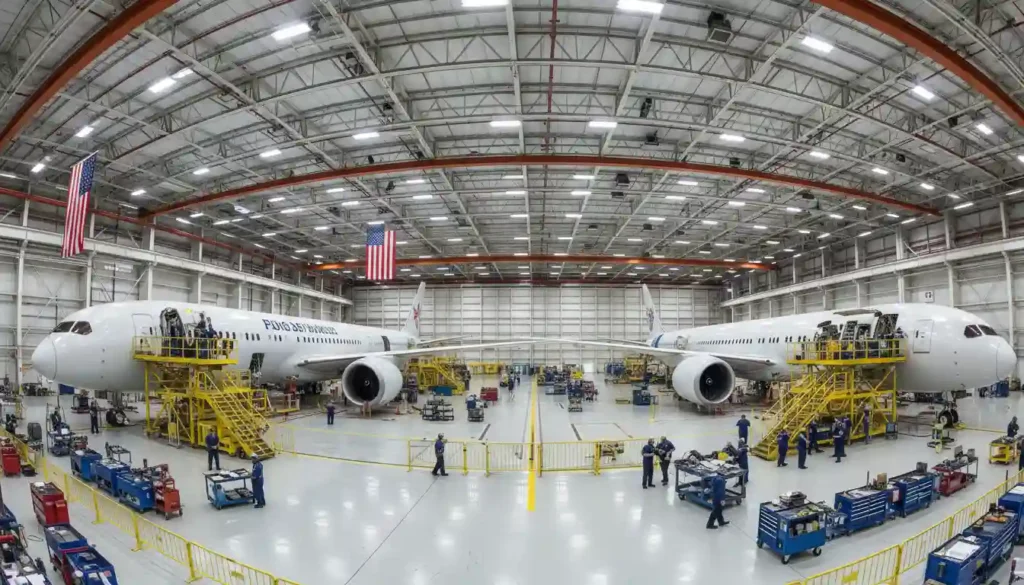
- Massive climate-controlled hangars: AAR Mobile spans 350,000+ sq ft under one roof, allowing multiple wide-body aircraft simultaneous maintenance
- Advanced material handling: Automated systems minimize time wasted searching for tools and parts
- Digital work packages: Computerized documentation ensures nothing gets missed
- Environmental control: Stable temperature/humidity critical for composite repairs and precision work
4. Superior Labor Force: A&P Mechanics
American A&P (Airframe and Powerplant) mechanics undergo extensive FAA-approved training combining classroom instruction with hands-on experience. Major MRO centers invest heavily in recurrent training, ensuring technicians stay current with evolving aircraft systems.
Many facilities actively recruit from military aviation backgrounds, leveraging the sophisticated training military technicians receive on cutting-edge aircraft systems. The result: a labor force capable of tackling complex challenges that inevitably arise during deep maintenance.
5. Aerospace Supply Chain Infrastructure
The concentration of aerospace suppliers in the United States means parts, materials, and specialized components are readily available. When an unexpected issue requires a custom-manufactured part, American facilities often source it within days rather than weeks.
This responsiveness minimizes delays that extend maintenance visits and compound costs. For airlines, schedule predictability is worth premium pricing.
6. Market Data: The Numbers Don’t Lie
According to Aviation Week’s annual MRO industry analysis, North American MRO facilities command premium pricing yet maintain strong global demand. The global aircraft MRO USA market exceeds $20 billion annually, with heavy maintenance representing the highest-margin segment.
📊 US MRO Market Dominance (2026):
- Total market value: $20+ billion annually
- Heavy maintenance share: 35-40% of total MRO revenue
- International customer base: 25-30% of work from foreign airlines
- Average D-Check completion: 10-15% faster than global average
🔍 Deep Dive: Want to understand the specialized tools and technologies that make this possible? Explore our comprehensive equipment guides.
D-Check vs C-Check: Understanding Aircraft Maintenance Levels
Airlines operate on a structured maintenance schedule with escalating inspection intensity:
A-Checks: Every 400-600 Flight Hours
- Duration: 10-20 hours (overnight)
- Cost: $6,000-10,000
- Scope: Visual inspections, fluid checks, minor repairs
B-Checks: Every 4-6 Months
- Duration: 1-3 days
- Cost: $50,000-150,000
- Scope: More detailed inspections, lubrication, operational tests
C-Checks: Every 18-24 Months
- Duration: 1-2 weeks
- Cost: $500,000-1.5 million
- Scope: Detailed structural inspections, panel removal, system testing
- Components: Some interior panels removed, specific areas inspected thoroughly
D-Checks (Heavy Maintenance Visits): Every 6-10 Years
- Duration: 45-60 days
- Cost: $5-10 million (wide-body), $2-4 million (narrow-body)
- Scope: Near-complete disassembly, every component inspected
- Components: Cabin stripped, skin panels removed, landing gear extracted, engines potentially removed
Think of the difference this way: C-Checks are detailed examinations; D-Checks are complete anatomical dissections and restorations. A C-Check mechanic might remove access panels; a D-Check team removes entire sections of fuselage skin.
Cost Management: Why Airlines Can’t Avoid Heavy Maintenance
Some airlines explore lower-cost international MRO facilities in Asia, Latin America, or Eastern Europe where labor rates run 30-50% below US facilities. However, this creates significant tradeoffs:
The True Cost Equation
| Factor | US MRO Facility | Lower-Cost International |
|---|---|---|
| Direct Labor Cost | Higher (baseline) | 30-50% lower |
| Ferry Flight Cost | Minimal (domestic) | $50,000-150,000+ (long-distance fuel burn) |
| Completion Time | 45-55 days (faster) | 55-70 days (slower average) |
| Quality Assurance | FAA oversight, proven standards | Variable (some excellent, some with compliance issues) |
| Communication | Same time zone, language | Time zone challenges, potential language barriers |
| Oversight Access | Easy airline engineer visits | Expensive travel, less frequent oversight |
Why Major US Airlines Choose Domestic MRO
Major carriers like American Airlines, Delta, and United Airlines generally prefer domestic facilities despite higher costs, valuing:
- Quality assurance: Consistent standards and regulatory alignment
- Faster turnaround: 10-15% time savings = millions in recovered revenue
- Easier oversight: Engineering teams can visit facilities within hours
- Supply chain access: Critical parts available quickly
- Regulatory certainty: FAA-certified work accepted worldwide
Interestingly, foreign carriers frequently choose US MRO facilities for the opposite reason: accessing superior technical capabilities justifies premium pricing. The global aircraft MRO USA market’s strength despite higher labor costs proves that quality and efficiency often outweigh pure cost considerations.
The Economics: Does Heavy Maintenance Make Financial Sense?
Airlines face a stark economic choice every D-Check cycle:
Option 1: Invest in Heavy Maintenance
- Cost: $5-10 million (wide-body D-Check)
- Result: Aircraft extended 5-7 years of service life
- Additional flight hours: 25,000-35,000 hours before retirement or next D-Check
Option 2: Retire and Replace
- Cost: $150-200+ million for new wide-body aircraft
- Financing: $8-12 million annual debt service over 12-15 years
- Delivery timeline: 2-5 years (current Boeing/Airbus backlogs)
The ROI Calculation
For most airlines, the mathematics strongly favor heavy maintenance investment:
- D-Check at $8 million extends aircraft life 6 years
- New replacement costs $180 million with 3-year delivery wait
- Aircraft continues generating $15-25 million annual revenue during extended service
Result: Heavy maintenance delivers compelling ROI despite short-term revenue losses. Only when an aircraft approaches 25-30 years of age—and has undergone 3-4 D-Checks already—does retirement become economically preferable to another maintenance cycle.
Safety Foundation: Why Heavy Maintenance Makes Aviation the Safest Transportation
The heavy maintenance infrastructure represents the invisible foundation of aviation safety. Commercial aviation is statistically the safest form of transportation humanity has ever created—and systematic heavy maintenance is a primary reason why.
✈️ Aviation Safety by the Numbers:
- Fatal accident rate (US commercial aviation): 0.02 per million departures
- Comparison to automotive travel: Flying is 100x safer per mile traveled
- Structural failures prevented: Thousands of microscopic cracks detected and repaired annually before they become critical
Source: National Transportation Safety Board (NTSB)
Every D-Check cycle:
- Detects and repairs microscopic cracks before they propagate to critical size
- Identifies and treats corrosion before it compromises structural integrity
- Replaces wear-limited components before they reach failure thresholds
- Validates that every safety-critical system operates within specifications
The traveling public benefits from this invisible infrastructure every time they board an aircraft. That “old” Boeing 737 might be fifteen years old, but after multiple heavy maintenance cycles, its structural condition rivals a newly-manufactured aircraft.
Frequently Asked Questions: Aircraft Heavy Maintenance Costs & Process
How much does aircraft heavy maintenance cost in 2026?
Heavy maintenance (D-Check) costs vary by aircraft size:
- Narrow-body aircraft (Boeing 737, Airbus A320): $2-4 million
- Wide-body aircraft (Boeing 777, 787, Airbus A350): $5-10 million
- Legacy wide-bodies (Boeing 747-400): $8-12 million
These costs cover labor, parts, materials, and facility charges but exclude major unplanned repairs. Engine overhauls, often performed separately, add $3-6 million per engine for large turbofans. Total lifecycle maintenance costs average $1,500-2,500 per flight hour—a major operating expense second only to fuel and labor costs.
How long does a D-Check take?
Aircraft D-Checks typically require 45-60 days of intensive work operating 24/7 in shifts. The duration reflects both the massive volume of work and the sequential nature of inspection-and-repair processes:
- Disassembly: 7-10 days to methodically document and remove thousands of components
- Inspection: 15-20 days using Non-Destructive Testing techniques that can’t be rushed
- Repair engineering: Variable timeline—unexpected issues require custom solutions
- Reassembly: 15-20 days following precise sequences
- Testing: 3-5 days of incremental system validation
Many factors affect duration: aircraft age (older = more corrosion/fatigue), findings during inspection, parts availability, and facility workload. While facilities work continuously to improve efficiency, aircraft complexity and safety requirements impose practical speed limits. Rushing D-Checks risks missing critical defects—an unacceptable outcome given safety implications.
What’s the difference between C-Check and D-Check maintenance?
C-Checks and D-Checks represent different maintenance intensity levels:
C-Check (Intermediate Maintenance):
- Frequency: Every 18-24 months (6,000-8,000 flight hours)
- Duration: 1-2 weeks
- Cost: $500,000-1.5 million
- Scope: Detailed inspections of specific areas, some panel removal, required tests
- Aircraft state: Partially disassembled, interior mostly intact
D-Check (Heavy Maintenance Visit/HMV):
- Frequency: Every 6-10 years (30,000-40,000 flight hours)
- Duration: 45-60 days
- Cost: $5-10 million (wide-body), $2-4 million (narrow-body)
- Scope: Near-complete disassembly, comprehensive structural inspection
- Aircraft state: Stripped to skeleton—cabin interior removed, large skin panels off, landing gear extracted
Think of C-Checks as detailed examinations; D-Checks are complete anatomical dissections and restorations. C-Check mechanics might remove access panels for specific inspections; D-Check teams remove entire fuselage sections to expose underlying frame structures. D-Checks cost 5-10x more and take 4-8x longer than C-Checks.
Do airlines lose money when aircraft undergo heavy maintenance?
Yes, significantly. An aircraft grounded for D-Check generates zero revenue while incurring substantial costs:
Direct revenue loss:
- Wide-body aircraft typically generates $40,000-60,000 daily revenue
- Over 55-day D-Check: $2.2-3.3 million in lost revenue
- Plus $5-10 million in direct maintenance costs
- Total economic impact: $7.2-13.3 million per D-Check cycle
Airlines partially mitigate losses through:
- Strategic timing: Scheduling maintenance during seasonal low-demand periods (post-holiday, mid-fall)
- Fleet planning: Maintaining spare aircraft ratios specifically to cover maintenance downtime
- Advance coordination: Planning D-Check schedules 2-3 years ahead to avoid having multiple aircraft down simultaneously
- Route rebalancing: Adjusting network to minimize impact on high-revenue routes
Despite these strategies, heavy maintenance represents major financial impact. However, the alternative—aircraft retirement and replacement—costs $150-200+ million per new wide-body. D-Checks extending service life by 5-7 years deliver compelling ROI despite short-term revenue losses. For airlines, it’s not about avoiding the cost; it’s about managing the inevitable expense strategically.
Can airlines avoid heavy maintenance or use cheaper overseas facilities?
Heavy maintenance cannot be avoided—it’s legally mandated. Aircraft that don’t undergo required D-Checks lose their Certificate of Airworthiness and literally cannot legally fly in commercial service. Airlines can’t “skip” this maintenance any more than structural engineers can skip building inspections.
Regarding overseas alternatives: Some airlines do send aircraft to lower-cost international MRO facilities in Asia, Latin America, or Eastern Europe where labor rates run 30-50% below US facilities. However, this creates tradeoffs:
Potential cost savings:
- Labor rates: 30-50% lower in some international markets
- Facility overhead: Sometimes lower in developing aviation markets
Offsetting costs and risks:
- Ferry flights: $50,000-150,000+ in fuel costs to transport aircraft long distances
- Extended timelines: International facilities often take 55-70 days vs. 45-55 days domestically (10-15% longer)
- Quality variability: While many international facilities maintain excellent standards, others have faced FAA findings regarding training or procedural compliance
- Communication challenges: Time zone differences and potential language barriers complicate coordination
- Oversight difficulty: Expensive travel for airline engineers to conduct site visits
- Supply chain delays: Critical parts may take longer to source in some international locations
Why major US airlines generally choose domestic MRO: Despite higher labor costs, they value quality assurance, regulatory alignment, faster turnaround times (10-15% time savings = millions in recovered revenue), and easier oversight. Foreign carriers frequently choose US MRO facilities for opposite reasons—accessing superior technical capabilities and FAA-certified work justifies premium pricing.
The global aircraft MRO USA market exceeds $20 billion annually despite higher costs, suggesting quality and efficiency often outweigh pure cost considerations for heavy maintenance decisions. It’s not just about finding the cheapest option; it’s about total cost of ownership, schedule reliability, and safety assurance.
The Future of Aircraft Heavy Maintenance: Technology and Innovation
The heavy maintenance industry continues evolving with technological advances:
Emerging Technologies in MRO
- Artificial Intelligence diagnostics: Machine learning algorithms analyzing flight data to predict component failures before they occur
- Augmented Reality (AR): Technicians wearing AR glasses overlay digital work instructions directly onto aircraft components
- Advanced materials: New composite repair techniques extending structural service lives
- Robotics: Automated systems performing repetitive inspection tasks with greater consistency
- Digital twins: Virtual aircraft models tracking every component’s history and condition
According to Oliver Wyman’s MRO forecast, the global maintenance market will grow from $90 billion (2024) to $125 billion (2034), with North American facilities maintaining market leadership through technological innovation.
Conclusion: The Invisible Infrastructure Keeping Aviation Safe
The next time you board a commercial aircraft, remember: that plane has undergone multiple heavy maintenance visits costing millions of dollars each. Teams of 200+ highly specialized technicians have disassembled, inspected, repaired, and rebuilt virtually every component to ensure your safety.
This invisible infrastructure—the $20+ billion US MRO industry—represents one of America’s quiet industrial advantages. While aircraft manufacturing gets headlines, the sophisticated capability to extend aircraft service lives decades beyond original design parameters through systematic heavy maintenance enables the economic viability of modern air travel.
The $100 million checkup isn’t just an expense; it’s the foundation of aviation safety and the reason commercial flying remains statistically the safest form of transportation humanity has ever created.
📚 Explore More Aviation Maintenance Insights
Aviation Titans brings you inside the technical realities of aviation maintenance, exploring the engineering excellence and skilled craftsmanship that keep global aviation safe.
- ➡️ Aircraft Maintenance Hub – Comprehensive guides to routine checks, emergency repairs, and preventive strategies
- ➡️ Tools & Gear – Deep dives into specialized equipment used in heavy maintenance
- ➡️ Latest Aviation Industry News – Stay current with MRO industry developments and technology advances

Senior NDT Controller with over 20 years of experience in aviation (FAA, EASA, and NRCAN certified). Expert in aircraft maintenance, non-destructive testing (NDT), and pilot training. I share practical, up-to-date 2026 guides for pilots and aviation maintenance technicians.