Introduction: Making the Invisible Visible
In the high-stakes arena of aviation maintenance, a crack the width of a human hair can lead to catastrophic structural failure. While visual inspections are the first line of defense, the human eye has limits. This is where Non-Destructive Testing (NDT) takes over, and for ferromagnetic materials (iron, steel, cobalt), the king of inspection is Magnetic Particle Inspection (MPI).
MPI is not a simple visual check; it is a physics-based process that requires a specific suite of sophisticated Magnetic Particle Inspection equipment. The principle is elegant: magnetize a steel part, and if there is a crack, the magnetic field will leak out of the defect like water from a punctured hose. By applying iron particles to the surface, those particles gather at the “leak,” effectively drawing a high-contrast line right over the crack.
For the Aviation Maintenance Technician, mastering MPI tools—from massive stationary benches to handheld electromagnetic yokes—is a critical skill. This guide explores the complete ecosystem of Magnetic Particle Inspection equipment required to set up a compliant NDT line in 2026.
The Heart of the Shop: The Wet Horizontal Bench
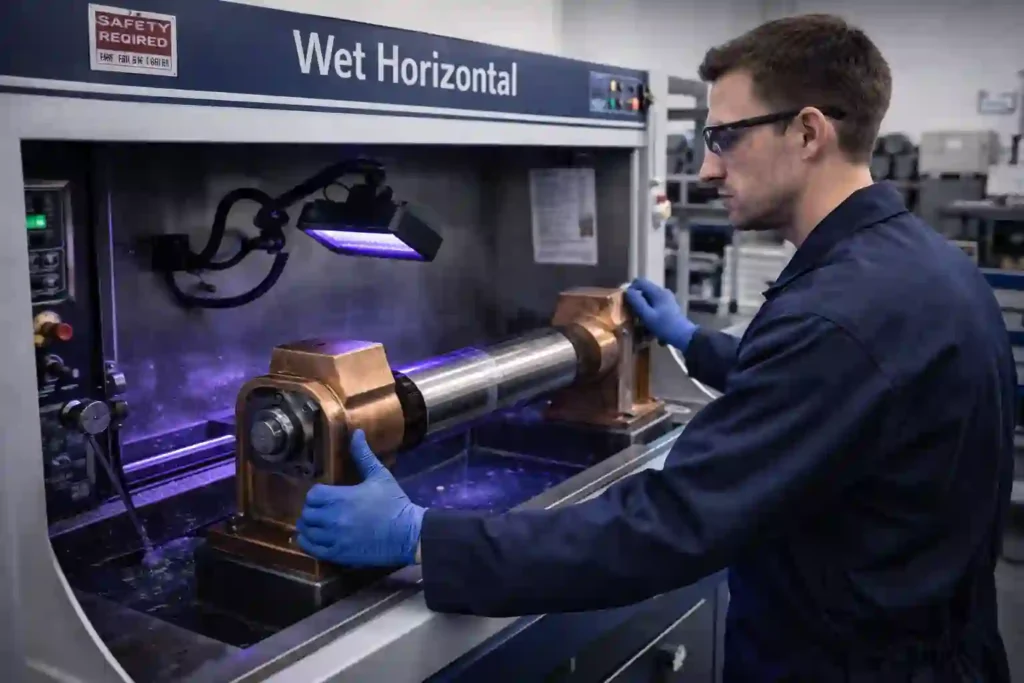
When people talk about an MPI “installation,” they are usually referring to the Wet Horizontal Bench. This is the centerpiece of any Aircraft MRO NDT department. It is a heavy-duty, stationary machine designed to inspect large components like landing gear struts, crankshafts, and engine bolts.
1. The Headstock and Tailstock
The bench functions like a giant lathe. The part is clamped between two electrical contact pads (the Headstock and Tailstock).
- Function: High-amperage low-voltage current (often 1,000 to 5,000 Amps) is shot directly through the part.
- Circular Magnetization: This “Head Shot” creates a circular magnetic field around the part, which is perfect for detecting longitudinal cracks (cracks running lengthwise).
2. The Coil (The “5-Turn” Loop)
Every bench features a large copper coil that can slide along the length of the machine.
- Function: Current is passed through the coil, not the part.
- Longitudinal Magnetization: This “Coil Shot” creates a magnetic field running through the part, which is used to detect transverse cracks (cracks running across the width).
3. The Bath (Recirculation System)
This is why it is called a “Wet” bench. The machine features a built-in reservoir, pump, and hose nozzle. It continuously floods the part with a liquid carrier (usually an oil base like kerosene) containing suspended magnetic particles.
- Why Wet? The liquid allows the particles to float freely and migrate quickly to the crack before the magnetic pulse ends.
Portable Tools: Taking the Lab to the Wing
You cannot put an entire Boeing 737 wing into a bench. For on-wing inspections, technicians use portable Magnetic Particle Inspection equipment.
1. The Electromagnetic Yoke (The “Contour Probe”)
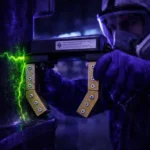
This is the most common portable tool. It looks like a large “C” or a horseshoe magnet with articulating legs.
- AC vs. DC: Most aviation yokes (like the Parker B-100) operate on AC power. AC current creates a “skin effect,” concentrating the magnetism on the surface, which provides maximum sensitivity for surface cracks.
- Usage: The technician places the legs on either side of the weld or area of interest, activates the switch, and puffs dry powder or sprays wet ink onto the area.
2. Permanent Magnets
In hazardous environments (like inside a fuel tank) where a spark from an electric switch could cause an explosion, technicians use strong permanent magnets. However, these are less effective than electromagnetic yokes and require strict “lift tests” to ensure they still have enough pull force (usually 40 lbs).
3. Prods
These are handheld copper electrodes connected to a portable power pack. They are pressed against the metal to pass current directly through a localized area.
- Warning: Prods are rarely used on finished aviation parts because if the contact is poor, they can cause “arc burns,” damaging the surface. This is a form of maintenance-induced damage similar to Foreign Object Debris (FOD) in its potential for harm.
Consumables: The “Ink” and Lights
Magnetic Particle Inspection equipment is useless without the media to visualize the defects.
1. The Particles (The “Mag” in MPI)
- Fluorescent (Wet): Used for 95% of aviation parts. These particles are coated in a pigment that glows bright yellow-green under UV light. They offer the highest sensitivity (1000:1 contrast ratio).
- Visible (Dry/Wet): usually black or red particles used under white light. These are common for field inspections on welds (like hangar door tracks) but are rarely used on critical engine components due to lower sensitivity.
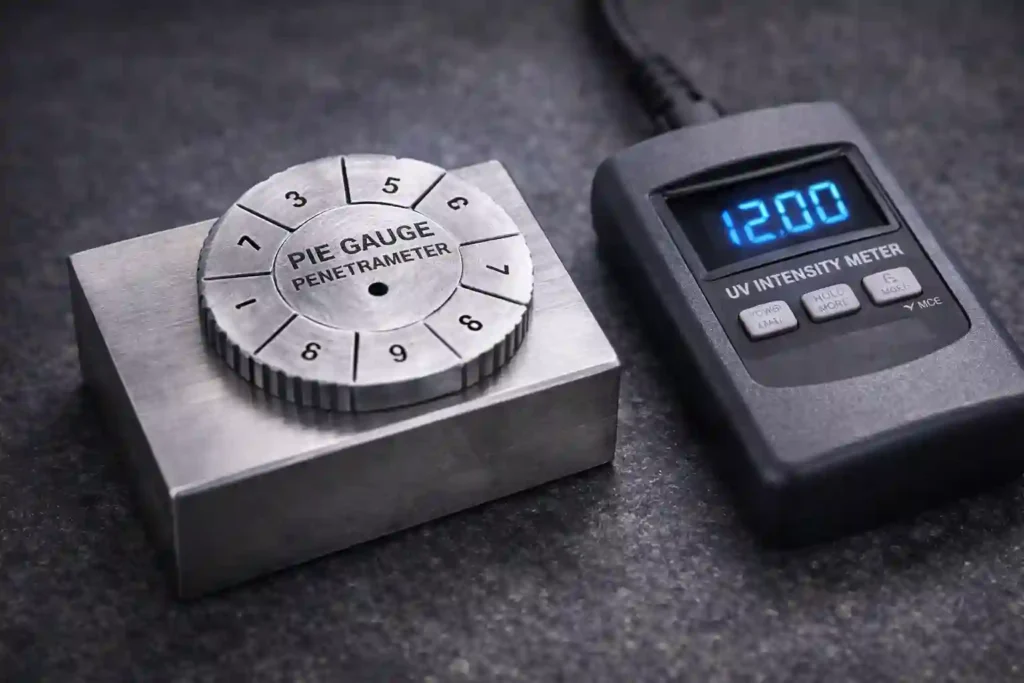
2. UV-A Lights (Black Lights)
For fluorescent inspection, the lighting conditions are strictly regulated by ASTM International (specifically ASTM E1444).
- The Shift to LED: Old mercury-vapor lights are obsolete. Modern Magnetic Particle Inspection equipment uses high-intensity UV-A LED lamps.
- Intensity: The light must deliver at least 1,000 µW/cm² at the inspection surface, while the ambient visible light must be less than 2 foot-candles (absolute darkness).
3. The Carrier Fluid
The liquid that carries the particles must be carefully chosen. It usually has a slight odor and an oily texture. It must have the correct viscosity (thickness) and a high flash point to prevent fires in the shop.
Quality Control Tools: Verifying the System
In aviation, you never assume the machine is working. You prove it. A specific set of Magnetic Particle Inspection equipment exists solely for calibration.
1. The Ketos Ring
This is a heavy steel ring with pre-drilled holes at various depths. It is clamped into the bench. The technician runs a current and checks how many holes are visible via particle indication. This proves the machine’s ability to find subsurface defects.
2. The Pie Gauge
Used primarily with yokes. It looks like a pizza cut into slices, made of highly permeable material. It is placed on the part to verify that the magnetic field is oriented correctly (at 90 degrees to the expected crack).
3. The Centrifuge Tube (Goetz Pear Shape)
How do you know if there are enough magnetic particles in your liquid bath? You fill this pear-shaped glass tube with 100ml of the bath and let it settle for 30 minutes. You then read the volume of solid particles at the bottom.
- The Standard: Usually between 0.1 to 0.4 ml of particles per 100 ml of fluid. Too little = missed cracks. Too much = messy background (noise).
4. Residual Field Indicators (Gauss Meter)
After inspection, the part must be demagnetized. A magnetized gear will attract metal filings, leading to rapid wear. A Gauss Meter is a small tool used to measure the residual magnetism. The industry standard usually requires the part to be below 3 Gauss.
The Process: Step-by-Step
Using this Magnetic Particle Inspection equipment follows a rigid sequence:
- Pre-Cleaning: The part must be stripped of paint and grease.
- Magnetization: The operator applies the current (Head or Coil shot).
- Application: While the current is flowing (continuous method), the bath is sprayed over the part.
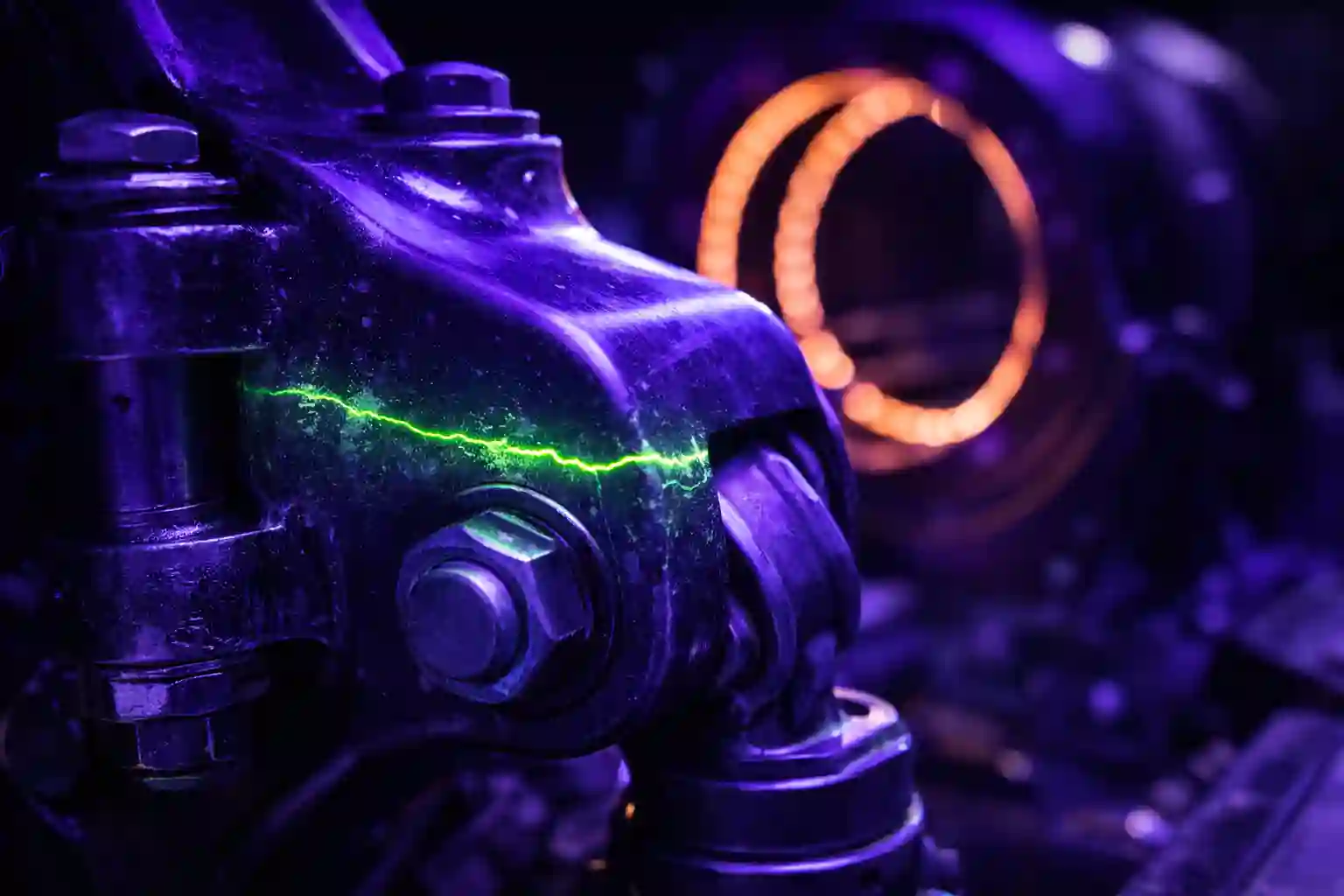
- Inspection: The operator scans the part under UV light, looking for the tell-tale green line.
- Demagnetization: The part is passed through a coil with decaying AC current to scramble the magnetic domains.
- Post-Cleaning: The oil and particles are washed off to prevent corrosion.
Conclusion: The Gatekeepers of Integrity
Investing in high-quality Magnetic Particle Inspection equipment is an investment in certainty. Whether it is a wet bench capable of delivering 6,000 amps or a simple handheld yoke, these tools allow technicians to see what the naked eye cannot.
However, MPI has a major limitation: it only works on ferromagnetic materials. It cannot inspect aluminum wings or titanium turbine blades. For those tasks, technicians must rely on other methods like Liquid Penetrant or the visual aids detailed in our Borescope Inspection Guide.
Ultimately, the goal of every NDT tool is the same: to ensure that when an aircraft takes off, its structure is as sound as the day it left the factory.
Frequently Asked Questions (FAQ)
1. What materials can be tested with MPI equipment? MPI only works on ferromagnetic materials—metals that can be magnetized. This includes iron, steel, nickel, and cobalt. It cannot generally be used on aluminum, copper, or titanium aircraft parts.
2. What is the difference between AC and DC yokes? AC (Alternating Current) yokes are best for detecting surface cracks because the current travels on the “skin” of the metal. DC (Direct Current) yokes penetrate deeper and are better for finding subsurface defects, though they are harder to use.
3. Why is a UV light required? Most aviation inspections use particles coated in fluorescent dye. The UV (Black) light excites the dye, causing it to glow bright green. This provides a high contrast against the dark metal, making tiny cracks easy for the Aviation Maintenance Technician to see.
4. How often must MPI equipment be calibrated? Calibration schedules are strict. The amperage output of the bench is usually checked every 6 months (or 90 days depending on the audit standard). Light intensity and bath concentration are checked daily before every shift.
5. Who certifies the NDT tools? The tools must meet standards set by organizations like the American Society for Nondestructive Testing (ASNT). The calibration itself must be traceable to a national standard (like NIST).

Senior NDT Controller with over 20 years of experience in aviation (FAA, EASA, and NRCAN certified). Expert in aircraft maintenance, non-destructive testing (NDT), and pilot training. I share practical, up-to-date 2026 guides for pilots and aviation maintenance technicians.