In the high-pressure world of line maintenance, the clock is the ultimate adversary. When a tail number is sitting at the gate, the temptation of shotgunning parts becomes almost irresistible. While shotgunning might seem like a shortcut to a quick departure, it is actually a primary driver of technical debt.
But as any seasoned technician or Non-Destructive Testing (NDT) inspector will tell you, hope is not a sub-component of airworthiness.
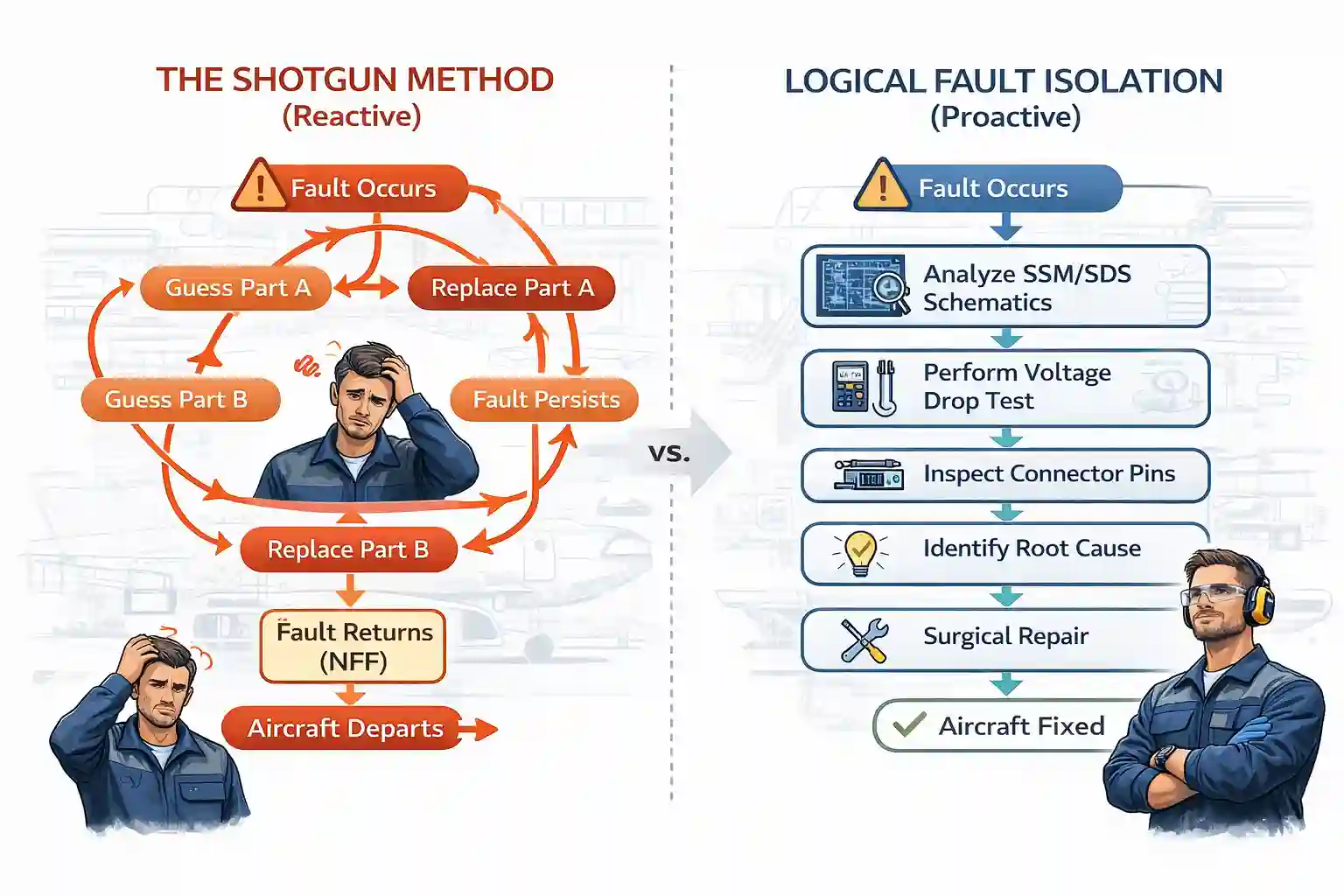
“Shotgunning”—the practice of replacing parts based on a guess rather than a diagnosis—might get a plane off the gate today, but it creates a cycle of inefficiency that erodes safety, drains company resources, and ultimately kills the professional growth of the mechanic. To transition from a “part-swapper” to a true Aviation Titan, one must master the art of precision troubleshooting.
1. Defining the “Shotgun” Philosophy
In aviation maintenance, shotgunning refers to the practice of replacing multiple components in a circuit or system simultaneously without confirming which one actually failed. It is a “scattershot” approach where the technician hopes that by replacing enough variables, the root cause will be accidentally removed.
The Commercial Pressure
Most mechanics don’t shotgun because they are lazy. They do it because of systemic pressure. Airlines operate on razor-thin margins where a delay or cancellation can cost upwards of $50,000. In that context, a $2,000 Line Replaceable Unit (LRU) is seen as a cheap “sacrifice” to keep the schedule moving. However, this is a short-sighted perspective that ignores the long-term technical debt created by poor diagnostics.
The Fault Isolation Manual (FIM) Trap
Ironically, the Fault Isolation Manual (FIM) can sometimes be the technician’s worst enemy. Many FIMs are designed as binary logic trees. If a basic wire check shows continuity, the very next step is often: “Replace Component A. If fault persists, replace Component B.” This rigid logic ignores the nuanced realities of aging airframes, such as pin tension, environmental corrosion, and intermittent thermal expansion—the “ghosts” that manuals rarely account for.
2. The Hidden Cost: The “No Fault Found” (NFF) Epidemic
When you shotgun parts, you aren’t just solving a problem; you are poisoning the aviation supply chain. This leads to a massive industry-wide issue known as No Fault Found (NFF).
The Logistics Nightmare
When a component is removed from an aircraft and sent to a repair shop, it undergoes a bench test. If the technician on the line shotgunned the part and the real issue was actually a chafed wire or a corroded ground, the component will pass the bench test. This part then goes back into the “serviceable” pool.
- The Recirculation of Faults: Often, these NFF parts are re-installed on another aircraft, only to fail again because they might have an intermittent internal fault that only appears under flight vibrations.
- Every time a technician resorts to shotgunning, they are essentially gambling with the airline’s supply chain. The high cost of shotgunning is most visible in the ‘No Fault Found’ (NFF) rates. When shotgunning becomes the standard operating procedure, logistics costs skyrocket because perfectly good components are being cycled through repair shops unnecessarily.
- The “Bad Out of the Box” Risk: By shotgunning, you introduce new variables. If you replace a perfectly good part with a “new” part that happens to be defective (it happens more than you’d think), you will wrongly assume your original diagnosis was correct, leading you further down a rabbit hole of confusion.
3. The NDT Connection: Finding the Invisible Failure
The debate between shotgunning and troubleshooting is a mirror image of the debate between Visual Inspection and NDT (Non-Destructive Testing). As we’ve discussed regarding Cessna wing strut attachment points, a visual check often misses what a specialized tool finds instantly.
“Visual” Troubleshooting is Just a Guess
In structural maintenance, we know that a “visual-only” inspection on a high-cycle airframe is often insufficient. A hairline crack can hide beneath paint or inside a clevis, invisible to a flashlight but glowing like a lightning bolt under Fluorescent Penetrant Inspection (FPI).
Electrical and system troubleshooting is no different. A wire that “looks fine” and passes a simple continuity test may have an “invisible” failure:
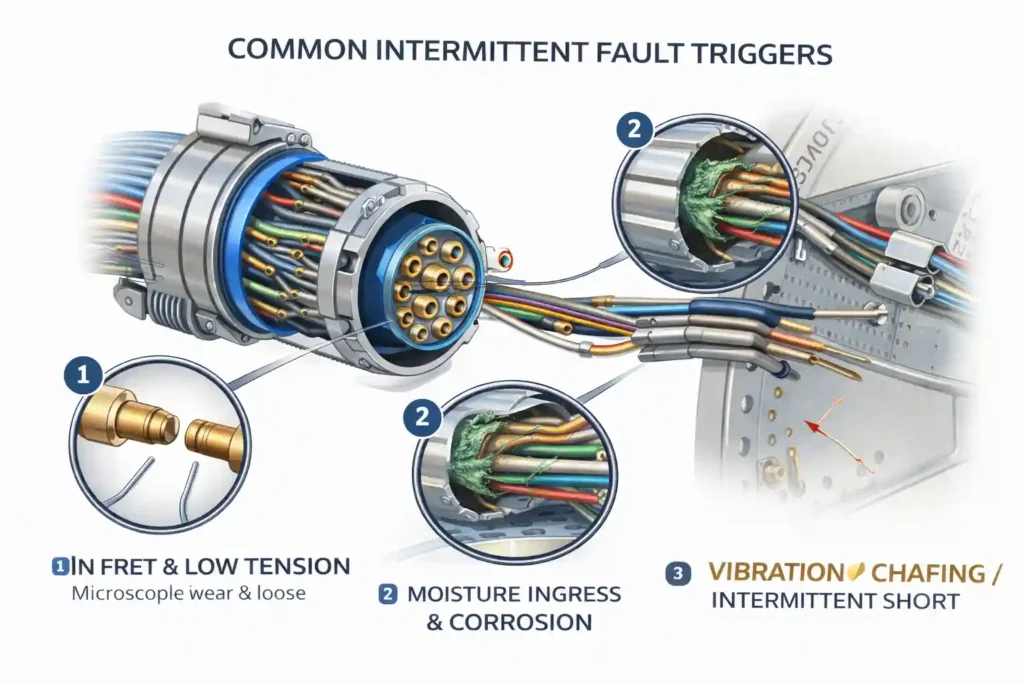
- Pin Fret: Microscopic wear on the surface of a connector pin that causes intermittent signals.
- Thermal Expansion: A circuit that works in a 70°F hangar but fails at altitude where the temperature drops, causing metals to contract and connections to break.
True troubleshooting is the NDT of the electrical world. It requires looking beyond what is visible to the naked eye.
4. Masterclass: Elite Electrical Diagnosis Tips
To move past the shotgun method, a technician must develop a “sixth sense” for electricity. This begins by using tools that reveal the truth rather than just a “beep” on a multimeter.
A. The Power of the Voltage Drop Test
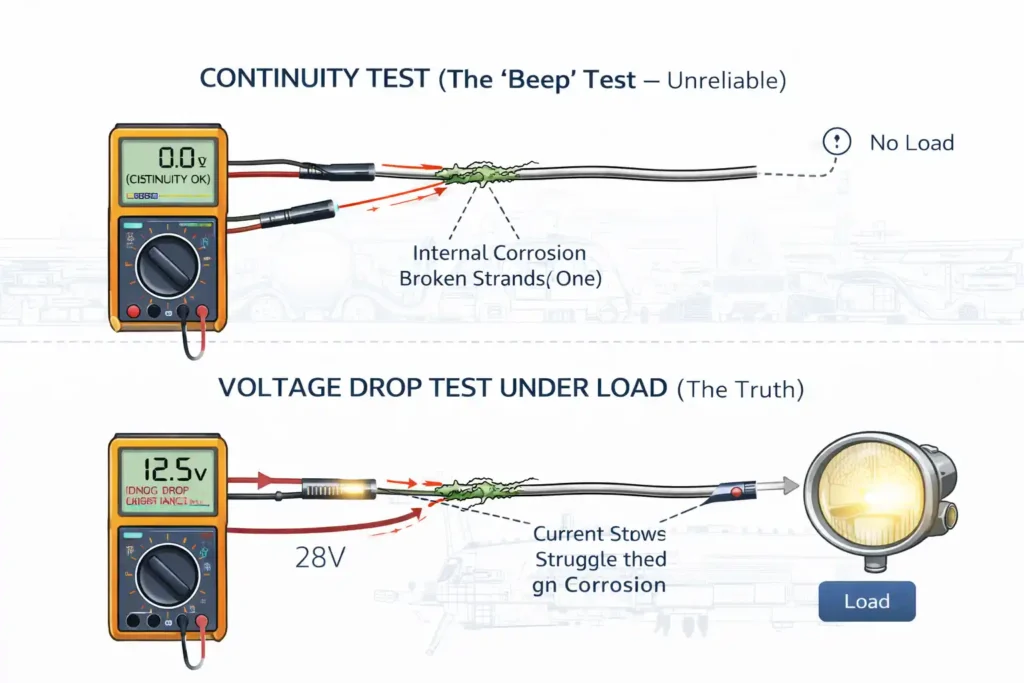
If there is one technique that separates the titans from the monkeys, it is the Voltage Drop Test. Many junior techs rely on Continuity Checks (the “beep” test). However, continuity can be a lie. A single strand of copper in a 10-gauge wire can provide enough continuity to trigger a multimeter’s buzzer, but it cannot carry the 20 amps required to move a landing gear actuator or a flap motor.
- The Technique: Measure the voltage at the component while the circuit is under load. If you see a significant drop between the power source and the load, you have found high resistance. This points to the “hidden crack” in your electrical system—usually a corroded terminal or a frayed wire.
B. Pin Tension: The Silent Intermittent Killer
Intermittent faults, like the tail nav light on a CRJ700 that fails 30 minutes into a flight, are rarely caused by a dead bulb. They are caused by physical connection issues.
- The Sacrificial Pin Test: Always check for pin tension. If a socket has lost its “spring,” the connection will break under the slightest vibration or thermal change. This is a physical failure that no software reset will ever fix.
C. The Ground Path: The Most Overlooked “Part”
In aviation, the airframe is the return path for almost every circuit. On aging aircraft—from 50-year-old Cessnas to early-generation jets—the ground points are susceptible to corrosion.
- The Tip: Don’t just check for power. Use your meter to check the resistance between the component’s ground and the actual battery negative. A difference of even 0.5 ohms is enough to trigger a “Fault” message on a modern digital flight deck.
5. Troubleshooting as an Art: FIM vs. SSM vs. SDS
A true Aviation Titan knows that the Fault Isolation Manual (FIM) is just a starting point. To truly master the aircraft, you must dive into the:
- System Description Section (SDS): This tells you how the system is designed to work. If you don’t know the logic of the system, you can’t possibly know why it’s failing.
- System Schematic Manual (SSM): This is your map. It shows you the logic gates, the relays, and the intersections where power meets signal.
The “Monkeys vs. Mechanics” Divide
As one Reddit contributor wisely noted: “Troubleshooting/diagnosing is an art. Part swapping can be done by monkeys.” Understanding the logic of the aircraft allows you to predict where a failure will occur before you even open a panel. It saves you from digging into a buried connector at 3 AM when the real problem was a simple proximity sensor out of rig in the tail section.
6. Dealing with Management and Maintenance Control
We cannot ignore the reality of the job. Sometimes, you are ordered to shotgun a part. In these cases, how do you maintain your sanity and professional integrity?
- Document the “Why”: If you are forced to swap a part you don’t think is failed, document your findings in the troubleshooting steps. This provides a trail for the next shift.
- The “Post-Game” Analysis: If a part you swapped returns as NFF, use it as a learning moment. What did the FIM miss? What would a voltage drop test have shown?
- Educate the “Clock”: Help Maintenance Control understand that a 1-hour diagnosis today prevents a 4-hour “AOG” (Aircraft on Ground) situation tomorrow.
7. Conclusion: The Path to Becoming an Aviation Titan
Becoming an expert in aviation maintenance isn’t about how fast you can turn a wrench; it’s about the accuracy of your mind. By rejecting the “shotgun” philosophy, you protect the safety of the flight crew, the financial health of your company, and your own professional reputation.
Whether you are inspecting structural fatigue in aging trainers or hunting for a “ghost” in a complex avionics rack, the principle remains the same: Trust the data, verify the physics, and never rely on a guess.
Mastering NDT and advanced diagnostics doesn’t just make the job easier—it makes you the most valuable person in the hangar.
Frequently Asked Questions (FAQ)
Q: What is the main difference between “shotgunning” and “troubleshooting”?A: Shotgunning is a reactive approach where multiple parts are replaced at once based on a guess, hoping to hit the root cause by chance. Troubleshooting is a proactive, logical process using tools like the System Schematic Manual (SSM) to identify the exact point of failure before any parts are removed.
Q: Why does the Fault Isolation Manual (FIM) sometimes recommend part-swapping?A: The FIM is designed to get an aircraft back into service as quickly as possible using the most statistically likely solutions. However, it often assumes the wiring, grounds, and connectors are in perfect condition. It is a guide for the “average” failure, not the complex “ghost” faults found in aging airframes.
Q: Is “shotgunning” ever appropriate?A: In very rare, time-critical “AOG” (Aircraft on Ground) situations at an out-station with limited tooling, Maintenance Control may authorize a part-swap to meet a flight schedule. However, this should always be followed by a thorough “post-game” analysis to ensure the root cause was actually addressed.
Q: How does electrical troubleshooting relate to NDT?A: They share the same philosophy: finding what is invisible to the naked eye. While NDT (Non-Destructive Testing) uses methods like Eddy Current to find sub-surface structural cracks, advanced electrical diagnosis uses methods like Voltage Drop Testing to find “cracks” in the electrical integrity of a circuit that a visual check would miss.
Q: What is a “No Fault Found” (NFF) part, and why is it bad?A: An NFF part is a component that was removed from an aircraft but passed all shop bench tests. It is “bad” because it indicates that the labor, shipping, and testing costs were wasted, and the original problem—likely a wiring or sensor issue—is still present on the aircraft.
Q: How can I improve my electrical diagnostic skills?A: Start by moving beyond the “continuity beep.” Practice Voltage Drop Testing under load and always perform a Sacrificial Pin Test to check for connector socket tension. Understanding the “how” in the System Description Section (SDS) is your greatest weapon against being a “part-swapper.”

Senior NDT Controller with over 20 years of experience in aviation (FAA, EASA, and NRCAN certified). Expert in aircraft maintenance, non-destructive testing (NDT), and pilot training. I share practical, up-to-date 2026 guides for pilots and aviation maintenance technicians.