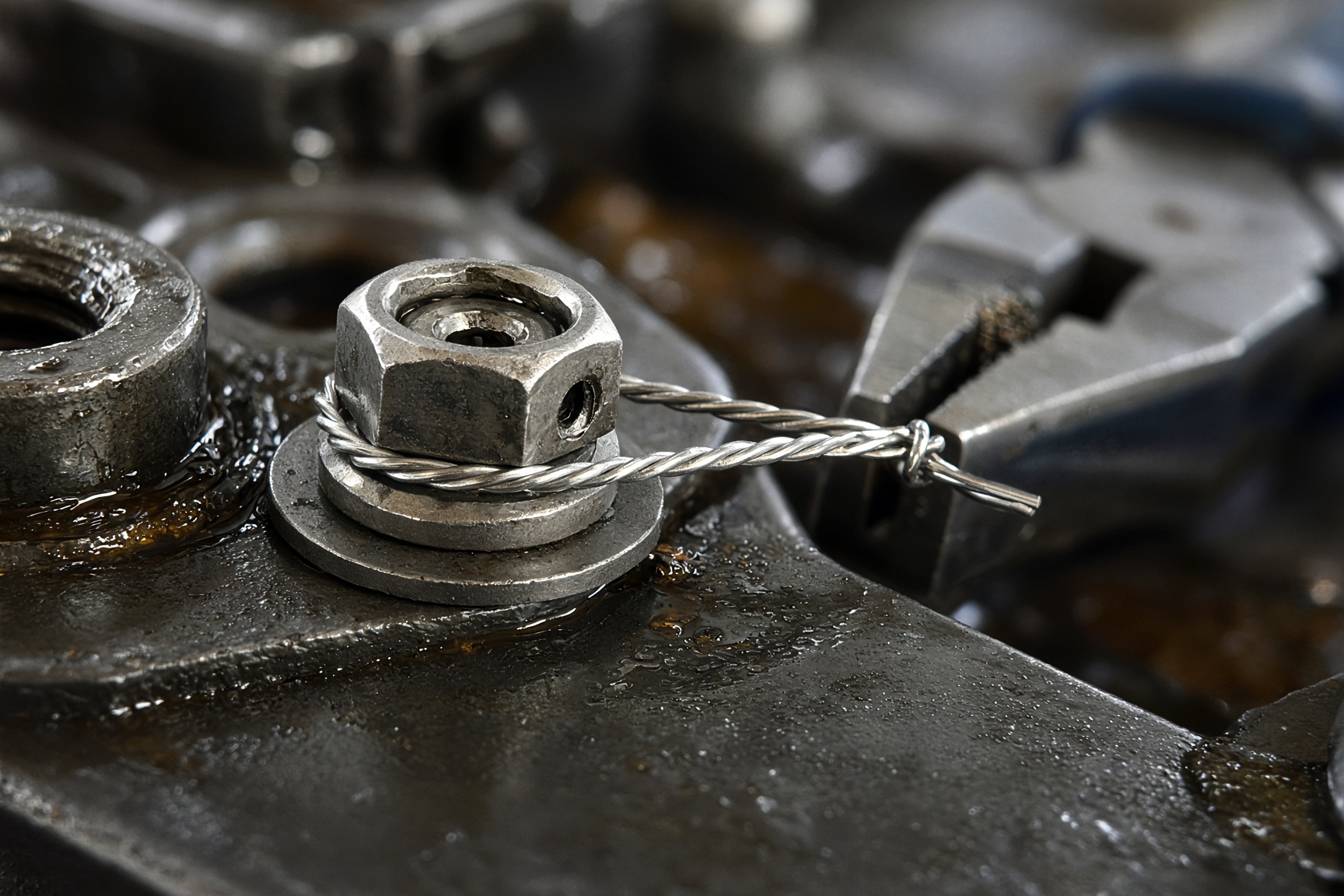
Safety wire (lockwire) is how hardware that can back out is told not to. Diameter follows the hole and the manual: .020, .032, and .041 inch are the everyday U.S. sizes, with .032 doing most airframe work. The twist is installed so that any loosening of the fastener pulls the wire tighter — direction of pull so loosening tightens — not so the loop looks pretty on Instagram. The pigtail is short, tucked, and not a bayonet for the next mechanic’s thumb. If the pliers will not lock, they go in the trash. This is not a personality. It is every shift.
People search “safety wire aviation” and “safety wire pliers” because they just bought the wrong pair, or because an oral-and-practical is next week. The mechanic tools desk is the rest of the first box. This page is the lockwire half: sizes, direction, pigtail, pliers that lock, and the fails inspectors actually write. The drawing, SRM, and AMM win. Typical practice lives in advisory material on the FAA Dynamic Regulatory System — AC 43.13-1 is the book people mean — but a type-specific instruction is not optional because a blog summarized a pigtail.
Why hardware gets wire
If a fastener can rotate under vibration, heat, or a load the designer did not want left to friction, the drawing calls out safety: lockwire, a cotter through a castellated nut, a tab washer, a self-locking nut where that is the specified method. Do not mix them because you like wire. Do not skip wire because you like a nylon locknut. The specified method is the method. Wire is a witness as well as a lock: a broken or missing tail on GVI is a reason to stop and ask whether the fastener is still in torque, not a reason to twist a new pretty loop over a loose bolt.
Stainless steel lockwire is the everyday airframe and engine material. Inconel (or other high-temp alloys the manual names) shows up where heat would laugh at stainless. Copper lockwire is a different job — often a breakaway or witness on an emergency control or a fire bottle, sized and installed so it will shear when it is supposed to. Do not “upgrade” copper to stainless because stainless is what is on your spool. Do not reuse a run. Once it has been twisted and cut, it is FOD or it is trash. Never both.
.020, .032, and .041 — pick the hole, not a vibe
Three diameters do almost all of the work in U.S. hangars. .032 inch is the default airframe size when the hole will take it and the manual does not say otherwise. .020 inch is the small-screw, closely spaced size. .041 inch is heavier hardware and larger holes. There is no “be safe, go thicker.” A fat wire in a small hole is a chewed hole and a wedge. Thinner than specified is a run that will fatigue and lie to the next GVI.
Hole size in the fastener head or the tab is the first check. If you have to force the wire, you have the wrong diameter or a burr. Do not drill a bolt head because the .032 “almost” fits. Typical practice keeps a double-twist span short — people quote on the order of six inches between fasteners as a common AC-flavored limit; the SRM may be tighter. Two fasteners, or fastener-to-tab. Do not daisy-chain an oil line because it photographed well.
Direction of pull: loosening must tighten
This is the sentence that fails orals and fails walkarounds. Install the wire so that if the fastener tries to loosen (usually counterclockwise on a standard right-hand thread), it has to pull against the wire — the loop takes the load in the tighten direction. On a pair of bolts, that means each loop leaves the head in the direction that would screw the bolt down, and the twist between them is in tension if either backs out. A pretty helix that would unwind a bolt is not lockwire. It is decoration. Inspectors will find it. So will vibration.
Single-wire method exists for specific hardware — a row of closely spaced screws, a castellated nut the drawing wants wired that way, a tab. Double-twist is the everyday two-fastener picture: through the first hole, around in the correct direction, twist in the space between, through the second, twist the pigtail. Count the way the loop sits on the head, not the way the pliers felt. If you cannot see, in one look, that backing out would tighten the wire, cut it off and do it again. The extra three minutes are cheaper than the finding. Left-hand threads reverse the picture; read the fastener before you read this paragraph as a religion.
Pigtails, runs, and the clip that becomes FOD
The pigtail is the twisted leftover after the last hole. Typical practice: a short tail — on the order of a half-inch, a few twists, not a 20 mm antenna — bent in toward the fastener or the part so it cannot snag a sleeve, a wire bundle, or a thumb. Bend it so the cut end does not spear. Three to six twists on the tail is the usual hangar English; the AC and the SRM are the law. Too long is a hook. Too few twists and the tail untwists into two needles. Cut with dikes that leave a clean end, not a mashed spade. The scrap goes in a pocket you empty before you leave the airplane. A glittering curl on the ramp is a finding with your name on it.
| Item | Do | Do not |
|---|---|---|
| .020 / .032 / .041 | .032 default airframe unless the hole or the manual says else; .020 small; .041 heavy | Guess a heavier gauge to “be safe”; force .032 through a .020 hole |
| Direction of pull | Wire so that loosening the fastener tightens the loop | A pretty twist that would unwind under tension; ignore left-hand threads |
| Pigtail | Short, a few twists, bent in, no spear — on the order of ~1/2 in, not a bayonet | A 20 mm antenna; two needles; a tail that snags a bundle |
| Run length | Short spans, usually two fasteners or fastener-to-tab, as specified | A daisy chain down the whole line because it looked even |
| Pliers | Lock (ratchet), twist without chewing, clean cut | The $12 pair that opens at the worst rivet; reuse of old wire |
| FOD | Every clipping in a pocket; inspect the tool and the bay before close | Sparkling curls in a cowl; a ferrule from cheap pliers |
Pliers that lock
Safety wire pliers (wire twisters) grip, lock, and spin so you can pull a tight, even helix without the jaws opening in the middle of a hot cowl. The lock is the feature. A pair that will not ratchet closed is a pair of expensive dikes. Jaws should hold .020 without chewing it and hold .041 without slipping. The twist rod should spin freely and retract without spraying filings. Cheap pairs open, chew, and leave a ferrule in the engine. That is why the $12 pair is a tax, and why a locking pair — the kind that stays shut while you pull — is in the first box instead of in a gag drawer.
You still need dikes. Twisters cut, but a dedicated cutter gives a cleaner tail. Do not cut toward an open bay. Do not use twisters as general pliers on AN fittings. Wipe oil out of the lock. Used locking pliers from a retiring AMT are a bargain if the jaws still meet. We will not send you to a marketplace listing. Put your hands on the lock in a real shop, then spend.
What inspectors actually fail
Wrong direction. Pigtail long enough to snag. Wire that missed the hole. A run that would look right if the bolt were left-hand. Reused wire. Wrong alloy on a hot section. Copper where stainless belonged, or stainless where copper was the shear. A chewed head from pliers that slipped. Those are GVI items as much as lockwire items. Raking light. The same eyes you use on filiform.
If you are kitting a first locker, one locking pair, one dikes, and three small spools (.020 / .032 / .041) will teach more than a 270-piece chrome set. Practice on a dummy plate until direction of pull is a reflex. Then do it on the airplane with the manual open. The FAA become-a-mechanic pages get you to the test. The Kit hub is the rest of the shopping. This page is the twist.
Which safety wire size is standard?+
There is no single standard. .032 is common on airframe hardware; .020 and .041 show up on smaller and larger holes. The manual and the hole win. Do not go thicker to “be safe.”
Which way does the wire go?+
Direction of pull so that loosening the fastener tightens the wire. If backing out would unwind the loop, cut it off and do it again. Left-hand threads reverse the picture.
How long should the pigtail be?+
Short — typical hangar practice is on the order of a half-inch with a few twists, bent in, no spear. The SRM and AC 43.13-1 practice are the references, not a 20 mm antenna.
Can I reuse safety wire?+
No. Once twisted and cut, it is trash or it is FOD. Never both. New wire every run.
What pliers should I buy?+
A pair that locks (ratchets closed) so you can twist without the jaws opening, that does not chew .020 or slip on .041. Skip the $12 pair. Put it in the first box with the rest of the mechanic tools.
Sources (verified)
Technique here is hangar English for readers. The drawing, SRM/AMM, and current advisory material on DRS win. Confirm before you twist. Aviation Titans is independent editorial. We may earn on partner links. We do not sell pliers and we do not certify inspections.