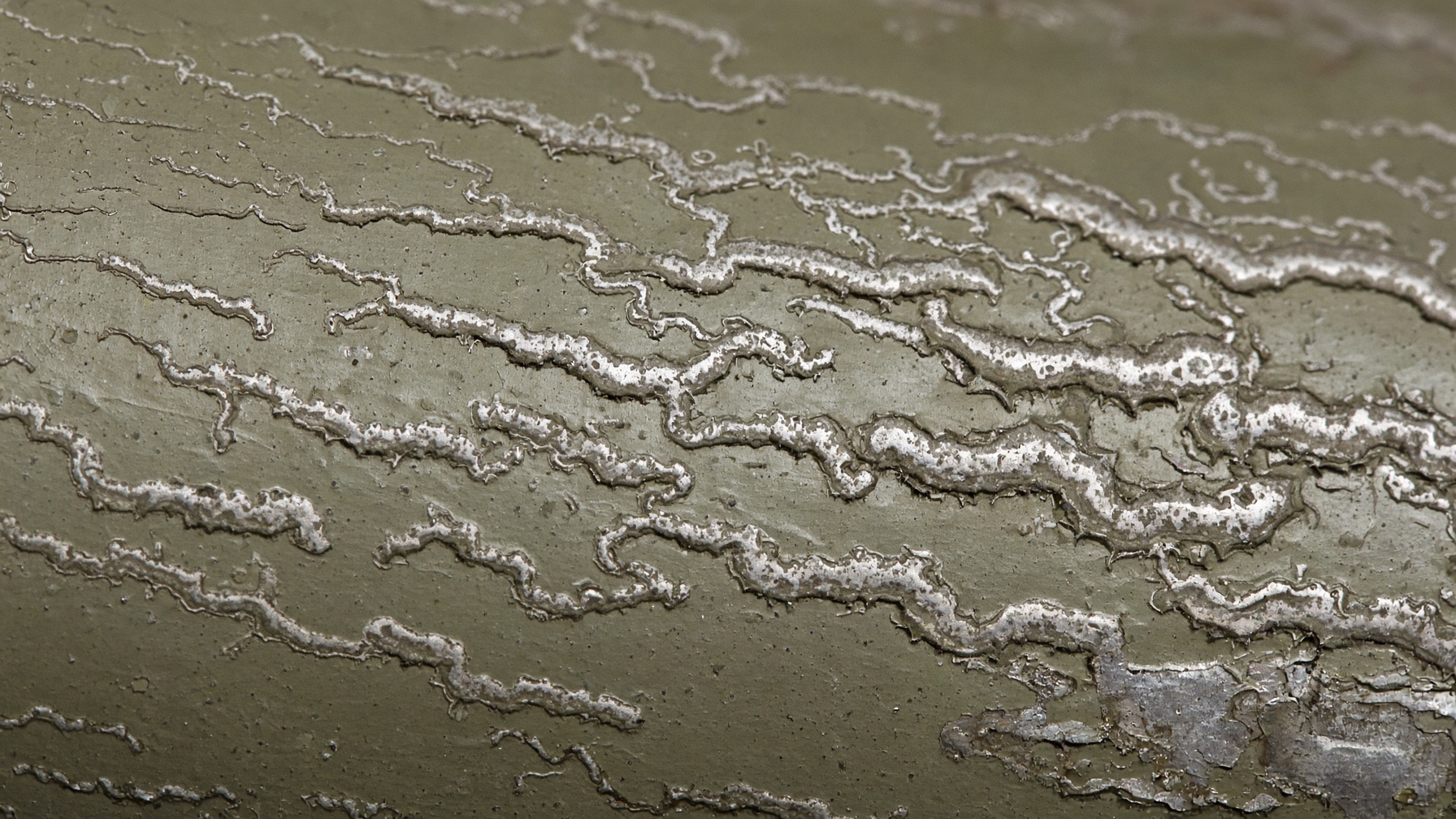
Filiform corrosion is the worm-trail under paint. On aluminum aircraft skin it starts at a chip, a fastener, a lap, or a poorly prepared edge, then tunnels through the oxide under the coating. The threads look cosmetic until a remaining-thickness check says they are not. AMTs find it on general visual inspection with raking light — not from the fuel truck, and not after someone already shot another coat over the last set of threads.
The chemistry is not mysterious and it is not rust in the carbon-steel sense. You need a coating, a defect in that coating, moisture, and oxygen. High humidity, salt, lav and galley leaks, and paint put on damp or contaminated metal are the usual accomplices. This desk exists because the query already sends people here, and because the fix is always the same sequence the structural repair manual and FAA Advisory Circular 43-4B have been saying for years: strip, treat, prime — then stop the water.
What filiform actually looks like
The morphology is specific. Raised filaments, often shiny or white-gray, advance from a head — the active cell — and leave a starved tail. From a few feet it can look like a stain or a badly rolled finish. From touching distance with the light raked along the skin, it looks like a dry river system under the film. You can sometimes feel a faint ridge even when the color has not broken. That ridge is the argument for a work order, not for a blending pad and a prayer.
It likes edges. Window belts, lap joints, the downhill side of a fastener, the place a previous mechanic nicked the topcoat with a screwdriver, the line where a decal used to live. Fairings and non-structural doors grow pretty pictures. Primary structure and bond lines grow conversations with engineering. Do not decide which one you have from a phone photo. Change the light, touch the film, and open the card the program named.
Why aluminum coatings do this
Aluminum wants an oxide. A conversion coating and a primer want a clean, prepared surface. Filiform lives in the gap between those two sentences. If the metal went to paint dirty, wet, or without the treatment the SRM called, the film is a tent, not a seal. An electrolyte — condensation, salt, a lav leak — finds the defect. Oxygen at the head of the filament keeps the cell alive. The tail is history. That is why painting over threads does not kill the cell. You buried it. You fed it.
Operators who park in marine air, who fly a lot of short sectors with cold-soaked skins, or who have a history of cabin water, see more of this. That is not a type-certificate curse. It is exposure plus coating quality plus time. The corrosion prevention desk is the unphotogenic half of the same problem: keep water out of the bay, treat what the manual allows, and stop using topcoat as a dam.
| Tell | Often is | Often is not |
|---|---|---|
| Worm threads under intact film | Filiform until proven otherwise | A stain you can buff |
| White powder at a fastener | Exfoliation or filiform at the hole | Just forgotten sealant |
| Soft spot in a sandwich | Core or moisture — different animal | Filiform under paint |
| Rundown below a screw | Leak or skipped torque | A morphology by itself |
How GVI finds it — if you bother
Most missed filiform on a C-check write-up was visible on a previous GVI by someone who did not change the light angle. Raking light is not optional. Neither is looking at the side of the fastener you did not photograph. Touching distance, adequate lighting, no magnification unless the task card says so: that is GVI. A glance from the tug is a walkaround. They are not the same inspection.
- Rake the light along laps, around windows, under fairings, at paint chips, and anywhere a previous blend lives.
- Feel for a ridge under the film, not just a color change.
- Do not confuse rundown from a fastener, filiform-looking putty, or a dry water stain with the worm pattern.
- If a bond line, a lap, or a named structural zone is involved, stop decorating and open a work order.
- Write what you saw, where, and under what light. A C-check crew cannot guess your angle.
NDT does not replace this look. Eddy current can own thinning and some fastener-hole work on conductive metal. Ultrasonic testing owns a path for sound. Neither is a substitute for stripping the film when the SRM says the corrosion is under the paint. Eyes first, method second, remaining thickness last.
Strip, treat, prime — the only sequence that holds
The repair is not a secret. Strip the coating back to clean metal beyond the last visible thread. Remove corrosion per the SRM — chemical, mechanical, or both — to the limits. Blend, inspect remaining thickness, treat with the conversion coating the data names, then prime and finish as the manual says, not as the paint shop prefers. Skip a step and you own a souvenir. The next heavy visit will find it again, larger, and someone will ask why the last card closed.
- Strip beyond the last visible filament. The head of the cell is not always the ugliest part of the picture.
- Remove corrosion to the SRM limits. Guessing a blend depth is how you buy a repair.
- Check remaining thickness and the surrounding structure before you talk about paint.
- Conversion-coat and prime as specified. Topcoat is last, not a treatment.
- Fix the water path — lav, galley, blocked drain, open fairing — or you painted a postcard.
AC 43-4B is the FAA corrosion-control circular a lot of GA and some 145 conversations still point at. It is not your SRM. It will not override a type-specific limit. It will remind you that coating over active corrosion is not control. Pull current data from the FAA Dynamic Regulatory System when the card names a regulation or an AD, and from the OEM data when the card names a structure.
Cosmetic on a fairing, structural on a lap
Is filiform dangerous? Depth and remaining thickness decide, not the photo. A non-structural door can look like a science project and still be a strip-and-treat. A lap, a window belt, or a fastener in a named zone can look mild and still eat margin. The SRM and the operator's damage-tolerance data own that call. Your job is to find it, map it, and stop pretending a scuff-sand is a repair.
Heavy visits are where the bill arrives. A C-check opens enough panels that last year's missed GVI becomes this year's non-routine. A D-check can take paint off on purpose. Filiform that lived under a beautiful livery for six years is not a surprise to the structures crew. It is a surprise to the lessor. Find it on the line and on GVI so the heavy shop is repairing, not discovering.
What it is not
Filiform is not exfoliation, not pitting by itself, not a composite soft spot, and not the white powder you wiped off a steel fitting. Composite inspection is a different physics and a different card. A tap test on honeycomb will not map worms under aluminum paint. Liquid penetrant needs a surface-breaking discontinuity on non-porous metal; it will not see a filament under intact film. Strip first when the procedure says the condition lives under the coating.
It is also not a reason to invent a new process because the paint shop is behind. The current NAS-410 revision plus the employer's written practice own NDT qualifications if the follow-up method is ET or UT. They do not own the GVI. Anyone signing a visual card still has to look. The maintenance hub is the rest of the hangar language — checks, NDT, and the shops that actually open this skin.
What does filiform corrosion look like on an aircraft?+
Worm-like filaments under the paint on aluminum, often raised, shiny or white-gray, advancing from an active head. Raking light at touching distance is how you see it on GVI.
Is filiform corrosion dangerous?+
It can be cosmetic on a fairing and structural on a lap or around a fastener. Remaining thickness and the SRM decide, not the Instagram crop.
Can I sand and paint over filiform?+
Not if you want it to stay gone. Strip beyond the last thread, treat, prime, and fix the water path. Read the SRM and AC 43-4B.
How do you prevent filiform corrosion?+
Keep water out, prepare metal before coating, conversion-coat and prime as specified, and inspect with raking light on a schedule you can audit. See the corrosion-prevention desk.
Does NDT replace a visual look for filiform?+
No. GVI finds the worms. ET or UT may follow for thickness or holes if the data calls them. Different physics. Do not mix the methods.
Sources (verified)
Repair limits and processes live in the applicable SRM, AMM, and the operator's program. AC 43-4B is guidance, not a substitute for type-specific data. Aviation Titans is independent editorial, not a repair station or an OEM.