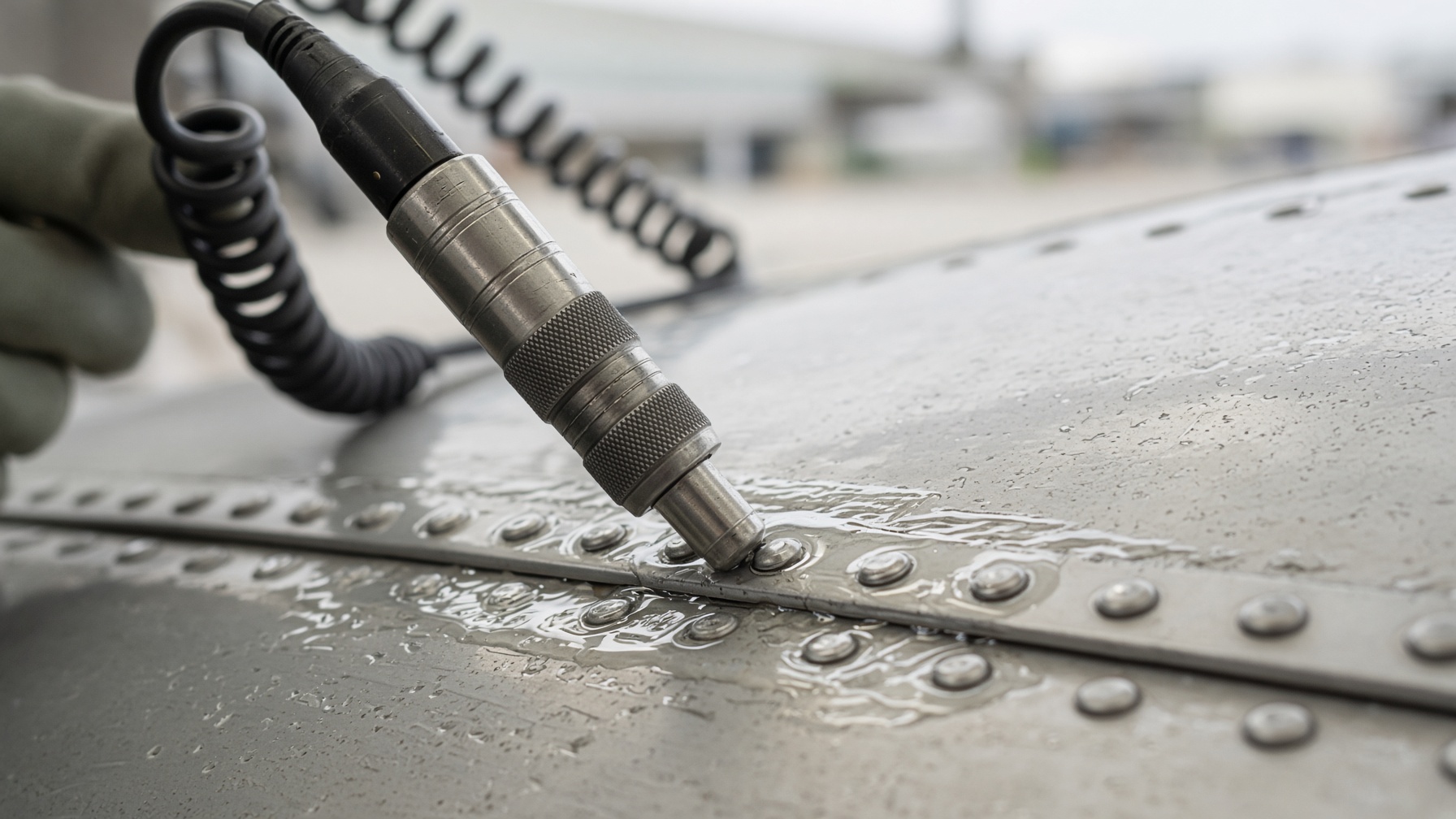
Eddy current testing (ET) is an electromagnetic method. A probe induces current in conductive metal; cracks, thinning, and some corrosion change the field. On aluminum airframes it lives on laps, fastener holes, and skins where GVI is not allowed to hope. It is not a walkaround with a fancy pen. It is a qualified method with a technique, a frequency, a calibration, and a person who can fail a practical.
Search already sends this desk people who typed eddy current testing and eddy current inspection. They want to know if ET is ultrasound with a different acronym. It is not. Ultrasonic testing is sound. ET is electromagnetics in metal. Liquid penetrant is a liquid in a surface-breaking discontinuity. Magnetic particle needs ferromagnetic steel. Different physics. Do not mix them on a card, in a log, or in an interview.
Physics in hangar English
An alternating current in a coil makes a changing magnetic field. In a conductor — aluminum skin, a steel bushing, a fastener hole — that field drives eddy currents. A crack that interrupts those currents, a thin-out that changes the lift-off and conductivity story, a heat-damage shift in conductivity: the instrument sees a change. Frequency, coil design, and lift-off are the knobs. A pretty screen is easy to lie to yourself about. That is why the technique sheet exists, and why the NAS-410 practical exists.
ET likes conductive metal near the surface. It does not like a sandwich you did not calibrate for. It does not like a composite skin except in the special cases the procedure actually wrote. It does not replace stripping paint when the SRM said the corrosion is under the film — filiform is still a visual morphology first. Use ET where the data named ET.
What ET is for on an airplane
- Surface and near-surface cracks in aluminum and some other conductive metals.
- Fastener-hole inspection after a removal the SRM called — rotating probe, known standard, recorded setup.
- Some conductivity and heat-damage screens on skins, when the procedure says so.
- Some thinning and corrosion mapping on conductive structure — again, when the technique exists.
- Not a substitute for GVI. Not a substitute for UT on a bond. Not a substitute for MT on landing-gear steel.
Holes are where ET earns its dock space. You pull a fastener because the SRM or the finding said pull. You inspect the hole with a probe the procedure named, at a frequency the standard named, against a calibration the shop owns. A flashlight in the hole is not ET. A worn probe you did not check is not ET. A Level 1 who went past the work instruction is not ET. Write the setup. Keep the standard. Sign only what you are authorized to sign. If the hole is out of round or the countersink is ugly, write that too — the probe is not a machine shop.
ET is not UT, PT, or MT
| Method | Physics | Lives on | Does not replace |
|---|---|---|---|
| ET | Electromagnetics in conductive metal | Skins, laps, fastener holes | Honeycomb you did not calibrate, or a stripped-paint GVI |
| UT | High-frequency sound and couplant | Thickness, bonds, some composites | A hole scan the SRM called ET |
| PT | Liquid in a surface-breaking discontinuity | Non-porous metal, open to surface | Subsurface anything, or cracks under intact paint |
| MT | Magnetic leakage in ferromagnetic steel | Gear, fittings, some engine steel | Aluminum. Aluminum does not magnetize for MT. |
If the SRM said eddy current, a coin tap is not a close. If the SRM said ultrasonic, an ET probe is not a close. If the SRM said penetrant, a yoke is not a close. The composite inspection desk is blunt about this for sandwiches. This desk is blunt about it for metal. The card wins.
Technique sheets, frequency, and standards
A technique sheet is not a vibe. It names the instrument family, the probe, the frequency, the calibration standard, the accept/reject, and the scan. Changing frequency because the screen looked noisy is how you invent a method. Lift-off is a variable, not an inconvenience. Paint thickness, anodize, and a burred hole all talk. The procedure tells you how to listen. The practical tells the Level 3 whether you can.
Keep the calibration standard where the practice says. A homemade notch you filed in 2019 is not a standard unless the Level 3 said it is, in writing, with traceability. Record the setup on the card. A C-check two years later will ask. So will an audit. The American Society for Nondestructive Testing will teach you language. The written practice will tell you whether that language is allowed on this floor.
Who may hold the probe
A line A&P may perform ET only if they are qualified in the method and the procedure allows it. The certificate on the wall is A&P. The stamp on the ET card is NDT. See how to get an A&P for the mechanic door, and the NAS-410 desk for the method door. EASA shops will say EN 4179 in the same breath. The hangar still needs a named Level 3.
Pull current FAA text and ADs from the Dynamic Regulatory System when the inspection exists because a regulation or AD called it. Pull the SRM when the inspection exists because the structure called it. Do not run a 'shop standard' hole scan on a part number the technique never named. That is how you get a pretty file and a bad hole.
Common ways to miss a crack
Wrong frequency. Worn probe. Calibration on the wrong standard. Scanning too fast. Interpreting lift-off as a crack, or a crack as lift-off. Skipping the fastener you could not reach and not writing the skip. Signing a Level 1 evaluation as if it were a Level 2 interpretation. Mixing a PT bleed with an ET phase angle in the same sentence on the card. Every one of those has a last name. Do not add yours.
The maintenance hub is the rest of the visit this method lives inside — C-checks, corrosion, visual. ET is one tool on that floor. Treat it like a method, not like a gadget.
Is eddy current the same as ultrasound?+
No. UT is sound. ET is electromagnetics in conductive metal. Different physics, different jobs, often the same Level 3 on the wall.
What is eddy current testing used for on aircraft?+
Surface and near-surface cracks, fastener holes after removal, some thinning and conductivity screens — when the SRM and the technique sheet say so. Not composites you did not calibrate for.
Can a line A&P do eddy current?+
Only if they are qualified in the method under the shop's written practice (NAS-410 or the named equivalent) and the procedure allows it. The A&P is not the stamp.
Does ET see through paint?+
Sometimes, within what the technique calibrated. It does not replace a GVI for filiform under film, and it does not replace stripping when the SRM said strip.
Is ET the same as magnetic particle?+
No. MT needs ferromagnetic steel and a magnetic field leak. ET needs a conductor and eddy currents. Aluminum airframes are an ET conversation, not an MT conversation.
Sources (verified)
Techniques, frequencies, and accept/reject live in the applicable SRM, NDT procedure, and the shop's written practice. This page is hangar English, not a technique sheet. Aviation Titans is independent editorial.