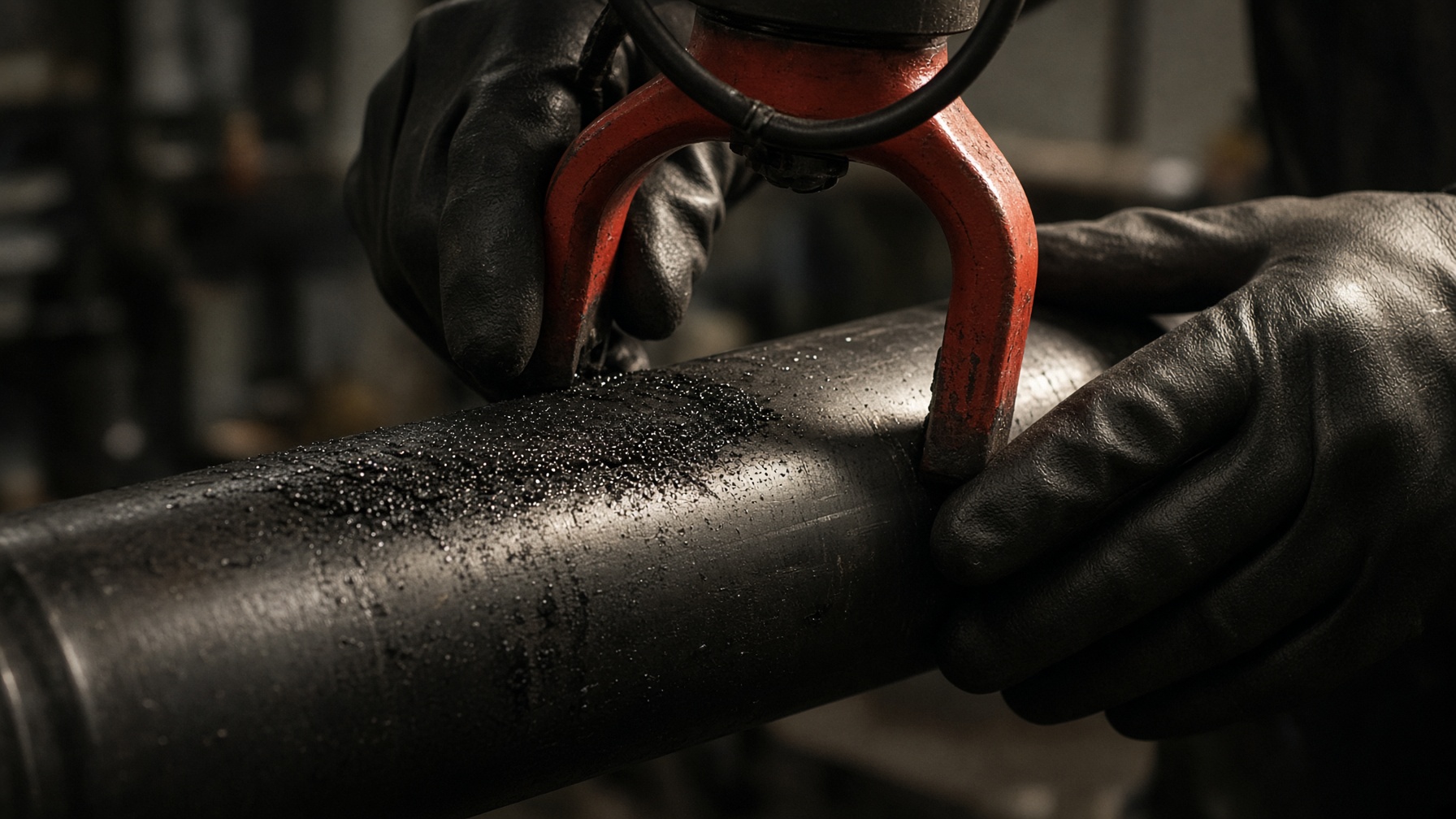
Magnetic particle testing (MT / MPI) finds surface and near-surface cracks in ferromagnetic steel — landing gear, fittings, some engine hardware. A yoke or a bench magnetizes the part; particles gather where the field leaks at a discontinuity. It looks like theater. It is not. Dry powder versus wet fluorescent is a technique choice, not a vibe. NAS-410 hours exist because a pretty indication you cannot interpret is a missed gear.
MT is not dye penetrant. PT is a liquid in a surface-breaking crack on many metals, including aluminum. MT needs magnetism in steel. Aluminum does not play. Eddy current is electromagnetics in conductive metal. Ultrasonic is sound. Different physics. Do not mix them on a card, in a log, or because the yoke was closer than the penetrant kit.
Physics in hangar English
You magnetize ferromagnetic material. Where a crack interrupts the field, flux leaks. Particles — dry visible, or wet fluorescent in a darkened booth — gather at the leak. Orientation matters: a crack parallel to the field can hide. That is why you magnetize in more than one direction, or use a bench that can, when the procedure says so. Residual versus continuous, AC versus HWDC: those are procedure knobs, not preferences you picked up on a forum.
If the part is not ferromagnetic, stop. Aluminum landing-gear components, titanium, stainless grades that will not take the field — MT is the wrong method. Use the method the SRM named. A yoke on aluminum is a workout, not an inspection.
Only ferromagnetic materials
- Landing-gear steel, many fittings, some engine and APU hardware — when the data says MT.
- Clean the part. Dirt is not a crack, but it will fake one. So will a rough blend and a hopeful powder.
- Lighting and contrast are part of the method, not extras. Visible MT needs the light the procedure named. Fluorescent MT needs UV and a darkened booth.
- Demagnetize when the procedure says so. A magnetized pin is a future FOD story.
- Aluminum, most composites, and non-ferromagnetic alloys are not MT. Wrong physics.
Gear is where MT earns its reputation. A fitting that passed a GVI can still hold a crack the particles will show — if you cleaned, magnetized, and looked. A D-check or a gear shop visit is where a lot of this work lives. Line can still see a steel fitting. Line cannot invent an MT card with a hardware-store magnet. If the overhaul manual named a bench and a wet fluorescent process, a yoke in a sunlit bay is not 'close enough.' Read the process. Set up the booth. Sign the process you actually ran.
Dry powder vs wet fluorescent
| Kind | What you see | Where it lives | Do not |
|---|---|---|---|
| Dry visible powder | Particles on a contrasting surface in shop light | Many field and yoke cards | Blow it like you are dusting furniture and call that a dwell |
| Wet fluorescent | Glow under UV in a darkened booth | NDT shop, NAS-410 hours, tanks and benches | Treat a red PT bleed as a fluorescent MT card |
| Not MT | A magnet you found and some dirt | Nowhere on a release | Sign it |
Visible and fluorescent are not interchangeable because you ran out of one. Sensitivity, lighting, and the qualification can differ. The NAS-410 training plan desk is the hours half. This desk is the physics half. Keep them both. If the overhaul data named wet fluorescent on a bench, a dry yoke in a sunlit aisle is a different test — write the test you ran, or do not sign.
MT is not penetrant
Liquid penetrant needs a discontinuity open to the surface on non-porous metal. It works on aluminum. It does not see subsurface. MT sees surface and near-surface in steel because the field leaks. A tight crack that will not take penetrant may still leak flux — or it may not, depending on orientation and process. That sentence is why you do not substitute methods to save a shift. The SRM named one.
Do not run PT and MT in a random order because both bottles live on the same cart. Residues fight. The procedure sequence exists. So does the cleaning step you wanted to skip. The American Society for Nondestructive Testing will teach you the family. The written practice will tell you which family member you are allowed to hold.
Clean, magnetize, inspect, demag
- Clean to the procedure. Paint, grease, and last week's powder are not contrast.
- Magnetize in the directions the technique sheet named. One pass the easy way is how cracks hide.
- Apply particles as specified — dry or wet, visible or fluorescent — with the light the method requires.
- Interpret against the standard. Pretty is not accept. Linear is not always reject. The procedure talks.
- Demagnetize and clean when the procedure says so. Residual field is not a souvenir.
Pull current FAA text from the Dynamic Regulatory System when an AD called the inspection. Pull the SRM when the gear overhaul called it. EASA shops will say EN 4179 in the same breath as NAS-410. The controlling document for the person holding the yoke is still the current NAS-410 revision plus the employer's written practice.
Who may hold the yoke
The A&P is not an MT Level 2. Some inspection-program visual looks on steel are still visual. MT is NDT. If the shop wants you to 'just yoke it' with no documented training, that is a conversation with quality, not a hustle. See how to become a mechanic for the FAA door. See the written practice for the method door. A yoke in a toolbox is not a qualification. Neither is a video of particles clustering on a cracked demo block. The practical is a part you have not seen before, a lighting setup you must get right, and a Level 3 who will fail you if the field is in the wrong direction.
The maintenance hub sits MT next to PT, ET, and UT because C-checks and D-checks run them as packages. A gear shop may run MT all day. A line station may never. Ask which floor you are on before you buy a yoke for the toolbox. Tools that belong in the first box are lights, wire twisters, and torque — not a magnetic bench.
Is MT the same as dye penetrant?+
No. PT is a liquid in a surface-breaking crack on many metals. MT needs magnetism in ferromagnetic steel. Different physics.
Can you magnetic-particle inspect aluminum?+
No. Aluminum is not ferromagnetic. Use the method the SRM named — often ET or PT for aluminum, not a yoke.
What is the difference between dry and wet fluorescent MT?+
Different techniques, lighting, and often different qualifications. Dry visible is shop-light powder. Fluorescent wet is a UV booth. Do not swap them to save a bottle.
Do I need NAS-410 to perform MT?+
If the shop's written practice implements NAS-410 (or EN 4179), yes — qualification in the method and level. The A&P certificate is not the stamp.
Why demagnetize after MT?+
Because the procedure said so, and because residual magnetism can attract debris and upset later processes. Demag is part of the method, not an extra.
Sources (verified)
MT techniques and accept/reject live in the applicable SRM, NDT procedure, and the shop's written practice. This page is hangar English, not a technique sheet. Aviation Titans is independent editorial.