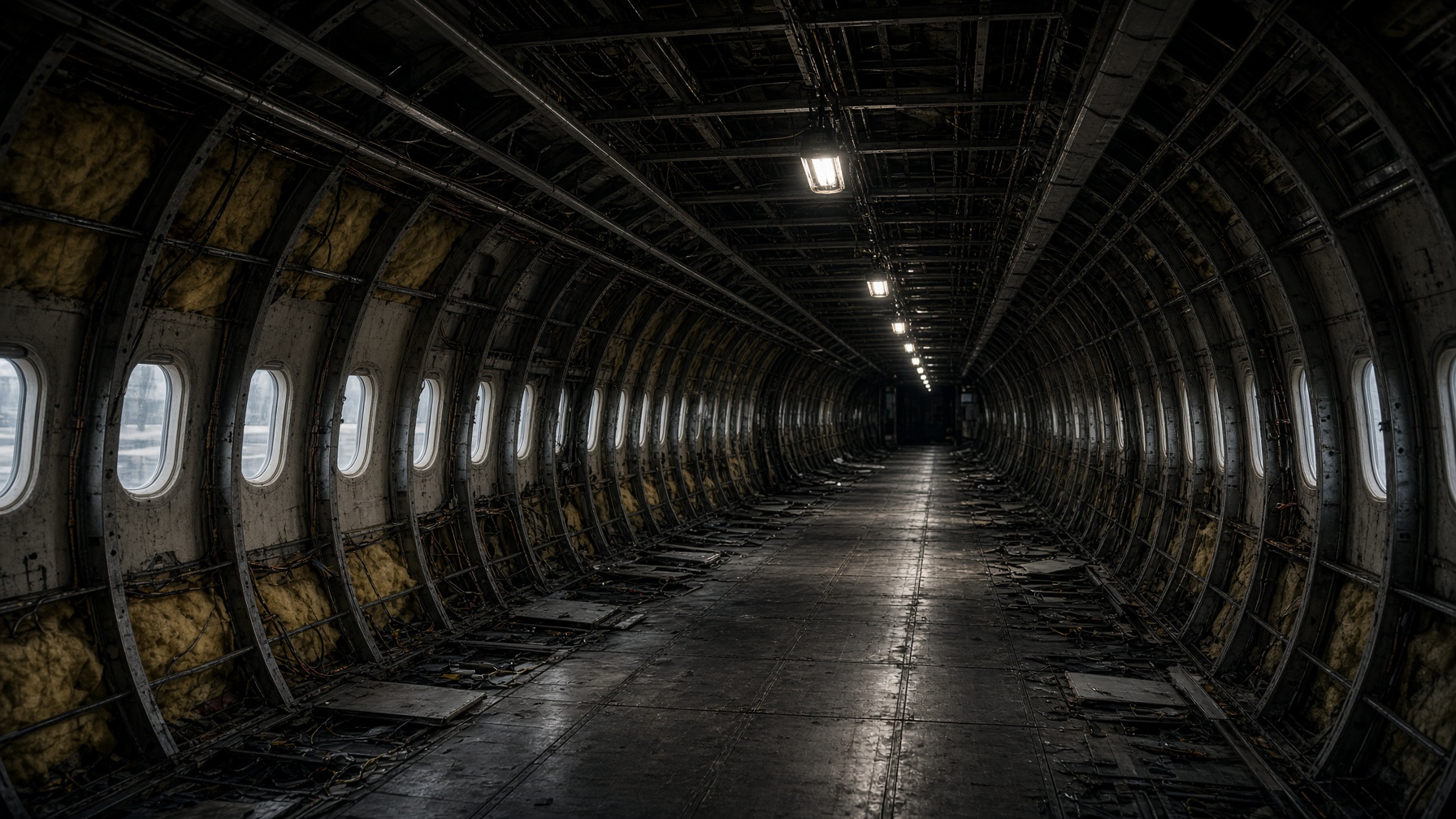
A D-check is the heavy visit most people mean when they say the airplane went in the shop for months. Interiors out, structure you only see a few times in a hull's life, systems opened far past a C-check. It is the structural teardown in letter-check language. Intervals are measured in years — commonly discussed around six to ten depending on the aircraft and the program — not the eighteen-to-twenty-four-month C-check rumor mill, and not a blog's exact hour-count.
If you searched aircraft d check or d check aircraft, you wanted the picture: empty cabin, docks, a hull that looks unfinished on purpose. That picture is real. The nickname is not a specification. Some operators equalized the program and still say D in the hangar. Some call it a heavy C or a named visit. Follow the maintenance program, not this page's table. The table is hangar English so students stop calling a long C a D.
What a D-check is
Depth is the definition. Duration is a consequence. A D-check can take the airplane apart until it looks like a kit: cabin stripped, monuments out, floor panels up, paint off or mostly off, structure and systems opened to a level the line will never see. Corrosion that lived under a livery, filiform that GVI could not reach, wiring that passed under cabin lighting — this is where those bills arrive. It is MRO at the heavy end. It is not an overnight A-check with extra stands.
Who lives there: structures, interiors, NDT, systems, cabin, paint, planners, and the certifying staff who will eventually release a hull that does not look like an airplane for a while. Line AMTs visit. Heavy AMTs live here. The pay conversation is different because the hours, the shift, and who signs are different. See the salary desk for medians. Ask the dock for the rate.
It is not a long C-check
A C-check is a heavy hangar visit: days to weeks, deep access, structure sampling, systems opened far beyond the line. The cabin is still mostly a cabin. A D-check is the teardown. If the airplane sat eight weeks because findings exploded on a C, you had a long C, not a D. Interviewers can hear the difference. So can lessors.
| C-check | D-check | |
|---|---|---|
| Where | Hangar, days to weeks | Heavy shop, weeks to months |
| Cabin | Mostly stays a cabin | Often a skeleton — interiors out |
| Structure | Sampling, known trouble, access | Deep, paint and interior off, rare zones |
| Paint | Local as needed | Often a full or large strip |
| Who lives there | Base AMTs plus NDT packages | Structures, interiors, NDT, everyone |
| How to talk interval | Typical industry talk on the order of 18–24 months, always per program | Years — commonly discussed around 6–10, always per program |
What comes off
Seats, bins, galleys, lavs, sidewall, ceiling, insulation when the card says so, floor panels, some systems, sometimes the livery. Drains you have been cursing for five years become visible. So do the water paths corrosion prevention was supposed to have killed. AC 43-4B will still tell you not to coat over active corrosion. The SRM will tell you the blend limits. The findings will tell you whether the quote survives.
NDT runs hard on a D. Eddy current on holes and skins, ultrasonic on thickness and some bonds, penetrant and magnetic particle on the steel that came off. Different physics. Different stamps. The current NAS-410 revision plus the employer's written practice own who may hold those probes. See the NAS-410 plan. Do not let a C-check Level 2 invent a D-check technique because the dock is behind.
Intervals in operator language
We will not print an OEM hour-count as law. Typical industry language talks in years for D, months for C, and overnight for a lot of A. Utilization, calendar, and equalized packages move the date. A lessor model that assumes a D at year eight is a model. Your AMP or Continuous Airworthiness Maintenance Program is the requirement. EASA operators write AMPs. U.S. operators write programs the FAA accepted. Pull current regulatory text from the FAA Dynamic Regulatory System when the visit exists because a rule said so.
Students who memorize 'every six years' walk into interviews with a number the shop has not used since the last program revision. Say: D is the heavy structural visit, years not months, always per the program. Then ask which visit this dock actually holds. A 145 that has never stripped a cabin will still say D-check capable on a banner. Capability is docks, certifying staff, NDT, interiors, and a quality system that will still be there in week six — not a logo.
Who lives on a D, and what it does to a career
Structures people become structures people here. Interior mechanics become the people who can still find a wire under a monument. NDT gets real. Planners either become legends or leave the industry. If you want variety, heavy is variety. If you want a bid system and overtime that outruns the hourly, the line still pays differently. The BLS outlook will not tell you which floor you will like. A week on nights in a D hangar will.
The first box still matters. Tools and safety wire do not become optional because the airplane is a skeleton. They become constant. A D-check is a lot of hardware that must go back correctly. The teardown is the easy photograph. The build is the career.
After the visit
The airplane has to become an airplane again: cabin, systems, operational checks, a release that means the program is satisfied, not that the dock is tired. Customer walk-throughs find the cosmetic. Inspectors find the rest. Findings that were deferred into this visit should die here. Findings that were created here should be closed here. A D that leaves a trail of open cards is a ferry with extra steps.
The maintenance hub sits this visit next to C, A, corrosion, and NDT because that is how the work actually arrives. A D-check is not a personality. It is a work package. Read it.
How often is a D-check?+
Years, not months — commonly discussed as roughly 6–10 years depending on the aircraft and the operator's program. The specification on the hangar wall wins. Do not memorize a blog's hour-count.
What is the difference between a C-check and a D-check?+
C is a heavy hangar visit with deep access; the cabin mostly stays a cabin. D is the structural teardown — interiors out, rare structure, often paint, weeks to months. Depth, not just duration.
Is a D-check the same as a heavy C?+
Some operators use those words for the same visit in an equalized program. Do not assume. Read the work package. Letter-check folklore is how students fail interviews.
Who performs a D-check?+
A heavy MRO or the operator's own base shop with the capacity, docks, and certifying staff. Line stations do not invent a D because a slot opened.
Does a D-check include NDT?+
Usually as packages: ET, UT, PT, MT, visual — whatever the program and SRM named. Different methods, different qualifications under NAS-410 plus the written practice.
Sources (verified)
Letter-check intervals are typical industry language, not OEM law. Follow the operator's approved program. Aviation Titans is independent editorial, not a repair station.