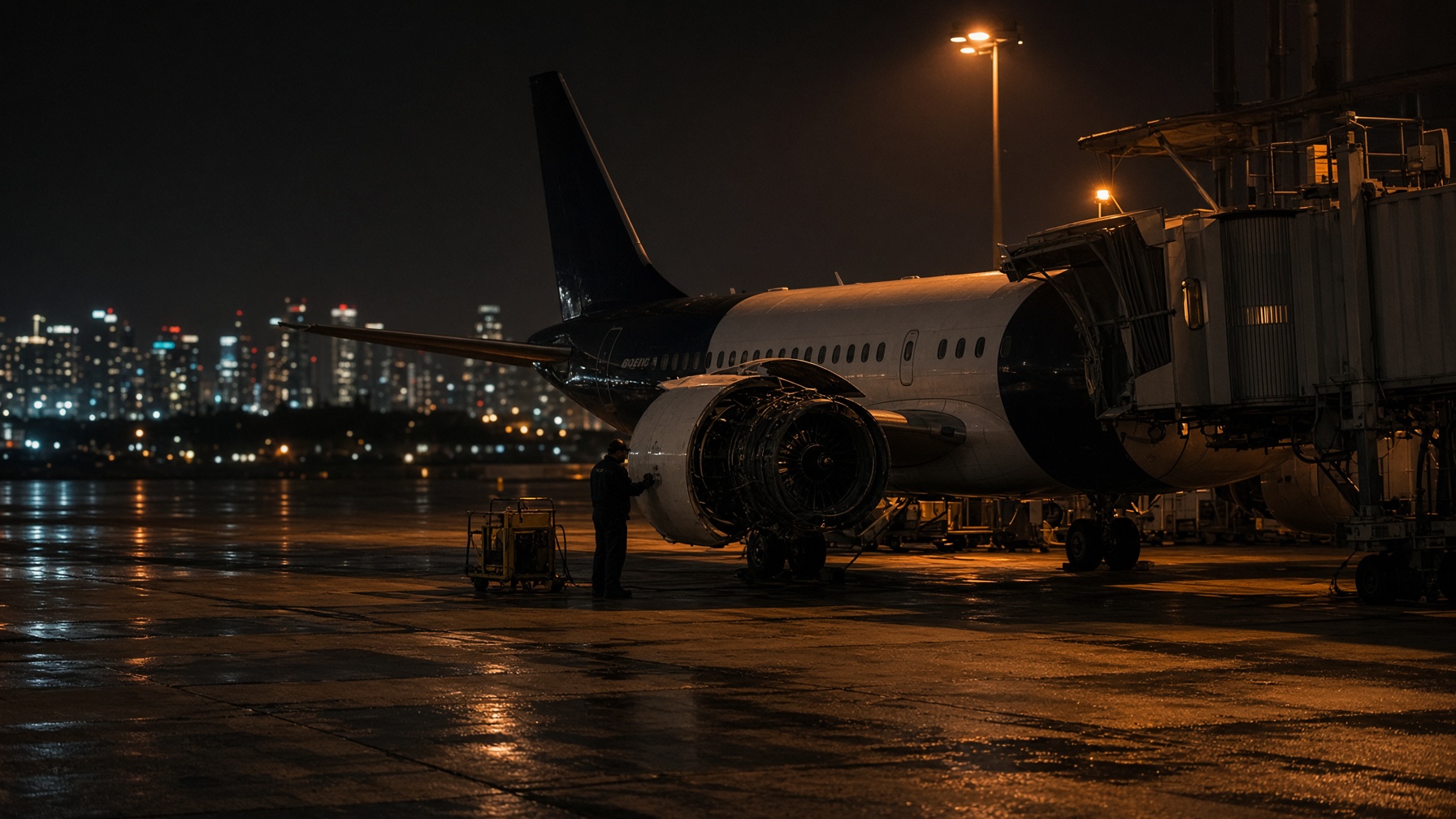
An A-check is a scheduled visit in an operator's maintenance program. It is heavier than a transit walkaround and lighter than a C-check. In practice it is often an overnight or a short package at a gate or a light bay: panels that the program named, lubrication, operational checks, and the defects the line already wrote up. It is not scaffolding around a tail. It is not a D-check. Line AMTs live here. Heavy AMTs visit.
Intervals live in the operator's program, not in a universal FAA hour-count. Historically many airliners saw A packages on the order of a few hundred flight hours or a matching calendar — and operators split, equalize, and rename packages constantly. If a blog prints every 500 hours as law, it is quoting a memory, not your MPD. This page will not invent an OEM interval. It will tell you where the work feels, what opens, and why the letter on a forum is not the letter in your hangar.
What an A-check is on the line
Named panels, not the whole leading edge. Lubrication the card listed. Filters, some operational checks, a look at the defects that have been riding the MEL. GVI in the zones the package named, with a light, at touching distance — not a glance while you wait for catering. You will find leaks, missing hardware, the start of filiform if you rake the light. You will not own a structural teardown. That is the point of the letter.
The work is still MRO: maintenance first, repair when you find something, overhaul almost never on an A. A Part 145 line station or the operator's own line releases the visit. Overnight is a culture. A light bay is a culture. A C-check hangar is a different building. If a posting says A-check and shows a photo of a stripped cabin, they borrowed the picture. Ask which visits the station actually holds before you bid a line job thinking you will live in docks.
Transit, A, B, C, D
| Visit | Where it feels | What opens | How to talk about interval |
|---|---|---|---|
| Transit / daily | Gate, turn | Walkaround, MEL, obvious leaks | Every service — not a letter check |
| A-check | Overnight, light bay | Named panels, lube, ops checks | Operator program; historically a few hundred hours or matching calendar, split constantly |
| B-check | Often absorbed into A packages now | Ask the program — the letter is not sacred | Many operators folded B into A years ago |
| C-check | Hangar, days to weeks | Deep access, structure sampling, systems | Typical industry talk on the order of 18–24 months, always per program |
| D-check | Heavy, weeks to months | Cabin out, structure, a hull that looks like a kit | Years — commonly discussed around 6–10, always per program |
B-checks are the letter students still ask about. Many operators folded B tasks into A packages years ago. You will still hear B in older manuals and older hangars. Ask the program. Do not die on a letter that the AMP already buried.
Where it happens
Gate, remote stand, light maintenance bay, sometimes a hangar that is really a big light bay. Jacks maybe. Docks no. The airplane is back in the board tomorrow morning if the findings behave. When they do not, the A becomes a delay, a cancel, or a ferry to somewhere that can hold a bigger opening. That decision is operations plus maintenance. It is not a student debate about letters.
Pull current ADs and regulatory text from the FAA Dynamic Regulatory System when a card on the A package exists because a rule said so. EASA operators write AMPs that still produce overnight packages even when the letter is gone. The work feels the same: line, lights, a hull that still looks like an airplane at shift-change.
Who lives in A-checks
Line AMTs, avionics on call, sometimes a dedicated NDT drop-in when the package named eddy current or a similar method on a specific zone. Most of the night is still eyes, tools, and cards. The A&P is the common U.S. door. The FAA become-a-mechanic page is the federal version. Inspection Authorization is GA paper — not what releases a 737 A-check.
Pay is a different conversation from heavy. Nights, bid, overtime that can outrun the hourly, weather, the MEL. The BLS handbook photographs the whole trade. The salary desk unpacks medians. Line versus C-check is culture. Ask the shift, not the SOC code.
What you find if you actually look
Leaks, worn tires you already knew about, the bonding jumper, the start of corrosion in a zone the C-check will later claim as original research. Raking light on a lap during an A is cheaper than a structures finding during a C. Corrosion prevention is still drains and honesty. An A-check that never looks past the named panel is a package, not an inspection culture.
- Do the named panels and the lubes. That is the card.
- GVI the zones the package included, with a light, at touching distance.
- Write defects so the next night or the next C-check is not guessing.
- Do not invent a C-check because a panel was interesting. Open a card. Call the program.
- Do not skip a named operational check because the gate is early. That is how A-checks become incidents.
Line culture is the job
Weather, catering, a crew that wants the airplane, a parts room that closed, a finding at 03:00. The tools that matter are the ones you can carry: light, mirror, wire twisters, torque you trust, safety wire that actually tightens. A borescope if the AMM named a port. A yoke and a penetrant booth live in other buildings. Know which building you are in.
The maintenance hub puts A next to C and D because search queries mash them. Your hangar should not. Do the A. Leave the teardown to the dock that owns it.
How often is an A-check?+
Whatever the operator's program says. Historically many packages ran on the order of a few hundred hours or a matching calendar, and operators split them constantly. Do not memorize a blog's hour-count.
Is a B-check still a thing?+
Many operators folded B tasks into A packages years ago. The letter on a forum is not the letter in your hangar. Ask the program.
What is the difference between an A-check and a C-check?+
An A-check is a lighter visit, often line or overnight. A C-check is a heavy hangar visit with deep access, days to weeks. A D-check is the structural teardown.
Can an A-check be done at the gate?+
Some packages and some operators yes, in a light form. Many A visits want a bay and a night. The work package and the station capability decide, not a blog.
Do line mechanics need NDT qualifications for an A-check?+
For the visual and mechanical cards, the inspection program and the A&P (or local equivalent) are the usual door. If the package includes ET, UT, PT, or MT, that is a method stamp under NAS-410 plus the written practice.
Sources (verified)
A-check content and intervals live in the operator's approved program. Typical industry language on this page is not OEM law. Aviation Titans is independent editorial.