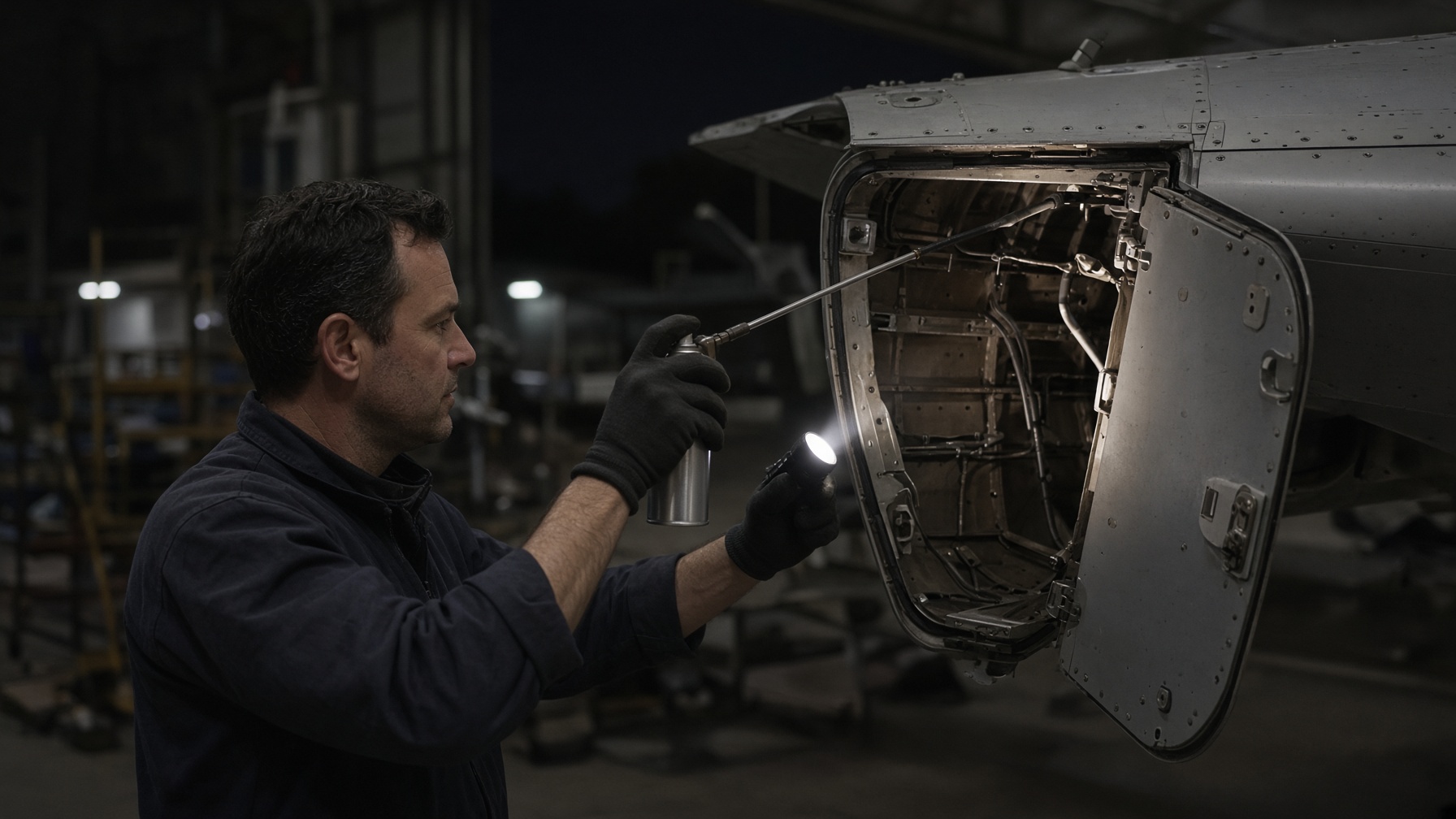
Filiform is the failure you can photograph. Prevention is the unphotogenic work: keep water out, treat dry bays, spray CPC where the SRM allows, fix the lav leak instead of blending another lap. Aviation corrosion protection in search is this page, not another morphology essay. The worms under the paint are a filiform story. This is the story that tries to make sure you do not take that photo twice.
Paint is not a dam. Conversion coating and primer are a system. Drains are a system. A blocked drain plus a proud topcoat is how you grow a science project in a bay nobody GVI'd with raking light. AC 43-4B is the FAA corrosion-control circular a lot of this conversation still points at. It is not your SRM. It will not override a type-specific limit. It will remind you that coating over active corrosion is not control.
Prevention versus the photo
The photo is always the worm, the pit, the exfoliated lap. Prevention is a drain you cleared, a fairing you actually closed, a CPC you applied where the manual permitted, a GVI you did with the light raked along the skin. Heavy visits — C-check and D-check — are where prevention's failures get invoiced. Find water on the line. Treat metal when you strip. Stop using topcoat as a personality.
Operators in marine air, operators with lav history, operators who park cold-soaked hulls in humid nights: they do not have a different physics. They have more electrolyte. The program should notice. If it does not, the findings at the next heavy visit will. Short-sector airplanes that never get hot enough to dry a bay, and hulls that live on a salt ramp, write the same card in a different handwriting. Prevention is not a climate. It is a drain, a seal, and a look. The person who 'always sees a little white' and never writes it is how a C-check inherits a creek.
Find the water path
- Find the water path. Paint is not a dam. Lav, galley, blocked drain, open fairing, failed seal — pick one and actually fix it.
- Strip, treat, and prime after you remove corrosion. See the filiform desk for the worm-trail sequence.
- CPC and compounds only where the manual permits. More grease is not always more protection.
- GVI with raking light on a schedule you can audit. Touching distance. Two angles.
- Write the zone and the leak. A C-check crew cannot guess which drain you swore you opened.
Cabin water is a structures problem wearing an interiors badge. A slow lav leak will paint a dry bay for months. Insulation hides it. Then a D-check takes the cabin out and someone asks why the stringer looks like a creek bed. That question has a name. It was on a previous GVI, or it should have been.
CPC and compounds — only where the manual permits
Corrosion-preventive compounds are not mayonnaise. They have specifications, application methods, and places they are forbidden — controls, oxygen, some composites, some bearings. Spray where the SRM or the operator's program named the product. Do not invent a fogging campaign because a YouTube hangar did. Wipe what the procedure says to wipe. Reapply on the interval the program wrote, not on the interval that felt lucky.
| Habit | Why it holds | Why it fails |
|---|---|---|
| Clear drains and close fairings | Water leaves | A proud paint job over a swamp |
| Conversion-coat and prime after strip | The system the SRM named | Topcoat as a treatment |
| CPC where permitted | Displaces electrolyte in named bays | Wrong product in a control or a composite |
| Raking-light GVI | Finds filiform and leaks early | A glance from the tug |
| Fix the lav | Stops the creek | Another blend at the next C-check |
GVI on a schedule you can audit
Inspection frequency lives in the operator's program, not in a blog. Line looks, A-check looks, zonal inspections, the heavy visit that finally opens the bay: they stack. If every look is a glance, the stack is theater. Touching distance, adequate light, the downhill side of the fastener. Write it. The visual inspection desk is the method. This desk is why you bother.
NDT follows when remaining thickness or a hole is the question. Eddy current and ultrasonic are different physics. They do not replace the look that finds the worms, and they do not replace stripping when the SRM said the corrosion is under the film. The current NAS-410 revision plus the employer's written practice own who may run those methods. Prevention still starts with water and eyes.
AC 43-4B and the data that actually binds
FAA Advisory Circular 43-4B is corrosion control for aircraft: morphologies, inspection philosophy, treatment language a lot of GA and some 145 conversations still share. It is guidance. The SRM, the AMM, the operator's program, and any AD are the binding bits. Pull current ADs and regulatory text from the FAA Dynamic Regulatory System. EASA operators live under their AMP and Part-145. The water does not care which flag is on the tail.
Do not import a GA circular as a transport SRM. Do not ignore the circular because you fly transport. Use both at the level they belong. Type-specific limits always win.
Hangar habits that actually prevent
Close what you opened. Clear what you found blocked. Do not store wet rags in a bay. Do not leave a cabin monument sitting on insulation over a wet floor. Torque and safety wire the hardware that keeps a fairing fairing. The first tool box is still a light and a mirror. Heavy MRO does not get a pass because the dock is impressive. A D-check that finds last year's leak is a D-check doing GVI's job.
Composites need the same honesty about water plus the methods that see into a sandwich. See composite inspection. Aluminum needs filiform literacy plus strip-treat-prime. Steel fittings need MT or the method the SRM named, not a hopeful wipe. Prevention is not one product. It is a set of habits the program can audit.
Can I just add more paint to stop corrosion?+
That is how filiform gets a winter coat. Strip, treat, prime, then stop the leak. See AC 43-4B and the SRM.
What is the best way to prevent aircraft corrosion?+
Keep water out, prepare and treat metal before coating, use CPC only where the manual permits, and inspect with raking light on a schedule you can audit.
Does AC 43-4B replace the SRM?+
No. It is FAA guidance on corrosion control. Type-specific limits and the operator's program bind. Use both at the level they belong.
Where does filiform fit in prevention?+
Filiform is the worm-trail under paint on aluminum — a coating-defect plus moisture plus oxygen failure. Prevention is preparation, treatment, and stopping water. Repair is strip-treat-prime.
Is CPC allowed everywhere?+
No. Only where the SRM or the operator's program permits the product. Controls, oxygen, some composites, and some bearings are common no-go zones. Read the data.
Sources (verified)
Prevention products and intervals live in the applicable SRM, AMM, and operator program. AC 43-4B is guidance, not a substitute for type-specific data. Aviation Titans is independent editorial.