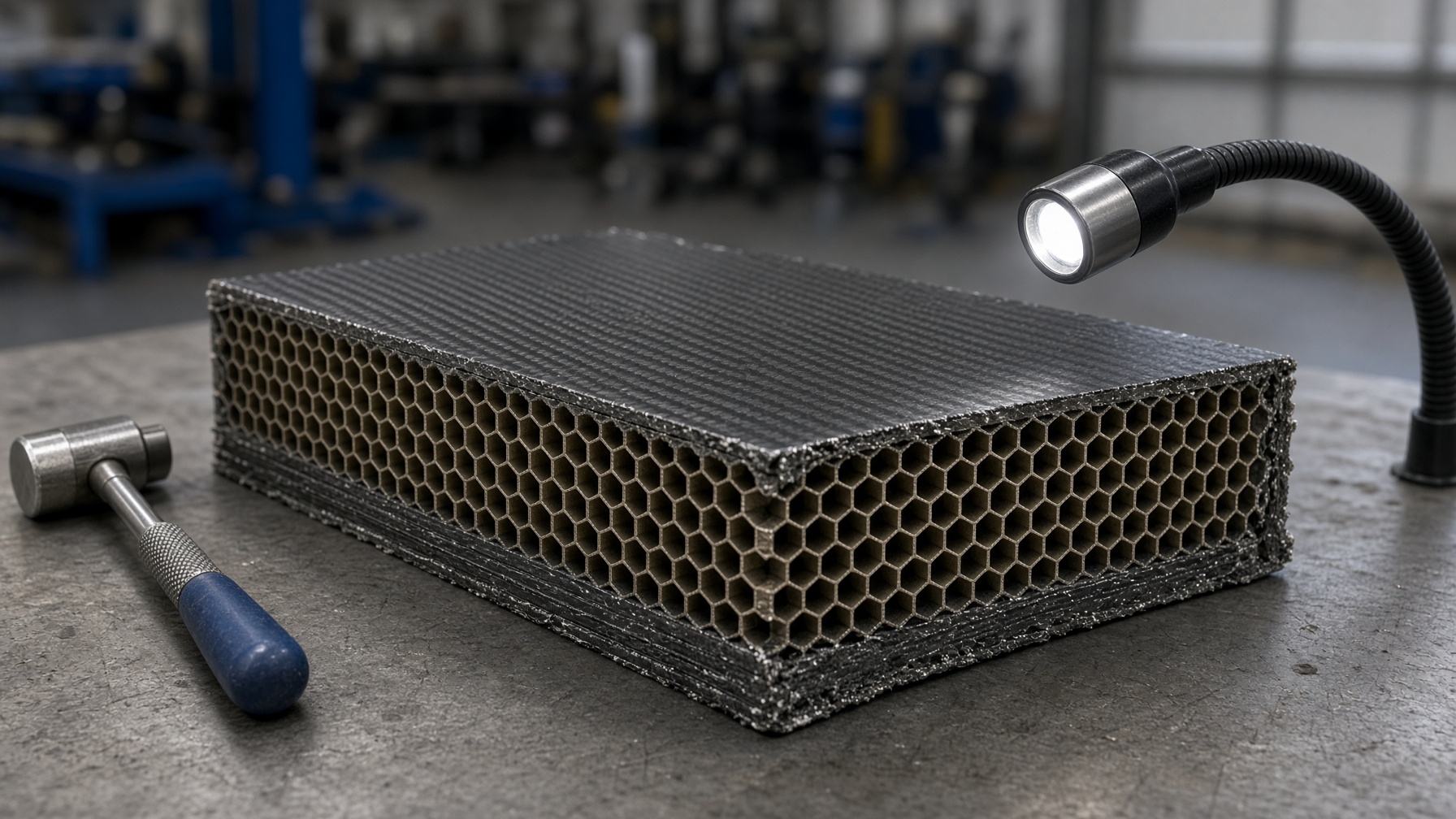
Composite inspection is what you do when the airframe is not all aluminum. Honeycomb, carbon, fiberglass — the tap test is a screen. It is not a method you sign like eddy current on a lap. Modern hulls hide damage in the core. Painting over a soft spot is how you meet it again on a C-check. This desk exists because composites NDT and composite inspection are real search queries from people who were handed a quarter and a smile.
Filiform is an aluminum-under-paint morphology. Do not import it. Moisture in honeycomb is a different animal than worm threads under a topcoat. GVI still finds the obvious hit, the peeled film, the missing fastener, the lightning-diverter that is no longer a strip. It does not own the core. If the SRM said tap, tap. If it said ultrasonic, a coin does not close the card.
Why composites are not aluminum
Aluminum cracks, pits, and grows filiform under a bad coating. Composites delaminate, disbond, crush core, take moisture, and show barely a witness on the face sheet. The energy went into the sandwich. The paint still looks proud. That is the whole problem. A raking-light GVI that would have caught worms on a lap will walk right past a barely scuffed carbon skin with a dead core. Eyes start the card. They do not finish it unless the procedure says visual only — and even then the standard is tighter than a walkaround.
Repair data is type-specific and unforgiving. Blend limits from an aluminum SRM chapter do not travel. Heat, contamination, and the wrong adhesive are how you own a larger repair. If you do not have the SRM open, you do not have a process. The maintenance hub will not invent one for you.
Tap / coin: a screen, not a method you invent
A tap test finds a change in sound. Then you open a card. The quarter in your pocket is not a qualified UT. It is not an accept/reject. It is a screening habit some SRMs still name, with a procedure that is more than 'hit it until you are bored.' Map the zone. Compare to a known good. Write what you heard as a map, not as a vibe. Then do the NDT the data named.
- Tap / coin: find a change in sound, then open a card — if the SRM said tap.
- Moisture in honeycomb: a different animal than filiform under paint. Do not mix the morphologies.
- UT and other NDT: qualified personnel, technique sheets, NAS-410 hours under the current revision plus the written practice.
- Visual of edges, fasteners, and lightning-diverters still matters. GVI starts a lot of composite cards.
- Painting over a soft spot is how you buy a larger repair at the next heavy visit.
UT and the methods that actually close cards
Ultrasonic testing is the method a lot of composite cards actually want: thickness, bonds, delaminations, some repairs — when the technique sheet says so. Gel is couplant, not theater. A-scan pretty is easy to lie about. Phased array and other variants are still UT. They are still a clock under NAS-410. Hours in ET do not count. Eddy current is electromagnetics in conductive metal. A carbon face sheet is not a 2024 lap. Do not wander.
| Look | What it can start | What it cannot close |
|---|---|---|
| GVI of face sheet, edges, fasteners | Hits, peeled film, missing hardware, obvious moisture telltales | Core damage under a pretty skin |
| Tap / coin per SRM | A map of sound change | A UT card, or an accept on a primary structure sandwich |
| UT (including variants the procedure named) | Bonds, delams, some thickness and repairs | A walkaround, or ET on an aluminum lap |
| ET | Conductive metal — holes, skins | Honeycomb you did not calibrate for |
| PT / MT | Open surface cracks on metal fittings still on the airplane | The composite. Wrong physics. |
The American Society for Nondestructive Testing is a training conversation. EASA shops will say EN 4179. The stamp on the card is still the shop's written practice. A line A&P with a good ear is not a Level 2.
Edges, fasteners, and lightning
GVI still earns its keep. Edges of sandwich panels, fastener lines through composite, trailing edges that got a belt loader, the place a previous repair lives, lightning-diverter strips and static wicks. Moisture stains at a core-to-skin edge are a tell, not a depth. Open the card. Do not wipe the stain and call it old paint. Visual inspection language still applies: touching distance, adequate light, the standard the card wrote.
Metal fittings in a composite structure are still metal. Liquid penetrant and magnetic particle belong on those fittings when the procedure says so — PT on non-porous metal open to surface, MT on ferromagnetic steel. Do not dye-check the carbon. Do not yoke the honeycomb. Physics does not care that they share a work order.
Moisture in honeycomb
Water in core is not filiform. It is a different inspection, a different dry-out, a different repair. Some programs use moisture meters, some use thermography, some use UT, some use a combination the SRM named. Inventing a heat gun and a hopeful afternoon is how you cook a face sheet. Follow the data. Pull ADs and regulatory text from the FAA Dynamic Regulatory System when the inspection is there because an AD said so.
Prevention is still water management: drains, seals, the fairing that was not quite closed, the repair that wicked. See aircraft corrosion prevention for the aluminum half of the water problem. Composites need the same honesty about leaks, plus the methods that can see inside the sandwich.
Who may inspect composites
Visual per the inspection program: the people the program authorizes. NDT: the current NAS-410 revision plus the employer's written practice, method by method. A tap-test authorization, if the shop has one, should be in the practice or the procedure — not in tribal knowledge. The A&P is the mechanic certificate. It is not a composite Level 2. Heavy visits — C-check and D-check — are where a lot of these findings get expensive. Find the hit on the line when you can.
Do not claim a photo shows a specific OEM defect. Photos show lighting and a crop. Remaining strength lives in the SRM and in a method you are qualified to run. Write the zone. Run the method. Stop decorating.
Can I inspect composites with GVI only?+
GVI finds obvious hits, peeled film, and missing hardware. It does not own core damage. Follow the task card. If it says UT or tap, do that.
Is a tap test the same as ultrasonic testing?+
No. A tap is a screening look at a change in sound. UT is a qualified NDT method with couplant, a technique sheet, and NAS-410 hours. Do not mix them.
Does filiform corrosion happen on composites?+
Filiform is the worm-trail under paint on aluminum. Honeycomb moisture and composite impact are different conditions. Do not import the morphology.
Can eddy current inspect carbon fiber?+
ET is electromagnetics in conductive metal. Do not wander onto a sandwich with an aluminum-hole probe. Use the method the SRM named.
Who is qualified to do composite NDT?+
Whoever the shop's written practice qualifies in that method under the current NAS-410 revision (or the named equivalent). An A&P ticket is not the stamp.
Sources (verified)
Composite repair and inspection limits live in the applicable SRM and the operator's program. This page is hangar English, not a process. Aviation Titans is independent editorial.