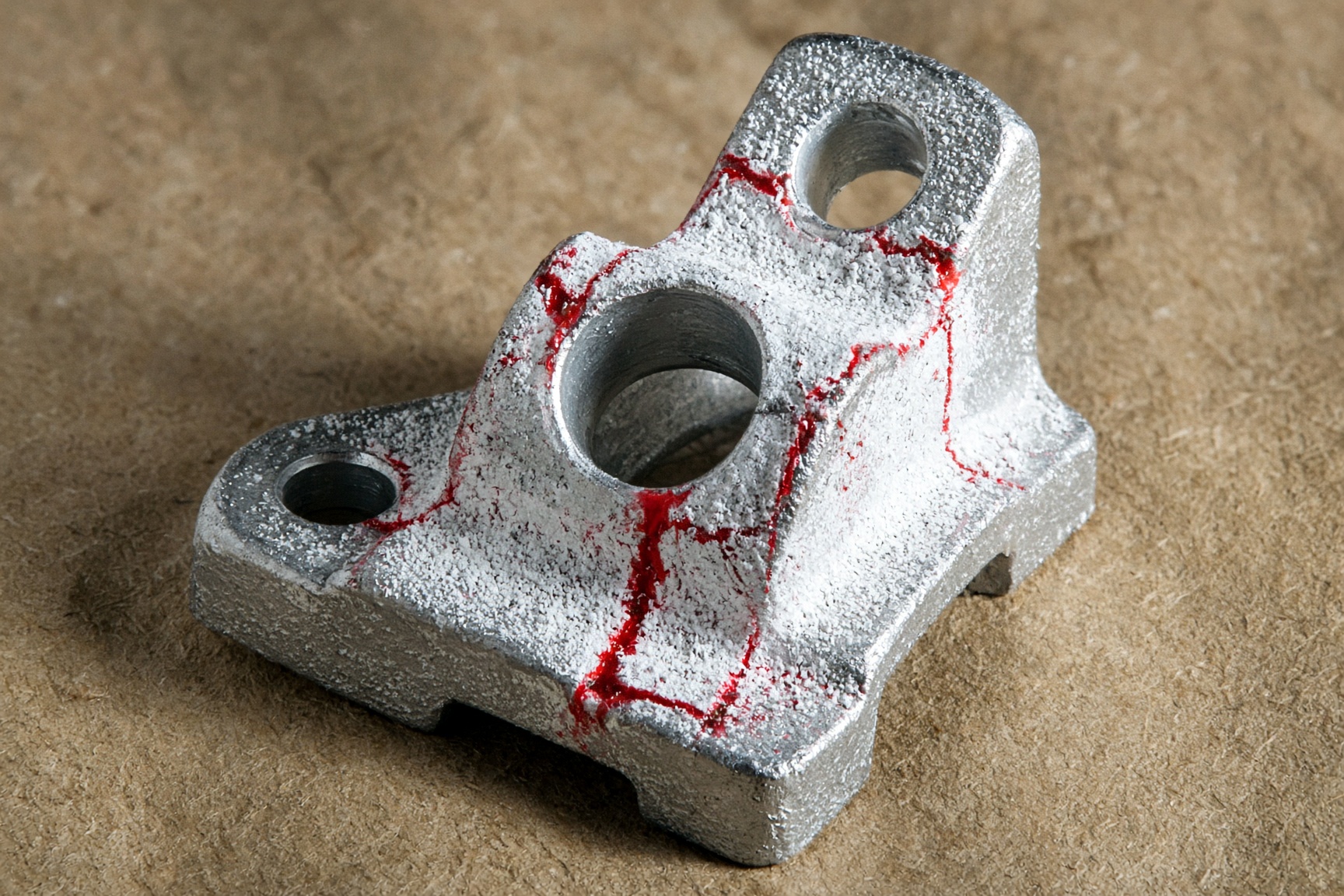
Liquid penetrant testing (PT) finds discontinuities open to the surface on non-porous metal. Visible red dye on white developer is the hangar picture. Fluorescent PT is the same physics under a blacklight — a different procedure, a different booth, often a different qualification. Do not treat a red bleed as a fluorescent card. Clean, apply, dwell, remove excess, develop, inspect. Skip a step and you own a pretty stain that means nothing.
PT does not see subsurface cracks. That is eddy current, ultrasonic, or a teardown the SRM named. PT is not magnetic particle. MT needs magnetism in ferromagnetic steel. PT will work on aluminum. MT will not. Different physics. Do not mix them because both bottles live on the same cart. And PT will not map filiform under intact paint. Strip first when the procedure says the condition lives under the coating.
A liquid in an open discontinuity
Penetrant wets a clean, open-to-surface discontinuity. Dwell lets it crawl. Excess comes off without emptying the crack. Developer pulls a bleed back to a surface you can read. Visible red on white is contrast in shop light. Fluorescent is a glow in a darkened booth under UV. Sensitivity levels, dwell times, and removal methods (water-washable, post-emulsified, solvent-removable) are procedure knobs. They are not a vibe you picked because the line was in a hurry.
Porous materials, rough blends, and dirty parts all fake indications or hide real ones. Non-porous metal is the usual hangar job: fittings, some engine hardware, aluminum structure the SRM named, welds that are allowed to be PT'd. Composites are not a dye check. A carbon face sheet is a composite inspection conversation. Temperature and contamination matter more than the brochure admits. Cold penetrant on a cold part dwells like molasses. Oil you did not fully clean will take dye and give you a map of last week's fingerprints. The process is boring on purpose.
Visible vs fluorescent
| Kind | What you see | Where it lives | Do not |
|---|---|---|---|
| Visible red dye | Red on white developer in shop light | Many GA and line cards | Treat it as a fluorescent qualification |
| Fluorescent PT | Glow under UV in a darkened booth | NDT shop, NAS-410 hours | Run it in a sunlit bay and guess |
| Not PT | A wipe with brake cleaner to see | Not a method | Sign it |
The red photo on a lot of internet pages is visible PT. It is not a blacklight. If your written practice qualifies them separately, they are separate. If it groups them, read the grouping. Do not assume. The NAS-410 training plan desk is the hours half. Sensitivity levels are not a personality either. A Level 2 process on a critical fitting is not the same kit you used on a practice coupon in school. Use the material the procedure named, at the dwell it named, under the light it named.
The sequence is the method
- Clean. Penetrant on dirt is modern art, not NDT.
- Apply and dwell as specified. Short dwell is how tight cracks stay empty.
- Remove excess without emptying the discontinuity. Over-wash is a classic miss.
- Develop. Thin, even, the time the procedure named — not a blob and a glance.
- Inspect with the light the method requires, at the working distance the procedure named.
- Post-clean when the procedure says so. Dye in a later process is a gift to the next shop.
GVI is still eyes and light for obvious damage. PT is a process on a prepared surface. Do not skip cleaning because the part 'looks clean.' Do not inspect fluorescent PT under a window. Do not read a bleed at a glance from across the bench. Touching distance applies here too, with the lighting the method paid for.
PT vs MT vs ET vs UT
MT: magnetism, ferromagnetic steel, surface and near-surface. PT: liquid, open surface, many metals including aluminum. ET: electromagnetics, conductive metal, holes and near-surface. UT: sound, thickness and some subsurface. Same C-check package can run all four. Hours do not transfer. A yoke is not a dye kit. A dye kit is not an eddy-current probe. See the magnetic particle desk before you magnetize anything that should have been PT'd.
Order of operations matters when a part needs more than one method. Residues fight. The procedure sequence exists because someone already learned this the expensive way. Do not invent a cart order on nights. Penetrant left in a thread can light up a later fluorescent booth like a Christmas tree and still mean nothing about a crack. Clean as specified between methods.
What PT cannot see
Subsurface fatigue in a gear bore. Core damage in a sandwich. Filiform under intact paint. A tight crack full of last year's primer. A discontinuity you smeared shut with a blend. Remaining thickness. Those belong to other methods or to strip-and-look. AC 43-4B will talk corrosion as a family. It will not turn PT into a corrosion mapper under film.
Pull ADs and regulatory text from the FAA Dynamic Regulatory System when the inspection is there because an AD said so. EASA shops will say EN 4179. The American Society for Nondestructive Testing will teach the family. The written practice will tell you which family member you may hold.
Hangar kit versus the booth
Visible PT on a fitting at a GA 145 and fluorescent PT in a NADCAP-audited booth can both be PT and still be different qualifications, lighting, and sensitivities. The controlling document is the current NAS-410 revision plus the employer's written practice — we will name NADCAP as an audit program and leave it there. The A&P is not a PT Level 2. Some inspection-program looks are still visual. When the card says penetrant, it wants the process and the stamp.
The maintenance hub sits PT next to MT, ET, UT, and visual because heavy MRO runs them as packages. Line may hold a visible kit. Line may not. Ask before you buy dye for a toolbox that needed a light and safety wire first.
Is dye penetrant the same as fluorescent PT?+
Same family, different procedure, and often different qualification. Visible red on white is shop-light PT. Fluorescent is a UV booth. Do not treat a red photo as a blacklight card.
Is PT the same as magnetic particle?+
No. PT is a liquid in a surface-breaking discontinuity on many metals. MT needs magnetism in ferromagnetic steel. Aluminum takes PT. Aluminum does not take MT.
Can penetrant find subsurface cracks?+
No. Open to the surface is the whole game. Subsurface belongs to ET, UT, MT (near-surface in steel), or a teardown.
Do I need NAS-410 to do visible dye penetrant?+
If the shop's written practice implements NAS-410 (or EN 4179) for that method, yes. Some visual inspection-program tasks are not PT. Read the card and the practice.
Will PT show filiform corrosion under paint?+
Not through intact film. Filiform is a visual morphology under the coating. Strip when the procedure says the condition lives under the paint, then inspect as the SRM named.
Sources (verified)
PT processes, dwells, and accept/reject live in the applicable SRM, NDT procedure, and the shop's written practice. This page is hangar English, not a technique sheet. Aviation Titans is independent editorial.