Introduction: Seeing Beyond the Surface
In our previous guides, we explored Magnetic Particle Inspection and Liquid Penetrant, methods designed to find cracks that break the surface. But what happens when the defect is buried deep inside a solid block of aluminum? What if a spar is corroding from the inside out, or a composite wing skin has delaminated internally?
Surface methods are blind to these dangers. To see inside the material without cutting it open, the aviation industry turns to the power of sound. This is Ultrasonic Testing (UT).
UT works on the same principle as naval sonar or medical ultrasound. A piece of Ultrasonic Testing equipment sends high-frequency sound waves (far above human hearing) into the part. These waves travel through the metal until they hit a boundary—either the back wall of the part or a hidden crack. The sound bounces back to the probe, and the machine calculates the distance based on the time of flight.
For the Aviation Maintenance Technician, UT is the most complex NDT method. It requires sophisticated electronics, precise calibration, and a deep understanding of physics. This guide details the essential ecosystem of tools required to perform this volumetric magic in 2026.
The Brain: The Ultrasonic Flaw Detector
The heart of any UT setup is the Flaw Detector. While thickness gauges are common, a true flaw detector is a diagnostic computer capable of visualizing the sound wave itself.
1. The Digital Flaw Detector
Modern units (from manufacturers like Waygate, Olympus/Evident, or Sonatest) look like rugged tablets.
- The Pulse Generator: The machine sends an electrical spike (often 100 to 400 volts) to the transducer to create the sound pulse.
- The Receiver/Amplifier: It listens for the tiny echoes returning from the material. The “Gain” control (measured in Decibels or dB) amplifies these weak signals so they can be seen on the screen.
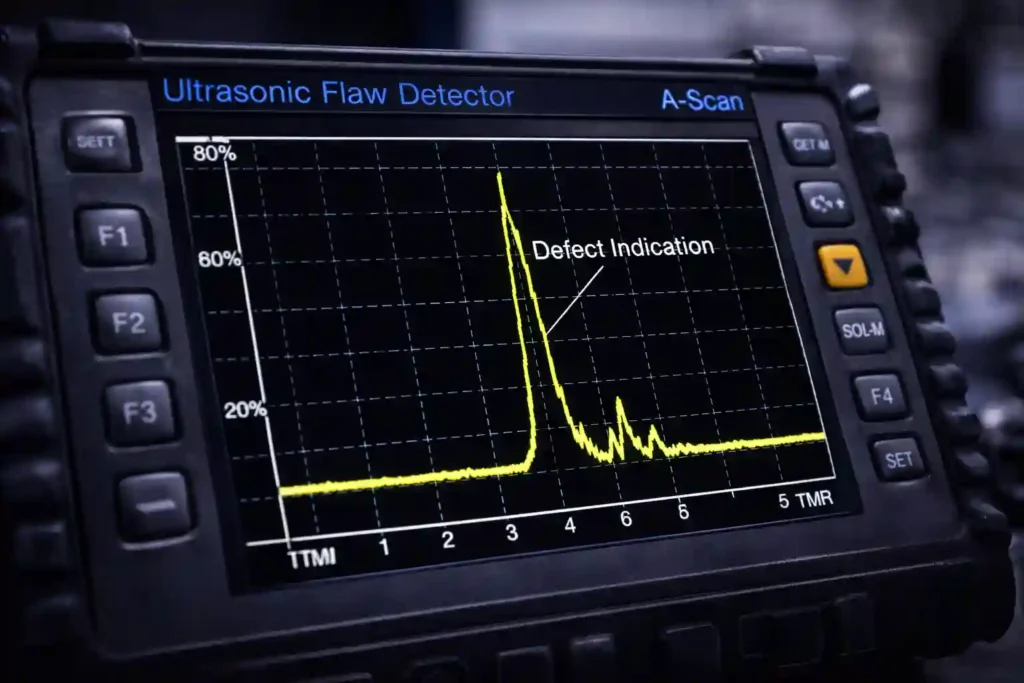
- The Display (A-Scan): This is the signature of UT. The screen shows a graph where the horizontal axis is Time/Distance (how deep the echo is) and the vertical axis is Amplitude (how loud the echo is). A spike in the middle of the screen usually means the sound hit a crack halfway through the part.
2. The Thickness Gauge (Corrosion Gauge)
This is a simplified version of a flaw detector.
- Usage: It is strictly used to measure wall thickness. In Aircraft MRO, these are used extensively to check fuselage skin thickness. If water gets trapped in the belly of a plane, it causes corrosion that eats the metal from the inside. A thickness gauge tells you exactly how much metal is left without removing the interior panels.
The Eyes: Ultrasonic Transducers (Probes)
The flaw detector is just a computer; the Transducer is the lens. It uses the “Piezoelectric Effect”—a crystal inside the housing vibrates when electricity hits it, creating sound. Conversely, when sound hits it, it creates electricity.
1. Straight Beam Transducers (Normal Beam)
These probes send sound directly down into the part (90 degrees).
- Application: Used for checking thickness or finding “laminar” defects (delamination) in composite skins or corrosion in fuselage plates.
- Construction: Usually a single crystal element protected by a hard wear plate.
2. Angle Beam Transducers (Shear Wave)
You cannot find a vertical crack with a vertical sound beam—the sound would just slide past it. You need to come in at an angle.
- The Wedge: The crystal is mounted on a plastic wedge (Lucite) angled at 45°, 60°, or 70°.
- Physics: When the sound hits the metal at an angle, it converts from a “Longitudinal Wave” to a “Shear Wave.” These waves travel at half the speed but are highly sensitive to vertical cracks in welds and landing gear struts.
3. Dual Element Transducers
These probes have two crystals: one transmits, one receives.
- Application: Essential for rough surfaces or very thin materials where a single crystal would be blinded by its own “ringing” noise. They are the standard for corrosion gauging.
The Medium: Couplant
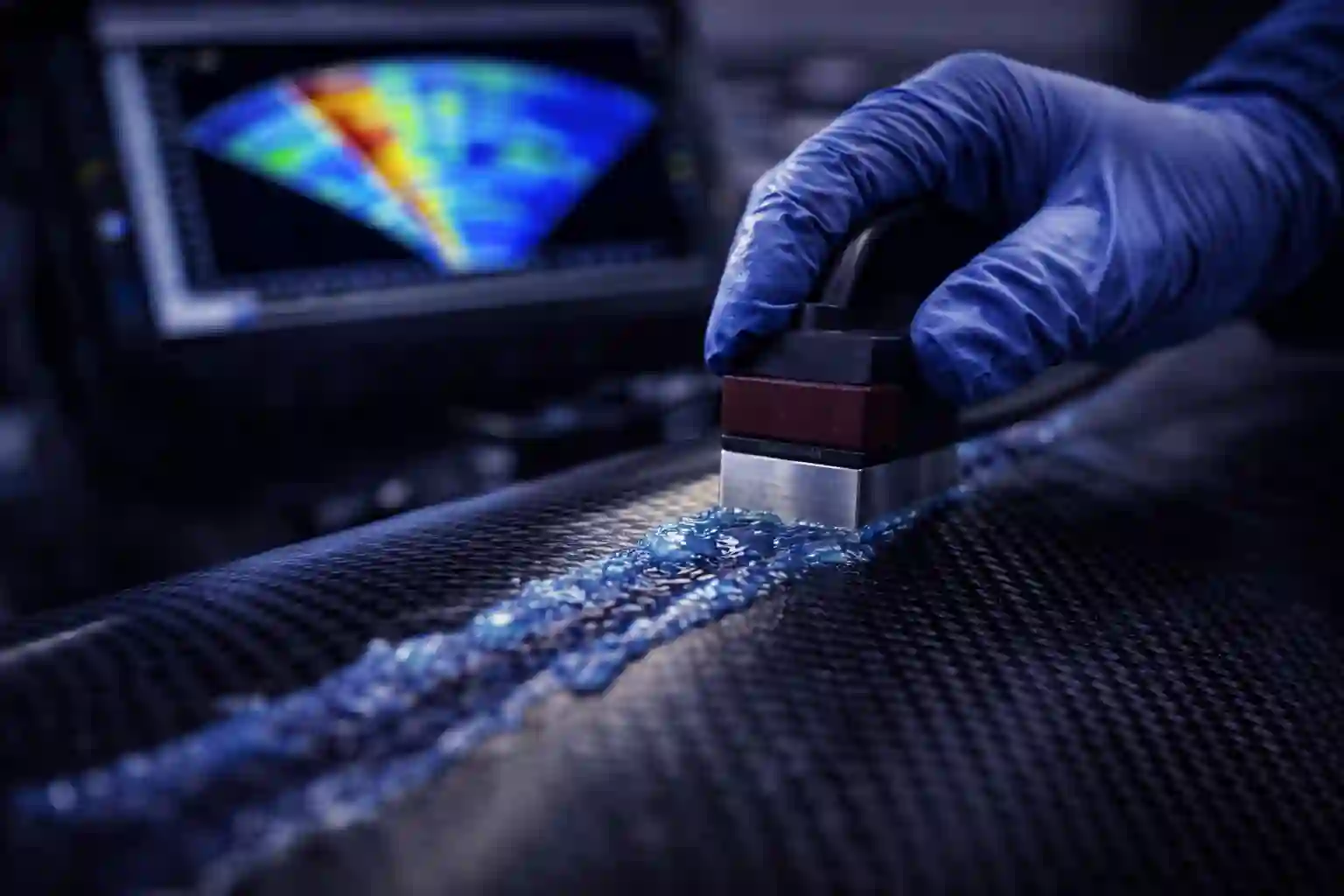
Sound travels great through metal and water, but it creates a massive reflection when it hits air. If you place a transducer directly on a dry aluminum wing, the microscopic air gap between the probe and the metal will block 100% of the sound.
To bridge this gap, technicians use Couplant.
- Types: It can be a specialized gel (like ultrasound gel at a doctor’s office), oil, or even water.
- Aviation Standard: The couplant must be “Halogen Free.” Some gels contain chlorides that can attack stainless steel or titanium over time. In aviation, you must use certified NDT couplant that won’t cause corrosion.
Calibration: The Reference Standards
Ultrasonic testing is purely comparative. The machine doesn’t know what “steel” is; it only knows “time.” If you don’t tell it the speed of sound in the material, your measurements will be wrong. This is why Ultrasonic Testing equipment includes heavy blocks of metal called Reference Standards.
1. The IIW Block (Type 1)
The “Swiss Army Knife” of UT blocks. It is a standardized chunk of steel with specific angles and holes.
- Usage: It allows the technician to calibrate the time base (distance), verify the angle of the wedge (is it really 45°?), and check the resolution (can I see two holes close together?).
2. Step Wedges
Used to calibrate thickness gauges. It looks like a set of stairs, with steps milled at precise thicknesses (e.g., 0.100″, 0.200″, 0.300″).
- Process: The technician measures the steps. If the machine reads 0.198″ on the 0.200″ step, they adjust the velocity setting until it reads perfectly.
3. Materials Matter
You cannot calibrate on steel to inspect aluminum. Sound travels at ~5,900 m/s in steel but ~6,300 m/s in aluminum. You must have a calibration block made of the same material as the aircraft part you are testing.
Advanced Tech: Phased Array (PAUT)
In the last decade, Ultrasonic Testing equipment has undergone a revolution. The old “A-Scan” (spikes on a graph) is being replaced by Phased Array Ultrasonic Testing (PAUT).
The Medical Link
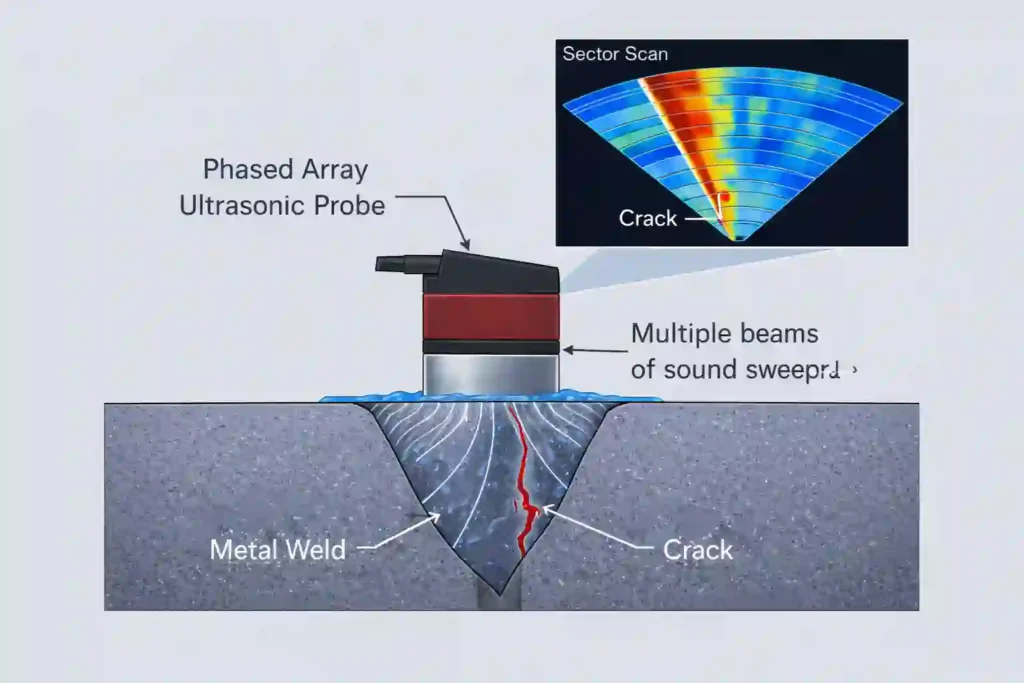
PAUT is essentially the same technology used to look at a baby in the womb. Instead of one crystal, the probe contains 16, 32, or 64 tiny elements.
- Beam Steering: The computer fires these elements in a sequence (phasing). This allows the beam to “sweep” back and forth or focus at a specific depth without moving the probe.
- The Image (S-Scan): Instead of a squiggly line, the operator sees a color-coded slice of the part. A crack appears as a red blotch on a blue background. This makes interpretation much easier and faster.
Time of Flight Diffraction (TOFD)
Another advanced technique used for inspecting heavy welds on landing gear. It uses two probes (pitch and catch) to measure the diffraction of sound waves from the tips of a crack. It is incredibly accurate for sizing the height of a crack, which determines if a part can be repaired or must be scrapped.
Conclusion: The Ultimate Diagnostic Tool
Ultrasonic Testing equipment represents the pinnacle of NDT. It gives the technician “X-Ray vision” without the radiation. Whether it is finding a 1mm crack inside a landing gear pin or measuring the thinning skin of a 30-year-old airliner, UT is indispensable.
However, it is also the most skill-dependent method. A magnetic particle indication is hard to miss—it glows green. An ultrasonic indication is just a blip on a screen. Interpreting that blip requires rigorous training and certification (Level II or Level III).
For the airline, investing in high-end UT gear—from Phased Array units to automated crawlers—is an investment in longevity. It allows them to catch internal fatigue before it ever reaches the surface, ensuring that the structural integrity of the fleet is absolute.
Frequently Asked Questions (FAQ)
1. Can Ultrasonic Testing be done on composites? Yes. In fact, it is the primary method for inspecting carbon fiber composites (like on the Boeing 787 or Airbus A350). UT is used to find “delamination” (where the layers of fabric separate) and water ingress in honeycomb structures.
2. What is the difference between UT and X-Ray (RT)? Radiography (X-Ray) passes radiation through the part to create a shadow image. It is great for seeing volumetric changes but poor for seeing cracks oriented flat against the beam. UT uses sound reflection and is much better for finding cracks and delaminations, and it poses no radiation hazard to the crew.
3. Why do I need couplant? High-frequency sound waves (MHz range) cannot travel through air. Even a microscopic layer of air between the probe and the part acts as a sound barrier. The gel or oil displaces the air and transmits the sound energy into the metal.
4. How accurate is a thickness gauge? A properly calibrated professional Ultrasonic Testing equipment gauge can measure thickness with an accuracy of +/- 0.001 inches (0.025 mm). This precision is vital for determining if a fuselage skin has corroded below the safe limit.
5. What is “Attenuation”? Attenuation is the loss of sound energy as it travels through the material. Some materials, like cast iron or coarse-grained aluminum, are “noisy” and scatter the sound, making UT very difficult. This is why selecting the right frequency probe (e.g., 2.25 MHz vs 10 MHz) is critical.
6. Where can I find standards for UT? The global standards are set by organizations like ASTM International (ASTM E164) and the American Society for Nondestructive Testing (ASNT). These documents dictate exactly how the equipment must be calibrated and used.

Senior NDT Controller with over 20 years of experience in aviation (FAA, EASA, and NRCAN certified). Expert in aircraft maintenance, non-destructive testing (NDT), and pilot training. I share practical, up-to-date 2026 guides for pilots and aviation maintenance technicians.